
How to Build a $10M One-Person AI Business in 2026 Without Coding (Using LLMs)
Let me be honest with you , most of what you’ve read about building a one-person AI business is either vague, wildly oversimplified, or quietly assumes you have a developer background you probably don’t have.
Here’s the truth nobody tells you: in 2026, the biggest opportunity isn’t about being the most technical person in the room. It’s about being the most strategic one. And the most strategic move right now? Validating before you build. Getting paid before you automate. Learning from real customers before you code a single line.
Start Small, Then Scale
I’ve spent a lot of time studying how solo operators are quietly building serious income using AI not by shipping polished software on day one, but by starting scrappy, staying lean, and letting the market guide them. And what I keep seeing over and over is this: the people winning are the ones who stop waiting to be “ready” and start solving real, painful problems TODAY.
This article is your blueprint. I’m going to show you exactly how to find a problem people will actually pay to solve, how to launch a functional service with zero code using LLMs and no-code tools, and this is the part most people miss how to get your first dollars in the door before you’ve automated a single thing.
We’re going to use what’s called the Wizard of Oz method where you present the business as automated while you manually deliver the work behind the scenes. We’ll talk about concierge AI delivery, and how to reverse-engineer your way into a scalable, AI-powered system. It sounds a little sneaky. It’s actually just smart.
This article is for you if you’re a solopreneur, side hustler, creator, consultant, or aspiring AI founder between 18 and 55 in the US and you’re tired of watching other people build income with AI while you’re still “figuring it out.” Let’s change that. Starting now.
1. Why One-Person AI Businesses Are a Big Opportunity in 2026

Why AI Has Changed the Solo Business Model
Something genuinely historic happened over the last two years. The tools that used to require entire engineering teams — natural language processing, content generation, data summarization, automated workflows — are now accessible to literally anyone with a browser and a monthly subscription.
LLMs like ChatGPT and Claude have collapsed the cost of doing high-skilled intellectual work. You can now write proposals, draft client emails, do competitive research, create onboarding sequences, and generate lead magnets in a fraction of the time it used to take. What once required a five-person team now takes one focused person and a smart AI stack.
No-code platforms like Zapier, Make, and Notion remove the technical barriers that used to gatekeep business automation. You don’t need to know Python. You don’t need to hire a developer. You need a problem worth solving and the discipline to iterate fast.
And AI agents? They’re only getting more capable. You can now automate repetitive research, classification, drafting, and even customer communication — all without writing a single line of code.
Why the Solo Model Is Attractive Right Now
Here’s what makes this moment different from every other “make money online” wave:
- Low startup cost. You can get started for under $100/month with the right tools.
- High margins. When you’re the only employee and AI does the heavy lifting, margins are extraordinary.
- Fast testing and iteration. You’re not managing a team or a complex budget. You make a decision and execute in hours, not weeks.
- Easy to pivot. If an offer isn’t working, you change it. No board meetings. No headcount discussions. Just you, your tools, and the market.
Traditional startups have overhead, burn rates, and investors breathing down their necks. A one-person AI business has none of that. You move fast, you stay lean, and you build toward profitability from day one.
What Makes a One-Person AI Business Scalable
This is where most solo founders get it wrong — they confuse busy with scalable. Scalability doesn’t mean doing more work. It means building systems that deliver value repeatedly without requiring proportionally more of your time.
A scalable one-person AI business has:
- Recurring revenue — retainers, subscriptions, or usage-based pricing that compounds over time
- Reusable workflows — processes you run repeatedly without reinventing them each time
- Automation — LLMs and no-code tools handling the repetitive parts
- Productized service delivery — a clearly packaged offer with a defined scope, timeline, and outcome
- Strong niche positioning — you’re the obvious choice for a specific customer with a specific problem
Build those five things, and you have a business that can grow without burning you out.
2. What a $10M One-Person AI Business Actually Looks Like
Define the $10M Goal Correctly
Let’s get real about what $10M means — because the hype around this number is part of why people chase it in the wrong direction.
$10M is a revenue milestone, not a valuation or a fantasy. It could mean:
- $10M ARR (Annual Recurring Revenue) from a Micro-SaaS product
- $10M in cumulative business value built through a productized service or consulting practice
- $830K/month in MRR from an AI-as-a-service model with strong retention
Not every $10M business looks like a Silicon Valley SaaS. Some of the most impressive one-person income stories I’ve come across are consultants billing $600K/year, productized service operators running $1M+ in annual revenue with 80% margins, and content-driven AI businesses generating $200K/month in ad and affiliate revenue.
The point is this: $10M is real, but it’s earned — not hacked.
Pro Tip: Don’t anchor your identity to $10M in year one. Anchor to building something that generates $5K/month first. That’s the real proof of concept.
The Business Models That Can Reach That Level
Here’s a comparison of the most viable models for a solo AI founder:
| Business Model | Revenue Ceiling | Time to First Dollar | Scalability |
| AI-as-a-service | Very High | Medium | High |
| Productized Service | High | Fast | Medium-High |
| AI-led Consulting | Medium-High | Fast | Medium |
| Micro-SaaS | Very High | Slow | Very High |
| AI Content/Lead Gen Engine | High | Medium | High |
Each of these has a viable path to $10M. The fastest path to cash is the productized service or concierge AI model. The fastest path to scale — once you’ve validated the market — is Micro-SaaS or AI-as-a-service.
Start where you can move fast. Build toward where you want to end up.
Why Most People Fail to Get There
I see the same three mistakes made over and over:
1. They build the tool before validating the demand. They spend three months building a beautiful product that nobody asked for. This is the most expensive mistake in the solo founder playbook.
2. They target broad, weak pain points. “I help businesses use AI” isn’t an offer. It’s a vague statement. Broad pain means low willingness to pay, low urgency, and high competition.
3. They never create repeatable systems. They deliver great work once and have no process for doing it again at the same quality level. That’s not a business. That’s a job you gave yourself.
Avoid these three, and you’re already ahead of 80% of people trying to build in this space.
3. The Best Type of Problem to Solve
Start With Pain, Not With a Tool
Here’s a question I want you to sit with: What problem are you solving, and for whom?
Not “What AI tool am I excited about?” Not “What’s trending on Twitter?” Those are tool-first questions. They lead to solutions looking for problems. And solutions looking for problems don’t make money.
What you want is the opposite — a problem looking for a better solution. You want to find urgent, expensive, repetitive problems that people already pay humans to solve. Because when people are already paying humans to do something, that’s proof the pain is real and the budget exists.
Think about it this way: if a business currently pays a VA $2,000/month to handle a specific workflow, and you can deliver that same outcome faster and more consistently using AI — you have a business. You didn’t invent the need. You just found a better way to meet it.
Signs a Problem Is Worth Solving
Not every problem is worth building a business around. Here’s how to know you’ve found a good one:
- It’s tied to revenue, leads, retention, or operations. Problems in these four zones get budget. Problems in other zones get ignored.
- It happens repeatedly. A one-time problem is a project. A recurring problem is a subscription waiting to happen.
- It’s annoying enough that customers want relief NOW. Urgency matters. If someone says “we’ve been dealing with this for months,” that’s a green light.
The best problems feel like a splinter — small enough that the business keeps tolerating it, but painful enough that when someone offers to remove it, they say yes immediately.
Good Customer Segments for This Model
Some segments are dramatically better suited to a concierge AI model than others. Here’s where I’d focus:
- Coaches and consultants — high ticket, need content, proposals, and follow-up systems
- Agencies — already pay for content, research, and reporting; love efficiency tools
- Small businesses — often understaffed and hungry for leverage
- Ecommerce brands — constant need for product copy, customer communication, and SEO
- B2B service providers — need lead gen, email outreach, and proposal automation
- Content creators and solopreneurs — building personal brands and monetizing audiences
These segments share a common trait: they have recurring operational needs, limited time, and a clear willingness to pay for outcomes.
Pro Tip: Start with the segment you understand best. Your prior experience in any industry is an unfair advantage. If you’ve worked in real estate, healthcare, marketing, or e-commerce — that domain knowledge is more valuable than any AI certification.
How to Know If the Niche Is Too Broad
This is one of the hardest things to internalize, but it’s critical. If you can’t clearly explain your offer in one sentence — you’re too broad.
Ask yourself:
- Does the pain sound generic? (“I help businesses grow” — too broad.)
- Is the customer hard to picture? (“Anyone who uses AI” — too broad.)
- Can you describe the problem in specific, dollar-denominated terms? (“I help e-commerce brands reduce customer support volume by 40% using AI-powered FAQ automation” — that’s specific.)
The more specific your niche, the less competition you face, the easier it is to find customers, and the higher price you can charge. Narrow is not a weakness. Narrow is where the money is.
4. The Wizard of Oz Prototyping Method

What Wizard of Oz Prototyping Means
Here’s a concept that changed how I think about launching anything: the Wizard of Oz prototype.
You’ve seen the movie. The great and powerful Oz turned out to be a regular guy behind a curtain, pulling levers. Your business launch works the same way — at first.
Here’s how it works:
- You present the business as automated — a clean offer, a polished landing page, an AI-powered outcome
- Behind the scenes, you manually do the work — using LLMs, templates, and your own judgment
- The customer sees the outcome, not the hidden process
The customer gets a real result. You get real feedback. Nobody is being deceived — you’re delivering exactly what you promised. You’re just not automating it yet.
This is NOT a scam. This is a PROTOTYPE STRATEGY used by serious founders. Zapier, Groupon, and even Amazon famously used manual processes before they built the automated versions. You’re in good company.
Why This Method Is Ideal for AI Founders
The reason Wizard of Oz prototyping works so well in the AI space is that most AI tools can help you simulate a sophisticated workflow long before you’ve actually built one.
Here’s why this matters for you:
- Faster validation — You find out in days, not months, whether people will pay for your offer
- Less risk — You’re not investing thousands into a product before you know it has demand
- Lower upfront cost — No developers, no infrastructure costs, no wasted runway
- Real customer feedback before development — You learn what customers actually want, not what you assumed they wanted
I can’t stress this enough: the single most expensive mistake in business is building something nobody asked for. This method eliminates that mistake entirely.
How to Build a Wizard of Oz Prototype in 48 Hours
Yes — 48 hours. Here’s the exact sequence:
Step 1: Choose one painful problem. Not five. ONE. Make it specific, urgent, and tied to money or time.
Step 2: Create a simple offer and landing page. Use a tool like Carrd or Notion to put up a one-page description of the service. Keep it clean, clear, and benefit-focused.
Step 3: Describe the solution as AI-powered. Because it IS — you’re using LLMs to deliver it. You’re not lying. You’re using AI tools to produce the output. The fact that a human is guiding the process is just good quality control.
Step 4: Accept real leads or payments. Use a Stripe payment link or a simple form. If someone pays — even $50 for a pilot — you have validated demand.
Step 5: Fulfill manually using LLMs, templates, and your own review. Use ChatGPT or Claude to do the heavy lifting. You review, refine, and deliver. This is your workflow in prototype form.
Step 6: Track what customers ask for repeatedly. This is GOLD. The questions customers keep asking, the edits they keep requesting, the features they keep wishing for — that’s your product roadmap.
Pro Tip: Don’t spend more than 4 hours building your first landing page. Imperfect and live beats perfect and invisible every single time.
What Not to Do
A few landmines to avoid:
- Do not overbuild the product first. Seriously. Every week you spend building before validating is a week of unpaid R&D on an assumption.
- Do not promise full automation too early. Overpromising on automation timelines destroys trust. Underpromise, overdeliver.
- Do not choose a problem with weak demand. If you can’t find five people in 48 hours who say “YES, I have this problem” — the market may not be there.
5. How to Use Concierge AI to Get Paid While You Learn

What Concierge AI Is
Concierge AI is the natural next step after your Wizard of Oz prototype. It’s where you formalize the service and start charging real money for it.
The definition is simple:
- It’s a done-for-you service powered by LLMs and your manual execution
- The customer buys the result, not the technology
Your client doesn’t care that you used Claude to draft their email sequence or Notion to manage their content calendar. They care that the sequence converts and the calendar gets filled. You’re selling outcomes. The AI is just how you deliver them efficiently.
Why Concierge AI Works
This model works because it solves a real problem for both parties.
For the customer: they get a high-quality outcome without needing to understand AI tools themselves.
For you: you get paid while you’re still learning. You’re not waiting until you’ve “figured it out.” You’re figuring it out on someone else’s dime — ethically, because you’re still delivering value.
Three things happen when you run concierge AI:
- You start getting paid fast — sometimes within a week of launch
- You learn the workflow in real conditions — real client needs, real edge cases, real feedback
- You discover what should be automated later — because you personally feel where the friction is
That last point is critical. You can’t build great automation for a workflow you’ve never run manually. Concierge delivery teaches you the workflow from the inside.
The Concierge AI Launch Sequence
Follow this sequence and you can be delivering paid work within two weeks:
- Pick one high-value outcome. Not a feature — an outcome. “Five ready-to-send cold emails per week” beats “AI email tool.”
- Package it as a service. Give it a name, a price, and a clear scope.
- Use LLMs to speed up delivery. Let ChatGPT or Claude handle the drafting. You handle the strategy and quality check.
- Keep the process human-guided at first. You’re the pilot. The AI is the autopilot. Don’t hand over the controls until you trust the system.
- Turn repeat work into automation later. Once you’ve done the same task 10+ times, that’s your automation trigger.
Examples of Concierge AI Offers
Here are real offer types you can model right now:
| Offer | What You Deliver | LLM’s Role |
| AI-driven lead generation | Qualified prospect lists + outreach drafts | Research + email drafting |
| AI-backed SEO content planning | Monthly content calendar + briefs | Keyword clustering + outline generation |
| AI-powered newsletter support | Weekly newsletter drafts | Drafting + formatting |
| AI-assisted research | Competitive intel reports | Summarizing + structuring data |
| AI-powered onboarding/support | Client onboarding docs + FAQ responses | Template creation + reply drafting |
Each of these is deliverable by one person using a combination of Claude, ChatGPT, Notion, and basic project management tools. No coding required.
The Honesty Principle
I want to be direct about this because it matters for your long-term reputation.
Be transparent. You don’t need to say “a robot did this.” But you also shouldn’t claim a fully automated system exists when it doesn’t yet. The positioning that works — and that I’ve seen build real trust — sounds like this:
“We use AI-assisted workflows to deliver results faster than traditional agencies.”
That’s honest. That’s accurate. And it sets the right expectation.
Sell outcomes, not fake magic. Build trust through results. Clients who trust you become retainer clients. Retainer clients are the backbone of a $10M business.
6. How to Validate Demand Before You Build Anything

Validation Methods That Matter
Validation is not asking your friends if your idea is good. (They’ll say yes. They love you. They’re wrong.)
Real validation means getting signals from strangers with money. Here are the five methods that actually count:
- Landing page test — Does anyone click? Does anyone sign up? Real traffic tells real stories.
- Waitlist — People who give their email for something that doesn’t exist yet are showing real intent.
- Discovery calls — 20-minute conversations where you ask about the problem, not pitch the solution.
- Paid pilot — Someone pays you, even a small amount, to solve the problem. This is the strongest signal.
- Concierge delivery — You deliver manually for a paying customer and track every friction point.
Work through these in order. Each one provides stronger signal than the last.
What to Test First
Before anything else, you need answers to four questions:
- Problem strength — Is this pain real and urgent, or just mildly annoying?
- Willingness to pay — Would they actually open their wallet?
- Response to pricing — What number makes them hesitate vs. say yes immediately?
- Clarity of the promised outcome — Do they understand what they’re buying?
The fastest way to test all four? A 20-minute discovery call. Ask about the problem first. Then present your offer. Then name a price. Their reaction tells you everything.
Simple Validation Stack
You don’t need much to validate a business idea. Here’s the lean version:
| Tool | Purpose | Example |
| Landing page | Describe and showcase the offer | Carrd, Notion, or simple HTML |
| Payment link | Accept money before you build | Stripe or Gumroad |
| Intake form | Capture client details + scope | Typeform or Google Forms |
| Manual fulfillment | Deliver the service by hand | ChatGPT + Google Docs |
| Feedback loop | Capture what clients want more of | Loom video review or email check-in |
That’s it. Five tools. Zero code. A complete validation system.
Pro Tip: Use Typeform for your intake forms — it’s clean, conversion-friendly, and integrates with Zapier so you can automate follow-ups later without rebuilding anything.
Signs You Should Keep Going
You know you have something when:
- Prospects keep asking the same questions — that’s your FAQ page, your content calendar, and your upsell sequence, all in one signal
- People are willing to pay for a pilot — even $200 changes everything psychologically; it means the pain is real
- The pain is urgent and recurring — not a one-time nuisance, but something that costs them every single week
If you’re seeing all three — keep going. You’ve found a real market.
7. Build the Offer Before You Build the Product
Why Service-First Beats Software-First
I know the dream is to build a SaaS product that generates passive income while you sleep. I get it. But here’s the thing — the fastest way to EVENTUALLY build that product is to start with a service.
Why? Because:
- Less risk — If the market doesn’t want it, you find out in weeks, not after 18 months of development
- Faster revenue — A service can generate income in days. Software takes months before it earns a dollar.
- Better product insight — After 50 client engagements, you know EXACTLY what to automate. Your product roadmap writes itself.
- Easier customer discovery — Clients tell you what they need in conversations. You can’t get that from a landing page alone.
The service IS the research. It pays you while it teaches you. That’s the most efficient business development process that exists.
How to Package a Strong Offer
A weak offer is vague. A strong offer is surgical. Here’s the anatomy of one that converts:
- Specific audience — “E-commerce brands doing $500K–$5M in revenue”
- Specific outcome — “We reduce your customer support ticket volume by 35%”
- Clear delivery timeline — “In 30 days”
- Measurable result — “Tracked through your helpdesk dashboard”
Put those four together and you have: “We help e-commerce brands doing $500K–$5M reduce support ticket volume by 35% in 30 days, tracked through your helpdesk.”
That’s a real offer. That’s something a business owner reads and thinks, “I need that.”
Pricing Your Offer
Pricing is where most beginners leave money on the table. Here’s a simple framework:
| Pricing Stage | Price Range | Purpose |
| Intro offer | $200–$500 | Get your first testimonial |
| Pilot pricing | $500–$1,500 | Validate the workflow with a real client |
| Retainer pricing | $1,500–$5,000/month | Build recurring revenue |
| Premium package | $5,000–$15,000+ | For clients with high-value, complex problems |
Start at intro pricing. Move up FAST. Most solo founders undercharge for too long, which creates burnout and makes the business unsustainable. You’re not a freelancer charging for hours. You’re charging for outcomes.
The Offer Ladder
Think of your business as having multiple entry points. The offer ladder looks like this:
- Free lead magnet — A checklist, template, or short guide that demonstrates your expertise
- Low-cost pilot — A $200–$500 engagement that proves your process works
- Core service — Your main offer at full price
- Retainer or subscription — Monthly recurring work at a flat or usage-based rate
- Productized or software version — The automated, scaled version you build after learning the service
Each rung on the ladder serves a different buyer at a different stage of trust. The ladder also creates a natural upgrade path — someone who buys the pilot often converts to the core service if the result is strong.
8. The Best LLM Use Cases for a One-Person AI Business
What LLMs Are Best At
Not all AI use cases are created equal. LLMs are genuinely excellent at a specific category of tasks — and understanding that category helps you deploy them where they actually move the needle.
LLMs shine at:
- Writing — first drafts, rewrites, variation testing
- Summarizing — turning long documents into concise briefs
- Research — gathering and synthesizing information quickly
- Drafting responses — email replies, support messages, proposals
- Structuring workflows — breaking complex processes into clear steps
- Creating first-pass deliverables — outlines, templates, SOPs, scripts
Notice the pattern? LLMs handle the drafting layer extremely well. The judgment layer — strategy, final decisions, personalization — still needs you. That’s not a limitation. That’s your value-add.
High-Value Business Tasks to Automate With LLMs
Here’s where the real time savings happen for solo founders:
| Task | Time Before LLMs | Time With LLMs |
| Proposal writing | 3–4 hours | 30–45 minutes |
| Client onboarding docs | 2–3 hours | 20–30 minutes |
| Cold email drafting | 1–2 hours per sequence | 15–20 minutes |
| Content outlines | 1–2 hours | 10 minutes |
| FAQ generation | 1–2 hours | 15 minutes |
| Support replies | 30–60 min/day | 5–10 min/day |
| Competitive research | 4–6 hours | 45–60 minutes |
These time savings compound. If you run a service business doing five client deliverables per week, LLMs can give you back 15–20 hours weekly. That’s time you reinvest into sales, product improvement, or simply not burning out.
Where Human Judgment Still Matters
Here’s the honest part — AI gets the draft right. It doesn’t always get the final version right.
You still need to own:
- Strategy — What are we doing and why? AI can’t set direction.
- Final editing — Every output needs a human quality pass before it leaves your desk
- Personalization — Clients notice when something feels generic. Add the human layer.
- Quality assurance — Especially for client-facing work. Your reputation is on the line.
- Sales conversations — No LLM closes deals the way a genuine conversation does
The best solo founders I’ve seen treat LLMs as a brilliant first-draft writer and research assistant — not an autonomous decision-maker. Keep that mental model and you’ll use AI effectively without embarrassing yourself in front of clients.
9. No-Code AI Stack for Solo Founders

Core Stack Categories
You don’t need 30 tools. You need six categories covered:
- AI model or assistant — This is your engine. Everything else supports it.
- Automation platform — Connect your tools and eliminate manual handoffs
- CRM — Track leads, clients, and follow-ups
- Forms and intake — Capture client information cleanly
- Database or project hub — Organize your work and deliverables
- Delivery and communication tools — How you present and send your work
One solid tool per category is enough to run a $10K/month business. Seriously.
Example No-Code Tools to Use
Here’s a lean, proven stack for solo AI founders:
| Category | Tool | Why It Works |
| AI assistant | ChatGPT or Claude | Best-in-class LLM drafting and reasoning |
| Automation | Zapier or Make | Connects everything without code |
| CRM | HubSpot (free tier) | Pipeline tracking and email sequences |
| Forms/intake | Typeform | Beautiful forms that convert |
| Project hub | Notion or Airtable | Organize clients, workflows, and deliverables |
| Video delivery | Loom | Send async walkthroughs to clients |
| Design | Canva | Professional graphics without a designer |
| SEO/content | Surfer SEO | Content optimization for AI-driven content services |
This stack costs roughly $150–$300/month at entry-level subscriptions. If you’re billing $3,000/month in client work, your tool overhead is under 10% of revenue. That’s exceptional margin.
Pro Tip: Start with Claude or ChatGPT plus Notion and Typeform — that’s enough to deliver most concierge AI services. Add Zapier once you have three or more repeating tasks you want to automate. Don’t buy tools in advance of the need.
How to Choose Tools Wisely
Tool selection is a real trap for solo founders. Here’s how to avoid it:
- Use only what helps you ship faster. If a tool doesn’t save you time or improve delivery quality, skip it.
- Avoid tool overload. Five tools you use well beats fifteen tools you barely understand.
- Start simple and add complexity only when needed. Every tool you add is a new thing to maintain, pay for, and learn. Earn the complexity.
The goal is a stack lean enough to run in your sleep — not a tech dashboard that makes you feel productive while you avoid doing the actual work.
10. Turn Manual Work Into a Repeatable Workflow

Map the Workflow Step by Step
Here’s a truth most solo founders discover too late: the difference between a exhausting service business and a scalable one is documentation.
Every service you deliver has a workflow underneath it. Your job is to find it, map it, and systematize it. Every workflow has five stages:
- Input — What information or assets do you receive from the client?
- Processing — What happens to that input? (This is where LLMs do the heavy lifting)
- Review — What does the human quality pass look like?
- Delivery — How does the finished output reach the client?
- Follow-up — What happens after delivery? Feedback, revisions, upsell?
Write this out for every service you offer. Even if it feels obvious. Especially if it feels obvious. The goal is to make the workflow so clear that it runs the same way every single time — with or without you personally thinking through every step.
Identify the Repeatable Parts
Once your workflow is mapped, look for the parts that repeat across every client engagement. These are your automation candidates:
- Intake — Every client fills out the same form, right? That’s automatable.
- Classification — Sorting requests by type, urgency, or service category? Automatable.
- Drafting — First-pass content creation with LLMs? Already semi-automated.
- Formatting — Consistent document structure, naming, and layout? Automatable.
- Reporting — Sending the same update or results summary every week? Definitely automatable.
Circle these in your workflow map. Each one is a future Zapier or Make automation waiting to happen.
Automation Sequence
Don’t automate everything at once. That’s how you break things and confuse clients.
Follow this order:
- Automate the easiest repeated task first — usually intake or delivery notifications
- Then automate handoffs — the moment a task moves from one stage to the next (e.g., “intake form submitted → notify me + create Notion task”)
- Then automate reporting and follow-up — weekly summaries, check-in emails, invoice reminders
Each automation frees up real time. Stack enough of them and you’ve turned a 40-hour workweek into a 20-hour one — at the same revenue level.
Pro Tip: Make (formerly Integromat) handles more complex automation logic than Zapier at a lower price point. If your workflows have multiple conditions or branching paths, Make is worth the learning curve.
Keep the Human Touch
Automation handles the process. You still own the relationship.
- Review outputs before sending — never let an AI draft go straight to a client without a human pass
- Explain results clearly — clients who understand what they received become long-term clients
- Add personal context where it matters — a one-line personalized note in a deliverable email goes further than you think
The goal is to feel boutique to the client while running like a system on your end. That’s the sweet spot.
11. How to Get Your First 10 Paying Customers
Where to Find Them
Your first 10 customers are not going to find you through Google SEO or viral content. They come from direct, deliberate outreach. Here’s where to look:
- LinkedIn — The most underused free tool for B2B solo founders. Search by job title, company size, and industry.
- Cold email — Still works in 2026, especially when it’s specific and outcome-focused (not a generic pitch)
- Communities — Slack groups, Discord servers, Facebook groups, Reddit threads. Find where your ideal customer hangs out.
- Referrals — One happy pilot client can send you two or three more. Always ask.
- Your existing audience or network — Former colleagues, clients, classmates. Start warm before you go cold.
You don’t need a massive audience. You need 10 people who have the problem you solve. They exist right now in your network.
Simple Outreach Structure
Long pitches get ignored. Short, specific ones get responses. Use this structure:
- Name the problem — “I work with e-commerce brands that lose customers at checkout because support response times are too slow.”
- Offer the outcome — “I help them cut response time by 60% using an AI-assisted support workflow.”
- Show a simple example — One sentence or a quick screenshot. Keep it concrete.
- Invite a quick call or pilot — “Would a 15-minute call make sense this week? Or I can send a quick sample if that’s easier.”
That’s it. Four sentences. No lengthy deck. No wall of text. People are busy — respect their time and they’ll respect your offer.
How to Close Early Buyers
Early buyers need three things to say yes:
- A clear result — They need to see exactly what they’re getting. Ambiguity kills conversions.
- Reduced risk through a pilot — Offer a low-stakes entry point. “Try it for $300 — if you don’t love it, I’ll refund you.” That line alone has closed deals that would otherwise die on the table.
- Make it easy to say yes — One payment link. One intake form. One clear next step. Remove every possible friction point.
Turn Early Buyers Into Proof
Your first 10 clients are also your first 10 case studies.
- Capture testimonials — Ask immediately after a strong result. The enthusiasm fades fast.
- Show before-and-after results — “They were spending 8 hours/week on this. Now it takes 45 minutes.” Specifics are convincing.
- Build mini case studies — Three paragraphs: the problem, what you did, the result. Post these on LinkedIn, your website, and in outreach emails.
Social proof is the fastest trust accelerator that exists. One real result shared publicly is worth more than any marketing copy you’ll ever write.
12. How to Scale a One-Person AI Business Toward $10M

The Scaling Path
Scaling is not just doing more of the same thing. It’s moving through a deliberate sequence:
- Validate — Confirm that people will pay for the outcome
- Deliver manually — Serve early clients, learn the workflow
- Standardize — Document and systematize what works
- Automate — Replace the repetitive parts with LLMs and no-code tools
- Productize — Package the service into a defined, repeatable offering
- Expand distribution — Drive traffic, build partnerships, and create content that compounds
Most solo founders stall at step 3 or 4. They keep delivering manually because it’s familiar, and they never free up the time to focus on distribution. Break that pattern deliberately.
The Key Metrics to Watch
If you’re not measuring it, you can’t improve it. Here are the metrics that matter:
| Metric | Why It Matters |
| MRR / ARR | Your recurring revenue baseline |
| Churn rate | How fast you’re losing clients (anything above 5%/month needs attention) |
| Conversion rate | What % of leads become clients |
| Average deal size | Tells you whether to raise prices or add packages |
| Lifetime value (LTV) | The true value of each customer relationship |
| Customer acquisition cost (CAC) | How much you spend to land each client |
| Time saved through automation | Measures whether your systems are actually working |
Review these monthly. They tell a story that your gut feeling can’t.
Revenue Models That Support Scale
Not all revenue is created equal. Here’s how different models stack up for a solo founder:
| Model | Scalability | Predictability | Best For |
| Retainers | High | High | Established client relationships |
| Subscriptions | Very High | Very High | Productized services |
| Usage-based pricing | High | Medium | AI-as-a-service |
| Licensing | Very High | Medium | Proprietary workflows or tools |
| Digital products | Very High | Low | Templates, courses, playbooks |
| Software add-ons | Highest | High | After service is fully productized |
The goal is to move progressively toward models with higher predictability and lower delivery cost per dollar earned. Retainers first. Subscriptions as you productize. Software when you’re ready.
Scaling Without Losing Quality
The biggest risk of growth without systems is that quality drops and clients churn. Prevent that with four habits:
- Document everything — SOPs, templates, email scripts, delivery checklists. If it happens more than twice, document it.
- Build templates — For proposals, onboarding, delivery, and reporting. Notion is excellent for this.
- Standardize the process — Consistent delivery is what makes a service feel premium.
- Improve the offer instead of adding chaos — When growth plateaus, the answer is rarely “do more things.” It’s usually “do the core thing better.”
13. Legal, IP, and Business Basics for U.S. Solopreneurs
Choose the Right Structure
You don’t need a lawyer on day one. But you do need a basic structure before you start handling client money.
- LLC — The standard starting point for most US solopreneurs. Separates your personal assets from the business. Easy to set up ($50–$500 depending on state). Gives you credibility with clients.
- S-Corp election — Worth considering once you’re consistently earning $80K+/year. It can reduce self-employment tax significantly. Talk to a CPA before making this move.
- Why structure matters as revenue grows — At $10K/month, structure is optional but smart. At $100K/month, it’s essential for tax efficiency, liability protection, and eventual exit planning.
Pro Tip: Set up your LLC through your state’s official website — not a third-party service charging $300+ for something you can do in 30 minutes for $50.
Protect Your Business Operations
Four basics that every solo AI founder needs:
- Terms of service — Define what you deliver, what you don’t, and what happens if either party exits
- Privacy basics — Especially if you’re handling client customer data. Know what you’re touching and how you’re protecting it.
- Clear client agreements — A simple one-page agreement beats a handshake every time
- Ownership of deliverables and data — Who owns the content you produce? Who owns the data you process? Clarify this upfront. Ambiguity here leads to expensive disputes.
Smart Risk Management
Three rules I keep coming back to:
- Do not overpromise automation. If the workflow isn’t fully automated yet, don’t say it is. Set honest expectations.
- Be careful with customer data. GDPR and CCPA compliance isn’t just for big companies. If you touch personal data, know the basics.
- Keep records of your workflows and approvals. Screenshot decisions. Save email threads. Document client approvals. If something goes wrong, your records protect you.
14. Common Mistakes Solo AI Founders Make
Building Too Early
Product before proof is the most expensive mistake in this space. I’ve watched people spend six months building a tool that they then can’t sell — because they never validated whether anyone wanted it. Validate first. Build second. Always.
Serving Everyone
Generic offers don’t scale. “I help businesses use AI” is not a business. The more specific your audience, the faster you close deals, the higher you can charge, and the easier it is to find customers. Narrow always beats broad in the early stages.
Underpricing the Service
Cheap work creates burnout. Full stop. If you charge $200 for something that takes you four hours, you’re earning $50/hour before taxes and tool costs. That’s not a business — that’s a bad job. Price for the outcome, not the time.
Chasing AI Hype Instead of Real Pain
Every month there’s a new AI model, a new agent framework, a new viral use case. Most of it is noise. Real businesses pay for real outcomes — not for the latest model or the coolest demo. Stay focused on the painful problem. The tools are just how you solve it.
Ignoring Distribution
You can have the best offer in the world and still earn nothing if nobody sees it. Great offers need attention, traffic, and consistent outreach. Content, LinkedIn presence, SEO, cold email — pick one or two channels and work them consistently. Distribution is half the business.
15. 12-Month Roadmap to a One-Person AI Business
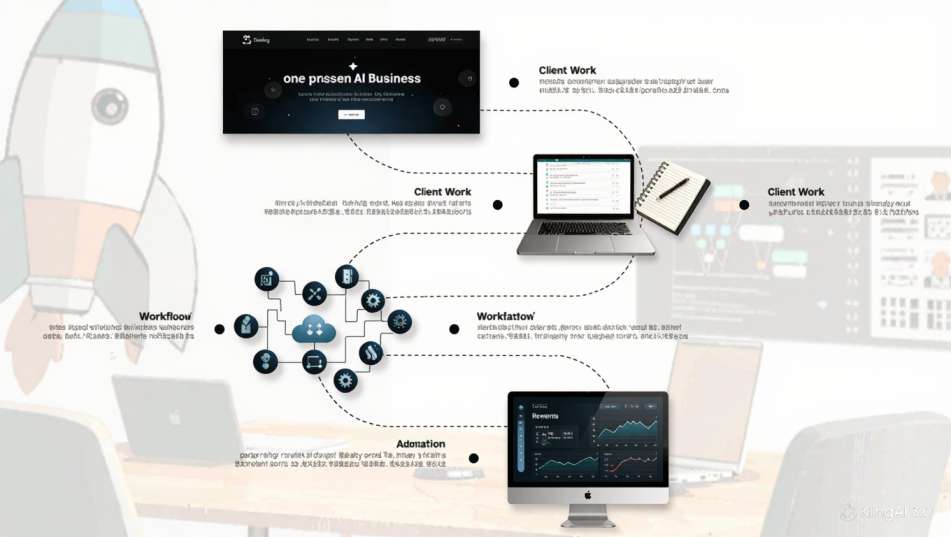
Here’s your practical timeline — no fluff, just milestones:
| Phase | Months | Focus |
| Foundation | 1–3 | Choose niche → validate pain → launch Wizard of Oz version → start concierge delivery |
| Traction | 4–6 | Collect testimonials → standardize workflow → raise prices → introduce light automation |
| Optimization | 7–9 | Improve retention → strengthen marketing → reduce manual work → add repeatable systems |
| Productization | 10–12 | Productize core offer → expand distribution → improve margins → prepare for software-plus-service |
Months 1–3 are about finding signal. Don’t try to scale yet. Find one painful problem, one customer segment, and get paid at least once. That first payment validates everything.
Months 4–6 are about building confidence and process. You have proof it works. Now make it repeatable and raise your prices. If you launched at $500/month, aim for $1,500–$2,000 by month six.
Months 7–9 are about efficiency. Reduce the time it takes to deliver results. Strengthen your marketing so leads come to you instead of you always hunting.
Months 10–12 are about productization. You know the service inside out. Now package it, automate more of it, and think about whether a software layer makes sense on top.
By month 12, a focused solo founder running this playbook should be at $5K–$15K/month in revenue — with a clear path to $100K/year and beyond.
16. FAQ: Your Top Questions Answered
Is it really possible to build a $10M one-person AI business without coding?
Yes — but it takes time and the right strategy. The $10M mark is a long-term goal, not a year-one milestone. Solo founders are already hitting $1M–$5M with productized AI services, Micro-SaaS, and AI-led consulting. No-code tools and LLMs have genuinely removed the technical barrier.
What is the best business model for a solo AI founder?
Start with a productized service or concierge AI model — fast to launch, easy to validate, and immediately revenue-generating. Once you understand the market deeply, layer in a subscription or software model for scale.
What no-code tools should I start with?
Three tools cover 80% of what you need early on: Claude or ChatGPT for AI delivery, Notion for project management and client docs, and Typeform for intake. Add Zapier when you have repeating tasks to automate.
How do I find a painful problem worth solving?
Look for work that businesses already pay humans to do — research, writing, lead gen, customer support, reporting. Then ask: can I deliver the same outcome faster and more consistently using AI? If yes, you have a business case.
How do I get the first paying customers fast?
Direct outreach beats everything else early on. LinkedIn messages, cold emails, and tapping your existing network. Offer a low-risk pilot. Make it easy to say yes. Your first client is one genuine conversation away.
How do I scale without hiring employees?
Through systems, not headcount. Document your workflows. Build templates. Automate the repeatable parts using Zapier or Make. Add digital products and subscriptions to create income that doesn’t scale linearly with your time.
Conclusion
The Main Takeaway
Let me leave you with the four things I want you to carry out of this article:
- Do not start by building software. The market doesn’t reward beautiful products without proven demand.
- Start by solving a painful problem that real people already pay to have solved.
- Use Wizard of Oz prototyping and concierge AI to get paid early — before you’ve automated a single thing.
- Automate only after you understand what customers actually need — because you’ve personally delivered it to them.
The one-person AI business model is one of the most powerful income vehicles available right now. Low overhead, high margins, and tools that let a single focused person do what used to take a team. But the path to $10M is paved with validated offers, happy clients, and documented systems — not viral demos and overhyped tools.
Your Next Move
Here’s your action plan — four steps, no excuses:
- Pick one painful problem that a specific type of business faces repeatedly
- Build the fake version first — a landing page, a Stripe link, and an LLM-powered manual delivery process
- Sell the outcome — not the technology, not the process, not the tool
- Let the business show you what to automate next — your clients and your workflow will tell you exactly where to invest
The best time to start was last year. The second best time is right now. Go build something real.