
I Tested 500+ AI Tools in 2026: These 10 Can Make You Money Fast
Let me be straight with you — I spent the last year testing over 500 AI tools so you don’t have to waste your time, your money, or your sanity.
And here’s what I found: 90% of them are pure noise.
Flashy landing pages. Big promises. Zero results. The AI space in 2026 is loud, and most of what’s trending on your feed right now won’t put a single dollar in your pocket. I know because I tried it all — the hyped-up ones, the obscure ones, the “secret weapons” buried in Reddit threads. Each one ran through real workflows and actual client work. That meant paying for subscriptions, testing the free tiers, and tracking exactly what works and what doesn’t.
Here’s what I know for certain: the right AI tools can genuinely change your financial life. Not someday. Right now, in 2026, the barrier between you and serious income has never been lower.
So whether you’re a complete beginner, a freelancer, a content creator, or someone building an online business on the side — this list is built specifically for you. No fluff. No recycled content. Just the 10 best AI tools to make money that I’d personally bet my business on.
Let’s get into it.
2. How I Tested 500+ AI Tools in 2026

I didn’t just scroll through Product Hunt and pick the prettiest logos. I actually used these tools — on real projects, real client work, and real income goals. Over 12 months, I ran hundreds of tools through a consistent evaluation framework. Here’s exactly how I did it.
2.1 My Evaluation Criteria
Every tool I tested had to earn its spot. I scored each one across 7 non-negotiable criteria:
| Criteria | What I Was Looking For |
| Output quality | Does it produce work you can actually use or sell? |
| Ease of use | Can a beginner figure it out in under 30 minutes? |
| Speed | Does it save meaningful time on real tasks? |
| Monetization potential | Can you build income directly from this tool? |
| Automation capability | Does it reduce repetitive, manual work? |
| Cost vs. value | Is the paid plan actually worth it? |
| Beginner-friendliness | Is the learning curve realistic for non-tech users? |
If a tool couldn’t score well across most of these, it didn’t make the cut. Simple as that.
Pro Tip: When evaluating any AI tool yourself, always test it on a real task — not a demo. The results will surprise you.
2.2 What “Real Results” Means
I’m not here to impress you with vanity metrics. When I say “real results,” I mean tangible, repeatable outcomes like:
- Time saved — Hours cut from content, research, or admin tasks
- Content produced — Actual blog posts, videos, scripts, and graphics delivered
- Client work completed — Projects finished faster and with higher quality
- Revenue opportunities created — New income streams opened or expanded
- Repeatable workflows — Systems I could run again and again without starting from scratch
That last one is EVERYTHING. A great AI tool isn’t just useful once — it builds into a workflow that keeps paying you.
2.3 Why LLMs Matter Most in 2026
Here’s the truth: Large Language Models (LLMs) are the backbone of almost every money-making AI workflow right now. Tools like ChatGPT, Claude, and Gemini aren’t just chatbots anymore — they’re full business engines.
In 2026, LLMs power:
- Content generation — Blog posts, newsletters, scripts, captions
- Research — Fast, accurate, sourced information on any topic
- Sales copy — Ads, email sequences, landing pages that actually convert
- Idea generation — Business ideas, product names, offer structures
- Customer support — Automated responses, chatbots, FAQ systems
- Business automation — Connecting tools, writing workflows, reducing manual tasks
If you’re only going to master one category of AI tools, make it LLMs. Everything else builds on top of them.
Now let’s get into the tools themselves.
3. The 10 AI Tools That Actually Made the Cut
After testing hundreds of tools, these 10 consistently delivered. They’re not just impressive — they’re income-generating machines when used correctly. Let’s break each one down.
3.1 ChatGPT — Best All-Around LLM for Making Money
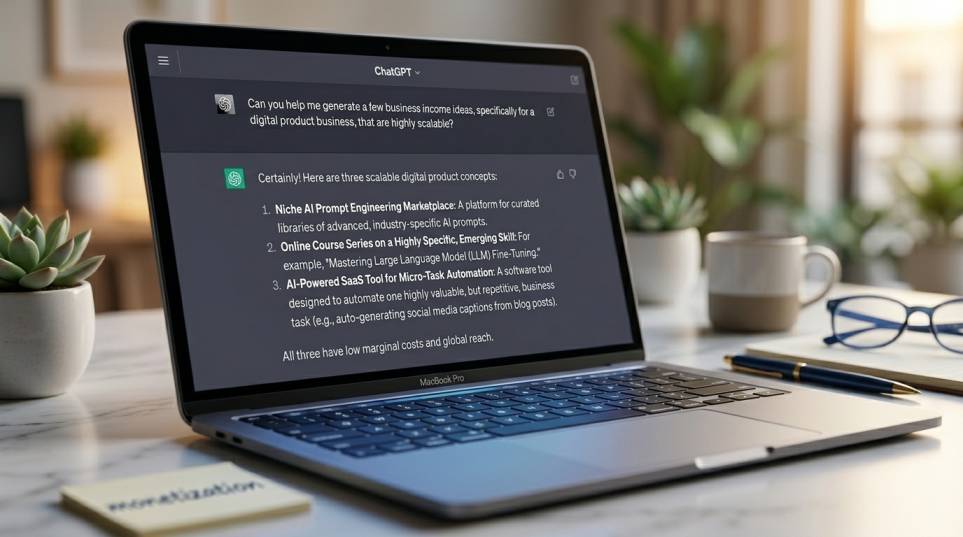
[Insert image: ChatGPT interface showing a business prompt with a polished output]
If there’s one AI tool you NEED on your stack, it’s ChatGPT. I’ve used it daily for over two years, and it still surprises me. Whether I’m drafting a client proposal at midnight or brainstorming a new digital product idea over coffee — ChatGPT delivers.
Best for:
- Blogging and long-form content
- Freelancing and client delivery
- Business idea generation
- Building prompt workflows
- Fast, polished client-ready output
Income use cases:
| Use Case | How It Works |
| Content creation services | Write blog posts, newsletters, and web copy for clients |
| Digital products | Create prompt packs, ebooks, and templates to sell |
| AI consulting | Help businesses implement ChatGPT into their workflows |
| Email marketing | Write high-converting email sequences for clients or your own list |
Why it ranks #1: ChatGPT is the most versatile LLM on the market right now. The GPT-4o model handles text, images, code, and voice — all in one place. It’s fast, it’s accurate, and the ecosystem of custom GPTs makes it endlessly adaptable to almost any business use case.
The free tier is genuinely useful for beginners. But if you’re serious about making money, the ChatGPT Plus plan ($20/month) unlocks access to the most powerful models, faster responses, and priority features. That’s an easy ROI if you land even one client project.
Pro Tip: Build a custom GPT trained on your writing style and client briefs. You’ll produce client-ready drafts 3x faster with near-zero editing time.
I’ve personally used ChatGPT to write email sequences, generate content calendars, and build out entire course outlines in a single afternoon. The people who treat it like a tool — not a magic button — are the ones winning.
3.2 Gemini — Best AI Tool for Productivity, Research, and Google Ecosystem Workflow
If your entire work life runs through Google — and let’s be honest, most of ours does — then Gemini is your unfair advantage. I was sleeping on this tool for months. Then I actually plugged it into my Google Workspace and my productivity DOUBLED.
Best for:
- Google Docs and Gmail workflows
- Deep research with real-time web access
- Brainstorming and content ideation
- Business productivity and planning
Best income ideas:
| Income Stream | Description |
| Virtual assistant services | Offer AI-enhanced VA work to busy entrepreneurs |
| Productivity consulting | Help clients set up Google Workspace + Gemini systems |
| Content research | Deliver fast, sourced research reports for content teams |
| Agency operations | Use Gemini to run faster agency workflows at scale |
| AI-enhanced workflows | Build and sell custom productivity systems to businesses |
Why Gemini stands out: Three things make Gemini uniquely powerful in 2026.
First, its deep Google Workspace integration is unmatched. Gemini lives inside Docs, Gmail, Sheets, and Meet — so you’re not switching tabs. You’re working smarter inside the tools you already use.
Second, its multimodal capabilities are excellent. You can drop in PDFs, images, spreadsheets, and audio — and Gemini processes it all coherently.
Third, it’s connected to the live web. Unlike some LLMs working off stale training data, Gemini pulls current information — which matters enormously for research, trend spotting, and fact-checking.
Pro Tip: Use Gemini inside Google Docs to generate first drafts, then use it in Gmail to write polished follow-up emails — all without leaving your browser. It turns a 2-hour content day into a 45-minute one.
For freelancers offering admin or research services, Gemini is a serious edge. You can deliver higher-quality work, faster, while charging the same rate — meaning your effective hourly rate goes UP.
3.3 Claude AI — Best for Long-Form Writing and Analysis
I’ll be honest — when it comes to writing, Claude is my personal favorite. There’s something about the way it constructs long-form content that feels more natural, more nuanced, and frankly more human than most other LLMs.
Best for:
- In-depth reports and research articles
- Long-form blog content and essays
- Strategy documents and business plans
- Deep editing and structural rewrites
Income use cases:
| Use Case | Real Application |
| Blog writing | Produce SEO-optimized articles faster with better quality |
| Ghostwriting | Write books, thought leadership pieces, and op-eds for clients |
| Business analysis | Deliver market research, competitor analyses, and strategy docs |
| Proposal creation | Write compelling client proposals that actually win deals |
Why it stands out for serious writers: Claude has an unusually large context window — meaning it can read and analyze very long documents without losing track of the content. I’ve fed entire 50-page PDFs into Claude and gotten back sharp, accurate summaries and action plans.
For ghostwriters and content strategists, this is a GAME CHANGER. You can upload a client’s existing content, match their voice precisely, and produce new material that sounds exactly like them.
Claude also tends to follow complex instructions better than most LLMs. If you give it a detailed style guide, a target audience brief, and a content structure — it delivers. Consistently.
The Claude Pro plan is worth every penny for writers doing serious volume. Pair it with Perplexity for research and you’ve got an unstoppable content production system.
Pro Tip: Use Claude to edit and restructure content, not just generate it. Paste in a rough draft and ask it to “tighten the logic, improve transitions, and make every sentence punchy.” The results are impressive.
3.4 Perplexity AI — Best for Research and SEO Content Briefs
Research used to eat up 30–40% of my content production time. Then I found Perplexity, and that number dropped to under 10%. I’m not exaggerating.
Best for:
- Fast, sourced research on any topic
- Fact-checking before publishing
- Content outlining and angle discovery
- Topic and keyword idea generation
Income use cases:
| Use Case | How It Generates Income |
| SEO research | Build detailed content briefs for clients or your own sites |
| Affiliate content | Research products and comparisons faster with cited facts |
| Niche site building | Quickly validate topics and find content gaps |
| Content planning | Map out entire editorial calendars with sourced data |
Why it saves hours for creators: Perplexity isn’t just a search engine — it’s a research assistant that thinks. It pulls real-time information from credible sources, cites every claim, and gives you a clean, readable summary you can actually work with.
Compare that to spending 45 minutes on Google, bouncing between tabs, copy-pasting stats into a doc. Perplexity does it in 90 seconds.
For SEO creators and affiliate bloggers, this tool is particularly powerful. You can research a niche, validate search intent, find data points, and outline a full article — all before your morning coffee gets cold.
The free version is genuinely useful. But the Perplexity Pro plan unlocks access to GPT-4o and Claude-powered answers, plus higher daily usage — worth it if you’re producing content at volume.
Pro Tip: Use Perplexity to generate your content brief first, then pass the research summary directly into Claude or ChatGPT to write the full article. That two-tool combo is one of the fastest content workflows I’ve ever built.
3.5 Notion AI — Best for Systems, Templates, and Productivity Products
Most people think of Notion as just a note-taking app. That’s like calling a Ferrari a “car.” Notion AI in 2026 is a full business operating system — and it’s quietly one of the best passive income tools available.
Best for:
- Content planning and editorial calendars
- SOPs (Standard Operating Procedures)
- Knowledge bases and team wikis
- Client-facing dashboards and portals
Income use cases:
| Income Stream | Description |
| Selling templates | Build and sell Notion templates on Gumroad or Etsy |
| Productivity systems | Create done-for-you systems for entrepreneurs and teams |
| Client portals | Charge a setup fee to build Notion dashboards for clients |
| Business organization | Offer ongoing Notion management as a retainer service |
Why it works for passive income: Here’s what most people miss — Notion templates sell incredibly well. Creators on Gumroad are making thousands of dollars per month selling Notion dashboards for content planning, freelance business management, and personal productivity. The templates cost nothing to duplicate and nothing to deliver.
Notion AI supercharges this because you can use it to build better templates faster. Need an AI-assisted content planner? Done. A client onboarding system with auto-generated SOPs? Done. An entire business-in-a-box template pack? Also done.
The barrier to entry is LOW. You don’t need to code. No need for design skills. You need to understand how people work — and solve that problem in Notion.
Pro Tip: Browse best-selling Notion templates on Etsy or Gumroad before you build. Find what’s already selling, then build a better version with Notion AI. Validate before you create.
3.6 Canva AI — Best for Creators and Digital Product Sellers

Canva was already popular before AI. Now? It’s an absolute powerhouse for creators who want to build and sell visual products without hiring a designer — ever.
Best for:
- Social media graphics and brand kits
- Lead magnets and opt-in freebies
- Presentation slides and pitch decks
- Ebooks, workbooks, and digital downloads
Income use cases:
| Use Case | Real Earning Potential |
| Design services | Offer social media graphics packages to small businesses |
| Template selling | Sell Canva templates on Etsy, Gumroad, or your own site |
| Content bundles | Package graphics + captions + strategy into a sellable product |
| Social media packages | Manage client social accounts using pre-built Canva systems |
Why creators should pay attention: Canva AI now includes Magic Design, AI image generation, text-to-design features, and a brand kit system that maintains visual consistency across everything you produce. You can go from zero to polished, publish-ready graphic in under 5 minutes.
For digital product sellers, this is unmatched. Canva templates are one of the easiest digital products to create and sell. You design it once, list it, and collect payments indefinitely. With AI speeding up the design process, you can build a template shop that generates passive income on autopilot.
Even for client-facing freelancers, Canva AI speeds up deliverables dramatically. You can produce a month’s worth of social media graphics for a client in an afternoon.
Pro Tip: Use Canva AI’s “Magic Write” feature to generate caption copy alongside your graphics. Bundle the design + copy together and charge more — clients love the convenience of getting everything in one package.
3.7 CapCut AI — Best AI Video Tool for Short-Form Content

Short-form video is still the fastest way to build an audience and a brand online in 2026. And CapCut AI makes it possible for ANYONE — with zero editing experience — to produce scroll-stopping content consistently.
Best for:
- TikTok and YouTube Shorts content
- Instagram Reels
- Auto-captions and subtitle generation
- Fast, polished video edits on mobile or desktop
Income use cases:
| Income Stream | How It Works |
| Faceless channels | Build themed YouTube Shorts or TikTok channels without appearing on camera |
| Short-form content services | Edit and produce content for business clients |
| Viral content production | Create high-volume, trend-based content for brand growth |
Why it matters for creator income: CapCut’s AI features are genuinely impressive. Auto-captions, background removal, beat-sync editing, AI voice enhancement, and smart script-to-video tools — all inside a free app.
The faceless channel strategy is especially powerful here. Combine ChatGPT for scripts, ElevenLabs for voiceover, and CapCut for editing — and you have a complete content production system that costs under $30/month total. Creators using this stack are building monetized channels without ever showing their face.
For freelancers, offering CapCut-powered short-form video editing as a service is a fast way to land clients. Small businesses desperately need Reels and TikToks but have no time or skills to produce them.
Pro Tip: Use CapCut’s “Script to Video” feature to turn a ChatGPT-written script into a rough video draft automatically. Then refine it manually. You’ll cut editing time by at least 60%.
3.8 Runway AI — Best AI Video Generator for Premium Content
If CapCut is the tool for speed and volume, Runway is the tool for quality and premium work. This is where you go when the client needs something that looks expensive.
Best for:
- Advanced AI video generation from text or images
- Cinematic motion effects and transitions
- AI-enhanced creative editing
- High-quality visual storytelling
Income use cases:
| Use Case | Client Type |
| Marketing videos | E-commerce brands, coaches, and online businesses |
| Ad creatives | Digital marketing agencies and paid media teams |
| Brand content | Corporate clients needing polished brand assets |
| Client video services | Agencies and freelancers offering premium video production |
Why it’s one of the strongest AI video tools: Runway’s Gen-3 model produces genuinely cinematic video from simple text prompts. We’re talking realistic motion, consistent characters, and high-resolution output that would have cost thousands to produce professionally just three years ago.
For freelancers in the video production space, Runway is a pricing upgrade. When you can deliver polished, motion-rich brand videos with AI assistance, you can charge premium rates — and deliver faster than any traditional video editor.
It’s not the cheapest tool on this list. But for the right niche — ad creatives, brand content, high-ticket client work — the ROI is clear.
Pro Tip: Offer a “video ad creative” package to e-commerce brands. Use Runway to generate the visuals, ChatGPT to write the script, and ElevenLabs for voiceover. A complete ad package that took you 2 hours can sell for $300–$800 per deliverable.
3.9 ElevenLabs — Best AI Voice Tool for Faceless Businesses

ElevenLabs changed the game for content creators who don’t want to be on camera — or on mic. The voice quality is so realistic that most listeners genuinely can’t tell the difference from a human narrator.
Best for:
- Professional-grade AI voiceovers
- Long-form narration for videos and courses
- Multilingual audio content
- Creating a custom branded voice
Income use cases:
| Income Stream | Opportunity |
| Faceless YouTube channels | Narrate scripts without recording your own voice |
| Audiobooks | Convert ebooks or manuscripts into professional audio |
| Podcast production | Produce AI-assisted podcast episodes at scale |
| Voiceover services | Offer voiceover packages to clients who need fast turnarounds |
Why it’s a top monetization tool: The faceless content strategy is one of the most scalable income models in 2026. You write the script (ChatGPT), generate the voice (ElevenLabs), add the visuals (CapCut or Runway), and publish. Rinse and repeat.
ElevenLabs also lets you clone voices and create multilingual versions of the same content — opening up international audience opportunities that most creators never tap into.
For service providers, offering affordable voiceover packages powered by ElevenLabs is a fast path to consistent client income. Quality is high, turnaround is fast, and overhead is near zero.
Pro Tip: Create a custom voice in ElevenLabs that matches your brand’s personality — confident, warm, professional. Use it consistently across all your content. It builds audio brand recognition the same way a logo builds visual recognition.
3.10 Zapier / Make / n8n — Best AI Automation Tools for Scaling
Every tool on this list gets MORE powerful when you connect it to an automation platform. Zapier, Make, and n8n are how you go from manually doing tasks to building systems that work while you sleep.
Best for:
- Connecting AI tools into automated workflows
- Eliminating repetitive, time-consuming tasks
- Integrating apps without writing code
- Building scalable business systems
Income use cases:
| Service Offering | What You Build for Clients |
| Client automation setups | Connect CRMs, email tools, and content systems automatically |
| Lead handling systems | Auto-capture, tag, and follow up with leads hands-free |
| Content pipelines | Auto-publish, repurpose, and distribute content across platforms |
| Recurring service retainers | Maintain and optimize client automations on a monthly basis |
Why automation raises profit potential: Here’s the math: if a tool saves you 10 hours a week and you charge $50/hour for freelance work — that’s $500/week of recovered capacity. Automation doesn’t just save time. It multiplies your earning potential without multiplying your work hours.
Zapier is the easiest to start with — no coding, huge app library, beginner-friendly. Make (formerly Integromat) gives you more complex, visual workflow control for intermediate users. n8n is the open-source powerhouse for advanced builders who want maximum flexibility.
You can offer automation setup as a standalone service, charge $500–$2,000 per project, and add a monthly maintenance retainer on top. It’s one of the highest-margin freelance services in the AI space right now.
Pro Tip: Start by automating your own workflows before selling the service. Build a content repurposing pipeline using ChatGPT + Zapier + your social platforms. Once you’ve seen how powerful it is firsthand, selling it to clients becomes effortless.
Now that you know each tool individually, let’s look at how to match the right stack to your specific money-making goal.
4. Best AI Tools for Different Money-Making Goals
Not every tool fits every person. The right stack depends on where you are and what you’re building. Here’s exactly what I’d recommend based on your situation.
4.1 Best AI Tools for Beginners
If you’re just starting out, keep it simple. Don’t try to master 10 tools at once — you’ll burn out before you earn a dollar.
| Tool | Why Beginners Love It |
| ChatGPT | Easy interface, handles almost any task, free tier available |
| Canva AI | Drag-and-drop design with zero learning curve |
| CapCut AI | Free, intuitive, and perfect for social content |
| Notion AI | Organize your business and start building sellable templates |
Start with ChatGPT + Canva AI. That combo alone can power a freelance writing service, a digital product shop, or a social media management offering — all from day one.
Pro Tip: Don’t buy anything until you’ve maxed out the free tiers. ChatGPT Free, Canva Free, and CapCut Free can generate real income before you spend a cent.
4.2 Best AI Tools for Freelancers
Freelancers need speed, quality, and reliability. These five tools deliver all three.
- Claude AI — Long-form writing, proposals, and deep editing
- ChatGPT — Versatile content, client communication, and ideation
- Perplexity AI — Fast research that saves hours per project
- Canva AI — Visual deliverables without a design background
- Zapier / Make — Automate client onboarding, invoicing, and content delivery
The winning freelance move in 2026 is pairing Claude for writing + Perplexity for research + Canva for visuals. That three-tool stack covers 90% of what most content and marketing freelancers need to deliver premium work — fast.
4.3 Best AI Tools for Content Creators
Creators need volume AND quality. These tools make both possible without burning out.
- ChatGPT — Hooks, scripts, captions, and content ideas
- Claude AI — Long-form articles, newsletters, and storytelling
- CapCut AI — Fast short-form video editing for Reels and Shorts
- Runway AI — Premium video visuals for high-ticket content
- ElevenLabs — Professional voiceovers without a recording studio
The ChatGPT + ElevenLabs + CapCut stack is my go-to recommendation for anyone building a faceless content business. Low cost, high output, completely scalable.
4.4 Best AI Tools for Marketers
Marketers live and die by speed and conversion. These tools handle both.
- ChatGPT — Ad copy, email sequences, and landing page content
- Perplexity AI — Competitor research and trend monitoring
- Canva AI — Fast creative assets for campaigns
- Zapier — Automated lead nurturing and follow-up workflows
- AI chatbot builders (e.g., ManyChat, Tidio) — 24/7 lead capture and customer engagement
For paid media marketers specifically, combining ChatGPT for copy + Canva AI for creatives + Zapier for automation cuts campaign setup time dramatically while improving consistency across channels.
4.5 Best AI Tools for Passive Income
Passive income requires upfront work and smart systems. These tools build both.
- Notion AI — Build templates once, sell them forever
- Canva AI — Design digital products that sell on autopilot
- ChatGPT — Generate content, product ideas, and sales copy at scale
- AI chatbot builders — Handle customer inquiries without your involvement
- Automation tools (Zapier / Make) — Connect everything so your business runs without you
The passive income formula here is simple: create once, automate delivery, repeat. Build a Notion template pack. Design a Canva bundle. Use ChatGPT to write the product descriptions and email sequences. Set up Zapier to handle delivery. That’s a real passive income system — not a fantasy.
5. Real Ways to Make Money With These AI Tools

Knowing the tools is one thing. Actually making money with them is another. Here are five proven income paths you can start building today.
5.1 Start a Faceless YouTube Channel
This is one of the most popular AI income strategies in 2026 — and it works.
The workflow:
- ChatGPT or Claude — Write the video script
- ElevenLabs — Generate a natural-sounding voiceover
- CapCut or Runway — Edit the video with visuals and captions
Pick a niche with strong search demand — finance, productivity, health, or motivation. Publish consistently. Monetize through YouTube AdSense, affiliate links, and sponsored content. Creators using this exact stack are generating $2,000–$10,000/month from channels they never appear in.
Pro Tip: Use Perplexity to research trending topics in your niche before writing scripts. Trending topics = faster channel growth.
5.2 Sell Digital Products
Digital products are the ultimate leverage play — zero inventory, zero shipping, unlimited sales.
What sells well:
- Notion templates — Productivity systems, content planners, freelance dashboards
- Canva templates — Social media kits, pitch decks, lead magnets
- Prompt packs — Curated ChatGPT prompts for specific niches or tasks
- Content calendars — Pre-built, done-for-you planning tools
List on Etsy, Gumroad, or your own site. Use ChatGPT to write product descriptions and Canva to design eye-catching mockups. One well-built template pack can generate passive sales for years.
5.3 Offer AI-Powered Freelance Services
The fastest path to income. Pick a service, land two or three clients, and deliver with AI assistance.
| Service | Tools to Use | Realistic Rate |
| Blog writing | ChatGPT + Claude + Perplexity | $150–$500/article |
| Email copy | ChatGPT | $100–$400/sequence |
| Social media content | ChatGPT + Canva AI | $500–$2,000/month retainer |
| Research reports | Perplexity + Claude | $200–$800/report |
| Chatbot setup | ManyChat + Zapier | $500–$2,000/setup |
You don’t need to disclose that you use AI. You need to deliver great work. AI helps you do that faster.
5.4 Build Client Automations
This is one of the HIGHEST-margin services you can offer right now. Most small businesses are drowning in repetitive tasks — and they’ll pay well to fix that.
What you can build:
- Lead capture systems — Auto-collect and tag new leads from forms or ads
- Follow-up workflows — Automated email or SMS sequences triggered by behavior
- Content scheduling — Auto-publish content across platforms on a set schedule
- Customer service automation — AI chatbots that handle FAQs and bookings 24/7
Use Zapier or Make to build these systems. Charge $500–$2,500 per setup plus a monthly retainer for maintenance. Once you have a few case studies, referrals come naturally.
Pro Tip: Offer a free “automation audit” to potential clients. Show them 3 tasks they’re doing manually that you can automate. Close the sale by showing the time and money they’ll save.
5.5 Launch a Content Agency
Ready to scale beyond solo freelancing? Build a small content agency powered entirely by AI tools.
Your core service stack:
- LLM-assisted writing (ChatGPT + Claude) — Blog posts, newsletters, website copy
- Design assets (Canva AI) — Graphics, ebooks, social content
- Video repurposing (CapCut + Runway) — Turn long content into short clips
- SEO research (Perplexity + Surfer SEO) — Keyword strategy and content briefs
You don’t need a big team. You need strong systems, reliable AI tools, and two or three anchor clients. From there, you scale by adding more clients — not more people.
One person running this model can realistically generate $5,000–$15,000/month. I’ve seen it done. The tools exist. The demand is massive. The question is whether you’ll start.
6. The Best Workflows I Actually Recommend
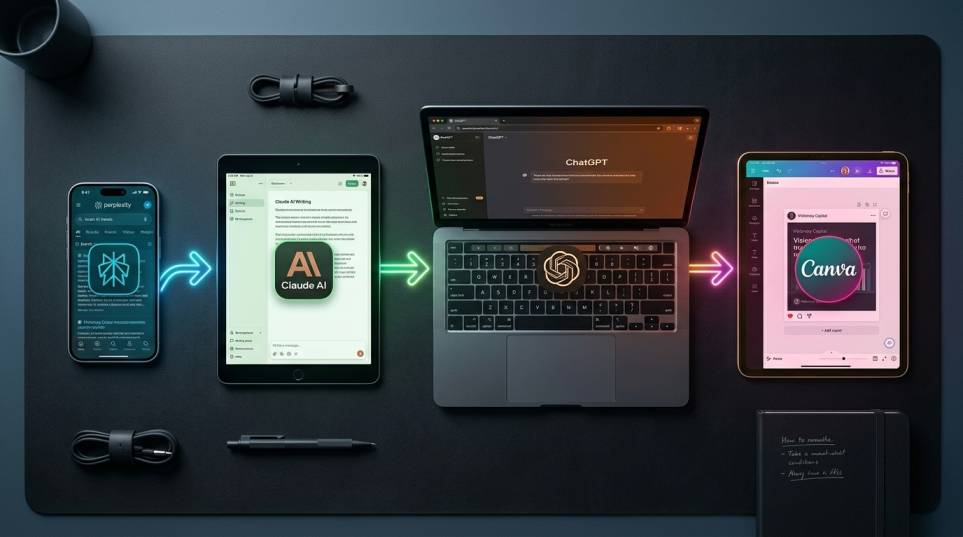
Tools are only as good as the systems you build around them. Here are the three workflows I personally use and recommend — each one is battle-tested, repeatable, and built for income.
6.1 LLM Workflow for Blog Content
This is my primary content production system. It’s fast, consistent, and produces articles that actually rank.
Step-by-step:
| Step | Tool | What It Does |
| 1. Research | Perplexity AI | Pull sourced facts, stats, and topic angles in minutes |
| 2. Draft | Claude AI | Write the full article using the research as a foundation |
| 3. Refine | ChatGPT | Tighten the copy, improve hooks, and punch up CTAs |
| 4. Visuals | Canva AI | Design featured images, infographics, and social share assets |
Why this works: each tool does what it’s genuinely best at. Perplexity handles accuracy. Claude handles depth and tone. ChatGPT handles polish. Canva handles presentation. Together, they produce publish-ready content in a fraction of the time it would take manually.
A full 2,000-word SEO article — researched, written, edited, and designed — takes me about 90 minutes using this workflow. Clients pay $300–$600 per article. You do the math.
Pro Tip: Save your Perplexity research summaries as reusable briefs. One research session can fuel 3–5 related articles — maximizing your time on every topic you explore.
6.2 Creator Workflow for Short-Form Content
Short-form video is still the fastest audience-building channel in 2026. This workflow turns a content idea into a published video in under an hour.
Step-by-step:
- ChatGPT — Write a scroll-stopping hook and full video script
- ElevenLabs — Generate a natural voiceover from the script
- CapCut AI — Edit the video, add captions, sync to audio
- Canva AI — Design a thumbnail or cover graphic for cross-platform use
This is the exact faceless content stack I’d use to build a monetized channel from scratch today. Total monthly cost: under $30. Total daily time commitment: 1–2 hours. The content compounds — old videos keep generating views and revenue long after you’ve moved on to the next one.
The key is consistency over perfection. Use ChatGPT to batch-write 10 scripts in one session. Record 10 voiceovers in ElevenLabs. Edit all 10 in CapCut. Publish one per day for two weeks. THAT is how creators build momentum.
Pro Tip: Use ChatGPT to generate 30 video hook ideas for your niche in one prompt. Test the top five as Shorts first — the one that performs best becomes your next long-form video.
6.3 Automation Workflow for Selling Services
This workflow transforms your freelance business from a manual hustle into a system that sells and delivers — even when you’re offline.
The setup:
| Component | Tool | Function |
| Sales assets | ChatGPT | Write your offer page, pitch emails, and sales scripts |
| Lead handling | AI chatbot (ManyChat/Tidio) | Capture, qualify, and respond to leads automatically |
| Backend automation | Zapier / Make | Connect your forms, CRM, calendar, and email sequences |
| Client delivery | Notion | Organized client portals with SOPs, files, and progress tracking |
Once this system is live, a new lead can discover your service, get a response, book a call, and receive an onboarding portal — all without you touching anything manually. That’s the power of combining AI content with smart automation.
This workflow takes a weekend to set up. But once it’s running, it works around the clock.
7. What I Would Buy First If I Were Starting Today

Budget matters. Here’s exactly what I’d spend — at three different investment levels.
7.1 Budget Stack (Under $25/month)
Perfect for beginners who want to start earning before scaling.
| Tool | Cost | Purpose |
| ChatGPT Plus | $20/month | Core LLM for all content and business tasks |
| Canva AI | Free tier | Design and digital products |
| CapCut AI | Free | Short-form video content |
Total: ~$20/month. This stack can generate real income through freelance writing, digital product sales, and social media content services. Start here. Prove the model. Then upgrade.
7.2 Growth Stack ($60–$80/month)
For creators and freelancers ready to scale output and take on more clients.
- ChatGPT Plus — $20/month
- Claude Pro — $20/month
- Perplexity Pro — $20/month
- Canva Pro — $15/month
- Zapier Starter — $20/month
Total: ~$75/month. At this level, you have a full content production and automation system. One extra client per month covers the entire stack cost — and then some.
Pro Tip: Before upgrading to the Growth Stack, make sure you’ve earned at least $200/month from the Budget Stack. Let your income fund your tool upgrades.
7.3 Pro Stack ($130–$160/month)
For serious operators building an agency or scaling a content business past $5K/month.
| Tool | Monthly Cost |
| ChatGPT Plus | $20 |
| Claude Pro | $20 |
| Runway Standard | $15 |
| ElevenLabs Creator | $22 |
| Make Core / n8n | $9–$20 |
Total: ~$86–$100/month. At this level, you’re producing premium video content, professional voiceovers, and fully automated client workflows. The Pro Stack is for people who’ve already validated their income model and are ready to deliver at a higher level — and charge accordingly.
The tools are ready. The income models are proven. The only question now is which stack matches where you are today — and how fast you’re willing to move.
8. Tools That Did Not Make the Top 10
I tested over 500 AI tools. Only 10 made this list. That means hundreds didn’t. Here’s why.
I’m not going to name every tool that failed — that would take all day. But I will tell you the five reasons most tools got cut, so you can apply the same filter yourself before spending money on anything new.
Why Most Tools Got Eliminated
| Reason | What It Looked Like in Practice |
| Weak output | Produced generic, low-quality content that needed heavy rewriting |
| Too expensive | High price point with results no better than cheaper alternatives |
| Poor workflow fit | Couldn’t integrate cleanly into a real production system |
| Limited monetization use | Impressive demos — zero practical income application |
| Too much hype, not enough value | Viral on social media, useless in the real world |
The biggest offenders were AI image tools promising “passive income” from selling AI art — the market is saturated and margins are razor-thin. Several “all-in-one” AI platforms also failed because they tried to do everything and excelled at nothing.
A few name-brand tools surprised me negatively. Jasper, for example, was a serious contender two years ago. In 2026, ChatGPT and Claude do everything Jasper does — better, faster, and cheaper. Hard to justify the cost when the free alternatives outperform it.
The pattern I noticed: the tools that failed usually marketed themselves to beginners with big income promises but delivered outputs that required expert-level editing to be usable. That’s not a beginner tool. That’s a trap.
One rule I now live by — if a tool can’t produce something I’d confidently send to a client within 10 minutes of signing up, it doesn’t make the cut. Apply that standard to every new tool you try and you’ll save yourself hundreds of dollars a year.
Pro Tip: Before paying for any AI tool, search “[tool name] vs ChatGPT” or “[tool name] vs Claude.” If the comparison doesn’t clearly favor the new tool for your specific use case — stick with what you have.
9. FAQs
9.1 What are the best AI tools to make money in 2026?
The top performers are ChatGPT, Claude AI, Canva AI, ElevenLabs, CapCut, and Zapier. Each one has clear, proven income applications — from freelancing and content creation to automation and digital products.
9.2 Can beginners really make money with AI tools?
Yes — and I’ve seen it happen fast. The barrier to entry is lower than ever. With ChatGPT Free + Canva Free, a complete beginner can offer social media content services or sell digital templates within days of starting. You don’t need technical skills. You need consistency and a willingness to learn.
9.3 Which AI tools are best for side hustles?
ChatGPT, Canva AI, and CapCut AI are the strongest side hustle tools. They’re affordable, versatile, and cover the three highest-demand services right now: writing, design, and short-form video. Start with one service, land three clients, then scale.
9.4 What AI tools help with passive income?
Notion AI and Canva AI are the best for passive income. Build templates once, list them on Gumroad or Etsy, and collect payments indefinitely. Combine with ChatGPT to write product descriptions and Zapier to automate delivery.
9.5 Are free AI tools good enough to start earning?
Absolutely. ChatGPT Free, Canva Free, and CapCut Free are all genuinely capable tools. I’d encourage every beginner to generate their first $200–$500 using only free tools before upgrading. Prove the model first — then invest in paid plans.
9.6 Which AI tools are best for content creators?
ChatGPT + ElevenLabs + CapCut is the go-to creator stack. ChatGPT writes the scripts, ElevenLabs voices them, and CapCut edits the final video. Add Runway AI when you need premium visuals for higher-ticket content.
9.7 How do people use ChatGPT to make money?
The most common and profitable use cases include:
- Writing blog posts and articles for clients
- Building and selling prompt packs
- Creating email marketing sequences
- Generating digital product content
- Offering AI consulting to small businesses
ChatGPT is the most versatile income tool on this list — and it’s the one I’d recommend starting with on day one.
9.8 What AI tools are best for freelancers?
Claude AI, ChatGPT, Perplexity AI, and Canva AI form the core freelance stack. Claude handles long-form writing. ChatGPT covers everything else. Perplexity speeds up research. Canva delivers the visuals. Add Zapier once you’re ready to automate client workflows.
9.9 What are the most profitable AI tools right now?
Based on real-world income potential:
| Tool | Highest-Income Use Case |
| ChatGPT | Content services, consulting, digital products |
| ElevenLabs | Faceless YouTube, voiceover services |
| Canva AI | Template sales, design retainers |
| Zapier / Make | Client automation setups ($500–$2,500/project) |
| Runway AI | Premium video production for brands |
9.10 Which AI tools are worth paying for in 2026?
If I could only pay for three subscriptions, I’d choose ChatGPT Plus ($20), Claude Pro ($20), and Canva Pro ($15). That $55/month stack covers writing, analysis, and design at a professional level — and can easily generate 10–20x its cost in client revenue every single month.
10. Conclusion: The Best AI Tools Are the Ones That Help You Ship, Sell, and Scale

Let me leave you with the most important thing I learned after testing 500+ AI tools in 2026.
The tool isn’t the strategy. You are.
The internet is full of people collecting AI tools like trading cards — subscribing to everything, mastering nothing, earning zero. Don’t be that person. The creators and freelancers actually making money right now aren’t using 20 tools. They’re using 3–5 tools exceptionally well, inside one repeatable workflow, pointed at one clear income goal.
Not All AI Tools Are Equal — And That Gap Is Growing
After everything I tested, the tools that consistently delivered real results fell into four categories:
| Category | Top Performers |
| LLMs | ChatGPT, Claude AI, Perplexity AI |
| Creative tools | Canva AI, CapCut AI, Runway AI |
| Voice & video | ElevenLabs, Runway |
| Automation | Zapier, Make, n8n |
The tools outside these categories? Most of them are noise. Shiny, well-marketed noise. You now know the difference.
Start With One Stack — Not Twenty Tools
The biggest mistake beginners make is tool-hopping. They spend more time evaluating AI tools than using them to build something. So here’s your challenge — right now, today — pick ONE stack and commit to it for 90 days:
- 🟢 Budget? ChatGPT + Canva + CapCut
- 🔵 Growing? ChatGPT + Claude + Perplexity + Canva + Zapier
- 🔴 Scaling? ChatGPT + Claude + Runway + ElevenLabs + Make
Then BUILD. Don’t switch. Don’t add new tools every week. Master what you have.
Your Practical Action Step — Right Now
Before you close this tab, make one decision across each of these four areas:
- Pick one LLM — ChatGPT or Claude. Start there. Use it daily.
- Pick one creator tool — Canva for design, CapCut for video, or ElevenLabs for voice.
- Pick one automation tool — Zapier if you’re a beginner, Make or n8n if you want more control.
- Build one monetizable workflow — A content service, a digital product, a faceless channel, or a client automation. Just one.
That’s it. One LLM. One creator tool. One automation tool. One workflow. That’s a real business — not a hobby.
The opportunity in front of you right now is genuinely historic. AI has compressed what used to take a team of five into what one focused person can execute alone. The income models are proven. The tools are accessible. The barrier has never been lower.
You don’t need more information. You need to start.
Pick your stack. Build your workflow. Ship your first product or land your first client. Everything else follows from that first move.
The tools are ready. The only question left is — are you?