
The Real Reason You’re Broke: It’s Not Money, It’s Productivity
Some people work six focused hours and keep earning more every year. Others grind twelve-hour days for a decade and stay stuck in the same financial spot. Same economy. Same opportunities. Wildly different results. That gap has a name: productivity.
Most people who feel stuck land on the usual explanations, inflation, a salary that hasn’t kept up, a market that isn’t playing fair. Those pressures are real. I won’t pretend otherwise. But they explain some of the gap, not all of it. And they definitely don’t explain why two people in identical circumstances end up in completely different financial positions ten years later.
The actual difference is rarely how much they earn. It’s how effectively they convert what they already have, their time, energy, and skills, into something worth paying for. That conversion rate is productivity. And it’s one of the most financially significant skills most people never think to develop.
Get that conversion rate up, and your income has real room to move, whether you’re climbing a career ladder, running your own business, or building something on the side. Leave it where it is, and no raise, rate increase, or side hustle will move the needle for long.
This guide explains why productivity is one of the greatest wealth-building skills you can build right now, and how replacing motivation, which fades, with daily systems, which don’t, can change your financial trajectory faster than you’d expect.
2. What Does Being Broke Really Mean?
Before you can fix a problem, you’ve got to name it correctly. And “broke” gets thrown around so loosely that most people never stop to ask what it actually means for them.
2.1 Being Broke vs Being Poor
Here’s something that took me years to understand: broke and poor are not the same thing. People use them interchangeably, but they describe two completely different financial realities.
Broke is temporary. It’s the gap between paychecks, the emergency that drained your savings, the month you overspent on something you probably didn’t need. Painful? Sure. Permanent? Not even close.
Poor is structural. It’s a long-term pattern — no safety net, no upward trajectory, the same financial pressure month after month with no real plan to escape it.

| Broke | Poor | |
| Duration | Short-term, situational | Long-term, ongoing |
| Cause | A bad month, an unexpected expense | A broken system or no system at all |
| Fix | Adjust spending, rebuild savings | Build new habits, skills, and income systems |
| Income alone fixes it? | Sometimes | Rarely |
That last row matters more than people think. I’ve watched friends get raises and still feel broke six months later — same stress, same scramble, just bigger numbers on the paycheck. Income alone doesn’t fix either problem if the system underneath it stays broken.
2.2 The Productivity-Income Connection
So if money alone isn’t the fix, what is? This is where productivity earns its place in the conversation.
Every dollar you’ve ever earned started as value you created for someone else. Your employer doesn’t pay you for showing up — they pay you for the problems you solve, the output you produce, the results you deliver. Same goes if you’re running your own business. Nobody pays for effort. They pay for outcomes.
This is why productivity directly increases your earning potential. The more value you can create per hour, the more leverage you have — to ask for a raise, to charge more, to get promoted, to build something that scales beyond your time.
Businesses reward output because output is what keeps the lights on. A team member who finishes the project early and makes it better gets remembered. A team member who’s “busy all day” but produces little gets overlooked, even if they worked just as many hours.
Pro Tip: Track your output for one week, not your hours. Write down what you actually finished each day. You’ll often find the connection between “time spent” and “value created” is weaker than you think.
3. The Hidden Productivity Crisis
Now here’s where it gets uncomfortable. A lot of people reading this work hard. Like, genuinely hard. And they’re still broke. So what gives?
3.1 Why Hard Work Alone Isn’t Enough
I used to think effort was the whole equation. Work harder, earn more — simple math, right? Except it’s not, because hard work without direction just burns energy in circles.
There’s a real difference between being busy and being productive. Busy means your calendar is full. Productive means your results are growing. You can spend ten hours a day “working” and still produce almost nothing of value if that time isn’t pointed at the right target.
This is the trap of high effort with low output. You feel exhausted at the end of the day, which feels like proof you’ve earned something. But exhaustion isn’t a result. It’s just a byproduct of motion, and motion without direction rarely pays the bills.

3.2 The Cost of Low Productivity
Low productivity doesn’t just cost you a little extra time. It quietly drains opportunities you never even see.
Here’s what tends to slip away:
- Lost opportunities — the project you didn’t finish in time, the client who went elsewhere
- Missed promotions — someone else gets the role because their output was visible and yours wasn’t
- Delayed career growth — years pass with the same title, same salary, same ceiling
- Reduced earning capacity — your skills stop compounding because you’re not producing enough to sharpen them
None of this shows up on a bank statement directly. It shows up later, as the gap between where you are and where you could’ve been.
4. Seven Productivity Habits That Keep People Broke
This is the part I want you to read slowly, because I’d bet at least two or three of these will feel uncomfortably familiar. I know they did for me.
4.1 Chronic Procrastination
Every delayed decision has a cost attached to it, even when it doesn’t feel that way in the moment. The opportunity you “think about” for three weeks is often gone by the time you act. Procrastination doesn’t just steal time — it steals options.
4.2 Lack of Self-Discipline
Inconsistent routines lead to inconsistent results. You can have the best plan in the world, but without follow-through, it’s just a nice idea sitting in a notebook. Discipline is what turns intentions into outcomes.
4.3 No Clear Goals
Without a target, you drift. And drifting feels productive because you’re still moving — you’re just not moving anywhere specific. Clear goals sharpen your focus and give every hour a purpose, instead of letting your day get hijacked by whatever feels urgent.
4.4 Constant Distractions
Social media, notifications, multitasking — these three alone can quietly eat hours of your most valuable time every single day. Multitasking especially feels efficient and almost never is. Your brain isn’t built to run two important tasks at once; it just switches between them badly.
4.5 Poor Time Management
Wasting productive hours on low-value tasks is one of the sneakiest ways people stay broke. You feel busy, but a planning failure at the start of the day means you spend it reacting instead of executing. Tools like Todoist or Google Calendar can help here, but only if you actually use them to protect your best hours, not just log your meetings.
4.6 Lack of Organization
A cluttered workspace leads to a cluttered mind. A cluttered schedule leads to missed deadlines. And cluttered finances? That’s how “I think I have enough” turns into an overdraft fee. Organization isn’t about being a perfectionist — it’s about removing friction so your energy goes toward actual work.
4.7 Waiting for Motivation
This one trips up almost everyone at some point, myself included. Motivation feels powerful right up until it disappears — and it always disappears, usually right when you need it most.
Here’s the truth nobody tells you early enough: successful people don’t rely on motivation. They rely on systems. Systems work on the days motivation doesn’t show up, which is most days. That’s exactly where we’re headed next.

5. Build Systems Instead of Depending on Motivation
If Section 4 left you a little exposed, good. That’s the point. Now let’s fix it — and the fix isn’t more willpower. It’s systems.
5.1 Why Systems Beat Motivation
Motivation is emotional. It shows up when you’re inspired, rested, excited about a new goal — and it vanishes the second life gets boring, hard, or inconvenient. You can’t build a financial future on something that disappears every time you’re tired.
Systems are automatic. A system doesn’t ask how you feel. It just runs — the same way brushing your teeth runs without a pep talk first. That’s the entire advantage. Once a system is built, it produces results whether you’re motivated or not, which is most of the time for most people.
This is the real difference between people who keep climbing and people who stay stuck. It was never about who wanted it more. It’s about who built something that worked without needing to want it every single day.
5.2 Build Daily Success Systems
You don’t need ten systems. You need a few solid ones, repeated until they’re boring. Here’s where to start:
| System | What It Does | Frequency |
| Morning routine | Sets your focus before the day pulls you in ten directions | Daily |
| Weekly planning | Maps your priorities before the week maps them for you | Weekly |
| Monthly review | Catches what’s working and what’s quietly draining you | Monthly |
| Financial review | Keeps your money visible instead of avoided | Monthly |
| Learning schedule | Compounds your skills so your value keeps rising | Weekly |
A morning routine doesn’t need to be elaborate. Even fifteen quiet minutes before the noise starts changes how the rest of your day goes. Weekly planning gives you a target instead of a reaction. And a financial review — even just twenty minutes with your bank app — keeps “broke” from creeping back in unnoticed.
Pro Tip: Use Google Calendar to block your weekly planning and financial review as recurring, non-negotiable appointments. If it’s not scheduled, it’s optional — and optional things get skipped.

5.3 Habit Stacking
Big transformations rarely come from big moves. They come from small habits, stacked on top of habits you already do automatically.
Want to start a learning habit? Attach it to something already locked into your day — read for ten minutes right after your morning coffee, not “sometime today.” Want better financial awareness? Check your accounts right after you brush your teeth.
The magic isn’t in any single habit. It’s in compounding results. A 1% improvement, repeated daily, doesn’t look like much in week one. By month six, it’s a completely different trajectory.
5.4 Make Good Decisions Easy
Willpower is a limited resource — treat it that way. The less you have to decide in the moment, the more consistent you’ll be.
- Environment design: Put your gym clothes out the night before. Keep your laptop open to the work doc, not the homepage.
- Remove distractions: Phone in another room during deep work. Notifications off during your highest-value hours.
- Automate repetitive tasks: Auto-transfers into savings, recurring bill payments, templated email responses — anything that removes a decision removes a chance to fail.
Tools like Notion or ClickUp can house your systems in one place, so you’re not rebuilding your routine from memory every morning.
6. Work Smarter — But Never Stop Working Hard
Here’s where a lot of productivity content quietly misleads you. It sells “smart work” like it’s a replacement for effort. It’s not, and I want to be straight with you about that.
6.1 Smart Work Multiplies Hard Work

Hard work remains essential. No system, app, or AI tool replaces showing up and doing the work. What smart work actually does is make sure every hour you put in creates greater impact.
Think of it as a multiplier, not a substitute. Two people can work the same eight hours. One spends it reacting to whatever’s loudest. The other spends it on the three things that actually move the needle. Same hours. Wildly different results.
6.2 Productivity Is Not Laziness
Let’s kill a myth right here: being productive is not the lazy way out. It’s the opposite.
Productive people practice intentional effort — they choose where their energy goes instead of letting the day choose for them. They protect blocks of deep work, free from distraction, where real progress happens. And they show up consistently, not just on the days they feel inspired.
None of that is lazy. It’s disciplined, and discipline is harder than just staying busy.
6.3 Why Successful People Combine Both
Look at any high performer and you’ll find the same pattern: hard work and smart work, working together.
Professionals who get promoted aren’t just logging hours — they’re targeting the work that gets noticed. Entrepreneurs who scale aren’t grinding blindly — they’re building systems that work without them in the room. Athletes don’t just train harder than everyone else; they train smarter, with recovery, strategy, and data built into the plan.
Hard work gets you in the game. Smart work is what wins it.
7. How AI Can Make You More Productive
I’d be doing you a disservice if I skipped this, because right now, AI might be the single biggest productivity unlock available to you — if you use it right.
7.1 AI Is a Productivity Multiplier
Let’s be clear about what AI actually does. It doesn’t replace effort. It removes repetitive work, freeing up your time and energy for the parts of your work that actually require a human brain — judgment, creativity, strategy.
Think of AI less like a shortcut and more like hiring an assistant who never gets tired and works at 2 a.m. if you need it to.

7.2 Best AI Productivity Uses
Tools like ChatGPT, Claude, Gemini, and Microsoft Copilot are genuinely useful across a wide range of everyday tasks:
- Writing — first drafts, outlines, editing
- Research — summarizing complex topics fast
- Brainstorming — generating angles you wouldn’t have thought of alone
- Email drafting — clearing your inbox in a fraction of the time
- Data analysis — spotting patterns in spreadsheets without manual digging
- Meeting summaries — turning an hour of conversation into five usable bullet points
- Learning new skills — explaining concepts in plain language, on demand
Pro Tip: Pick one repetitive task this week — meeting notes, email replies, research summaries — and hand it to an AI tool for seven days straight. Track the time it actually saves you. That number usually convinces people faster than any article can.
7.3 AI Still Requires Human Discipline
Here’s the part that gets left out of most AI hype: the tool doesn’t do the thinking for you.
Critical thinking, decision-making, creativity, and execution still belong to you. AI can draft the email, but you decide what it should say. It can summarize the research, but you decide what to do with it. The tool removes the friction. You still have to show up and use what it gives you.
AI without discipline is just a faster way to produce nothing. AI with discipline is one of the most powerful productivity systems available to you right now.
8. Productivity Tools That Help You Stay Consistent
A system is only as good as your follow-through, and follow-through gets a lot easier with the right tool doing the remembering for you. None of these tools work magic. They just remove friction so your discipline has less to fight against.
8.1 Planning Tools
Google Calendar earns its spot first because almost everyone already has it open. Time-block your priorities here and your day stops getting hijacked by whoever emails you first.
Notion works well if you like one home base for everything — goals, notes, habit trackers, project plans. It’s flexible enough to bend around your system instead of forcing you into someone else’s template.
Todoist and Microsoft To Do are simpler, and that’s the point. If Notion feels like overkill, a clean task list that syncs across your phone and laptop does the job without the setup time.
8.2 Project Management
Trello uses boards and cards, which makes it easy to see your whole workload at a glance. Good for visual thinkers who want to drag a task from “doing” to “done” and actually feel that small win.
ClickUp goes deeper — task dependencies, time tracking, custom views — built for people juggling multiple projects or running a small team.
Asana sits in between. Strong for assigning work, tracking deadlines, and keeping a team aligned without drowning in spreadsheets.
Time Management
A Pomodoro Timer sounds almost too simple to matter. Twenty-five minutes of focused work, five-minute break, repeat. It works because it makes starting easier — you’re only committing to twenty-five minutes, not “finish the whole project.”
Focus apps that block distracting sites during work blocks remove the temptation entirely. You can’t doomscroll a site you can’t open.
8.3 AI Tools
ChatGPT, Claude, Gemini, and Microsoft Copilot all do the same core job from slightly different angles: they take repetitive cognitive work off your plate. Drafting, summarizing, brainstorming, researching — work that used to eat hours now takes minutes.
| Tool | Best For |
| Google Calendar | Time-blocking your day |
| Notion | All-in-one planning and notes |
| Todoist / Microsoft To Do | Simple daily task lists |
| Trello | Visual project tracking |
| ClickUp | Complex projects, team workflows |
| Asana | Team task assignment and deadlines |
| Pomodoro Timer | Focused work sprints |
| ChatGPT / Claude / Gemini / Copilot | Writing, research, summarizing |
Pro Tip: Don’t install five of these at once. Pick one planning tool and one AI tool. Master those for thirty days before adding anything else. Tool-hopping is just procrastination wearing a productivity costume.
None of these replace the work. They support it — which brings us to something just as important as the tools themselves.
9. The Organization Advantage
I’ve noticed something over the years: the people who earn more aren’t usually the smartest people in the room. They’re often the most organized ones.
9.1 Why Organized People Usually Earn More
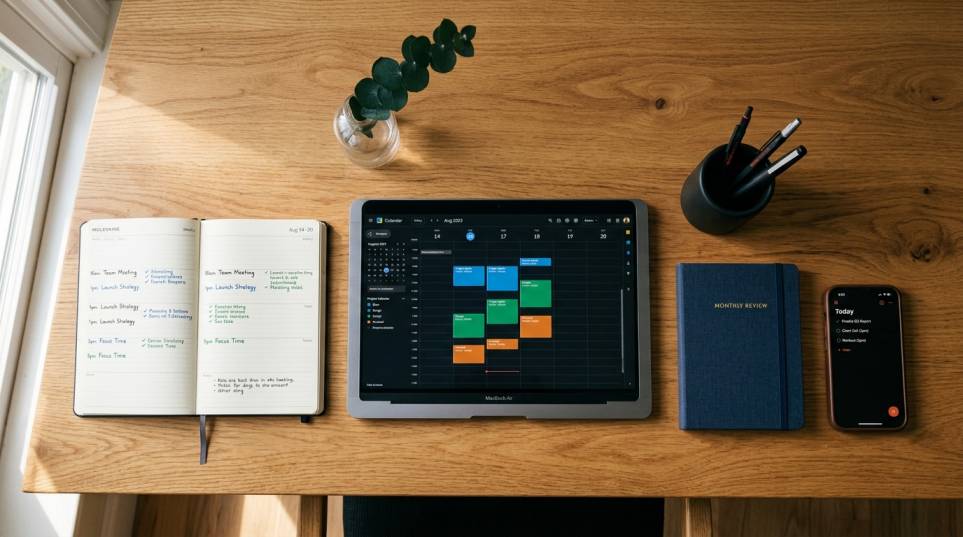
Organization sharpens decision making. When your information is where you expect it, you spend your mental energy on the decision itself, not hunting for the file you need first.
It also lowers stress, and stress is expensive. A cluttered, reactive day drains you by 3 p.m. An organized one leaves you with energy left over.
Faster execution follows naturally. You’re not pausing every ten minutes to find something or remember what’s next — you just move.
And reliability compounds. Show up prepared and on time, consistently, and people start handing you bigger opportunities. That trust is worth more than almost any single skill on a resume.
9.2 Practical Organization Tips
You don’t need a complete life overhaul. Start small, in this order:
- Organize your files — one folder structure, used consistently, beats five half-used systems
- Organize your tasks — one list, not six sticky notes and three apps
- Organize your finances — one place to check your numbers, reviewed weekly, not avoided monthly
- Organize your workspace — clear desk, charged devices, ready to start without setup friction
Each one removes a tiny daily decision. Tiny decisions add up to real fatigue by the end of the week.
Pro Tip: Pick the messiest area from that list first — usually it’s finances or files — and give it one focused hour this weekend. One clean system beats four half-organized ones.
Organization buys you speed and clarity. Consistency is what turns that speed into something measurable over time.
10. Build Consistency Like High Performers
Here’s something most people get backwards: they chase intensity when they should be chasing repetition.
10.1 Why Consistency Beats Intensity
A brutal, three-hour workout once a month does almost nothing for your body. Thirty minutes, four times a week, for a year? That changes you completely.
Money works the same way. Small, consistent improvements — saving a little more, working a little smarter, learning a little weekly — beat sporadic bursts of effort every time. Daily execution, even imperfect daily execution, outperforms occasional perfection.
10.2 The Compound Effect
This is the part that’s almost impossible to feel in the moment, because compounding is invisible at first and then suddenly obvious.
Improve by just 1% a day, and in a year you’re not 365% better — you’re roughly 37 times better, because each gain builds on the last one. Most people quit in month two, right before the curve starts bending upward. The ones who stay past that point are the ones whose numbers everyone else suddenly notices.
It’s not exciting on a Tuesday. It just works.

10.3 Track Your Progress
You can’t manage what you don’t measure, and tracking turns invisible progress into something you can actually see.
- Habit trackers — a simple checkmark each day you follow your system, nothing fancy required
- Weekly reviews — fifteen minutes, every Sunday, asking what worked and what didn’t
- Monthly scorecards — a quick look at income, savings, and key habits side by side
Pro Tip: Use Notion or a basic spreadsheet for your monthly scorecard. Seeing your numbers move — even slightly — is one of the strongest motivators there is, and unlike motivation itself, the evidence doesn’t fade.
Consistency feels unremarkable while you’re living it. Looking back a year later, it’s the only thing that ever actually worked.
11. A 30-Day Productivity Reset Plan
Most people wait for a perfect moment to start fresh. That moment never shows up. So here’s a more realistic plan: thirty days, four focused weeks, small moves that actually compound.
You don’t need to overhaul your entire life in week one. You just need to start somewhere and keep going.
Week 1: Clear the Deck
Before you build anything new, you need to see what you’re actually working with.
Declutter. Start with your physical workspace — desk, laptop desktop, home office corner. Then move to your phone: delete apps you haven’t opened this month. Clutter isn’t just visual. It’s cognitive weight you carry all day without realizing it.
Set goals. Write three specific goals for the next thirty days. Skip the vague ones like “be more productive.” Go concrete: “finish the project proposal by Friday,” “save $200 this month,” “read twenty minutes every morning.” Specific targets focus your effort automatically.
Time audit. For three days, log how you actually spend every hour. Not how you think you spend it. Most people discover their time and their intentions are two very different things. Todoist or a basic spreadsheet works perfectly here.
Week 2: Build the Foundation
Now you know where your time goes. Week 2 is about redirecting it.
Build routines. Lock in a morning routine — fifteen minutes before the noise starts is enough to change your whole day. Add a weekly planning session on Sunday or Monday morning. Those two habits alone restructure your week within a fortnight.
Remove distractions. Look at your week 1 audit and find your biggest time drain. Social media, unscheduled meetings, constant notifications — pick the worst offender and cut it aggressively. A focus app helps, but so does simply putting your phone in another room during your deep work hours.
Pro Tip: Don’t attack every distraction at once. Target the single biggest one and eliminate it for the full week. One real fix beats five half-hearted ones every time.
Week 3: Bring In the Leverage
The structure is in place. Now let’s put some force behind it.
Introduce AI tools. Pick one repetitive task — email drafts, meeting summaries, research — and hand it to ChatGPT, Claude, or Gemini for the entire week. Get comfortable with the workflow before you add more tools to the mix.
Automate repetitive work. Set up automatic savings transfers. Auto-pay recurring bills. Create email filters that sort your inbox before you even open it. Each automation removes a small daily decision you never needed to be making manually in the first place.
Week 4: Measure, Refine, Repeat
Don’t skip this week. This is where the plan pays off.
Measure results. Run your time audit again and compare it to week 1. You’ll almost always see a shift — even if it’s smaller than you expected. That shift is real evidence. Use it.
Refine systems. What worked? What felt forced? Cut what didn’t fit and double down on what did. A system you’ll actually follow beats a perfect one you’ll abandon by week five.
Plan next month. Set your month two goals while the momentum is fresh. The worst time to plan is after you’ve already lost the thread.
| Week | Focus | Key Actions |
| 1 | Clear the deck | Declutter, set goals, run a time audit |
| 2 | Build the foundation | Lock in routines, cut your biggest distraction |
| 3 | Add leverage | Introduce AI tools, automate repetitive tasks |
| 4 | Measure and refine | Review results, adjust systems, plan month two |
12. Common Myths About Productivity

Productivity gets misunderstood constantly — partly because a lot of content about it is designed to sell you something. Let’s clear a few things up before they send you in the wrong direction.
Myth 1: Busy people are productive.
Busy and productive are not the same word. They just get used that way. A packed calendar with no meaningful output isn’t productivity. It’s motion. The question that matters isn’t how full your day looks — it’s what actually got finished.
Myth 2: More hours equal more success.
Working sixteen hours a day doesn’t double your results. Past a certain point it just produces worse decisions, made more slowly, on less sleep. The research on this is consistent: beyond eight to ten hours, output quality drops. The goal is better hours, not more of them.
Myth 3: AI replaces hard work.
AI removes repetitive tasks. It doesn’t replace judgment, creativity, or execution. Every tool we’ve covered still requires a person willing to show up and do something with what the tool produces. The output is only as good as the direction you give it.
Myth 4: Successful people never procrastinate.
Every single one of them does. The difference is they catch it faster and have systems that pull them back on track without needing a motivational speech first.
Myth 5: Motivation creates success.
Motivation is a spark. Sparks start things. But a house doesn’t run on sparks — it runs on electricity. Systems are the electricity. Build enough of them and they’ll keep producing long after motivation stops showing up.
13. Frequently Asked Questions
Why am I always broke even though I work hard?
Hard work without direction produces effort, not results. If your income isn’t growing, time and energy are likely going into the wrong activities — or the right ones with no system holding them together. Start with a time audit and find out exactly where your hours go.
Can productivity increase my income?
Yes, directly. Higher output creates more visible value, which leads to raises, promotions, better clients, and stronger business results. The connection between what you produce and what you earn is tighter than most people ever stop to examine.
What habits keep people financially stuck?
Procrastination, poor time management, no clear goals, lack of organization, and waiting for motivation that never quite arrives consistently enough to build anything real on.
How do successful people stay productive?
Systems. Routines repeated without deciding to. Environments designed to reduce friction. And tools — Notion, ClickUp, AI assistants — that handle the repetitive cognitive load so energy stays where it counts.
Does AI really improve productivity?
For specific tasks, yes — significantly. Writing, research, summarizing, drafting emails go faster with AI assistance. The key word is assistance. You still make every real decision.
What are the best productivity tools?
For planning: Google Calendar, Notion, Todoist. If you want project management tools: Trello, ClickUp, Asana. For AI: ChatGPT, Claude, Gemini, Microsoft Copilot. Start with one from each category, not six at once.
Why is consistency more important than motivation?
Motivation shows up randomly. Consistency shows up on schedule. You can build a life on something that shows up on schedule.
How can I build better daily systems?
Start small. One morning routine. One weekly planning session. One monthly financial review. Add one system at a time and only stack more once each one runs on autopilot.
How do I stop procrastinating?
Shrink the starting point. Instead of “write the report,” your only task is “open the document.” The resistance almost always lives in starting, not in continuing. A Pomodoro Timer helps — twenty-five minutes is easy to say yes to.
What’s the connection between productivity and wealth?
Every dollar earned is a result of value created. The more efficiently you create value — through better skills, smarter systems, and consistent execution — the more earning power you carry. Productivity isn’t a soft skill. It’s a financial one.
The goal is to make every hour count.
Architected compelling conclusion reinforcing productivity-over-money thesis
Architected compelling conclusion reinforcing productivity-over-money thesis
14. Conclusion: Make Every Hour Count

Let me leave you with the thing most people spend years figuring out the hard way.
Being broke is rarely just a money problem. More often, it’s a productivity problem wearing a money problem’s clothes. The income is there — or it can be. The real gap is in how much value you’re creating per hour, per week, per year, and whether you have the systems in place to keep that output consistent when life gets in the way.
That’s what this entire article has been about.
Not hacks. No shortcuts. Not a “do this one thing and wake up rich” promise — because those don’t exist and you already know it. What does exist is the slow, unglamorous, deeply effective work of building systems that compound. Getting organized so your energy goes to the right places. Using AI as a tool, not a crutch. Developing habits that outlast your motivation. And combining smart strategy with the kind of consistent, hard, purposeful work that most people quietly abandon when nobody’s watching.
That combination is what changes bank accounts. Not in thirty days necessarily — though the 30-day reset plan in Section 11 will already show you movement. Over time. The kind of time that passes anyway, whether you’re building something or not.
So the question isn’t whether you have enough money right now. The question is whether your hours are building toward something — or just disappearing.
The goal was never to work less. The goal has always been to make every hour count.
Start with one system this week. One routine. One hour blocked and protected. That’s not a small thing. That’s exactly how every financial turnaround I’ve ever seen begins — not with a windfall, but with a decision to stop drifting and start building.
You’ve got everything you need right here. Now go use it.