
25 Productivity Habits of Successful People (Work Smarter, Not Harder)
Some people put in eight hours and finish exhausted with nothing to show for it. Others put in three focused hours and finish with the whole day still ahead of them. Same 24 hours. The difference usually isn’t talent or luck — it comes down to the productivity habits of successful people, the small, repeated choices that quietly compound until they look like magic from the outside.
It’s tempting to chalk the gap up to having “one of those brains.” But that’s rarely the real story. The people who get more done aren’t working harder in the brute-force sense — they’re working differently. They chase priorities instead of chasing activity. They protect focus instead of juggling ten tabs at once. They lean on systems instead of waiting around for motivation to show up. And they aim at high-value work instead of just… more work.
You don’t need to overhaul your entire life to close that gap. You need the right habits, applied consistently. In this post, I’m walking you through 25 of them — practical, real-world habits you can start using today, whether you’re running a business, grinding through school, or just trying to get through your inbox without losing your mind. This is how to be more productive, and yes, how to finally work smarter, not harder.
What Are Productivity Habits?
Let’s clear something up before we get to the list: being busy and being productive are not the same thing. Not even close.
You already know someone who answers every email within four minutes, sits in every meeting, and still can’t tell you what they actually accomplished last Tuesday. That’s not a productivity problem. That’s an activity problem.
Here’s the difference, laid out plainly:
| Term | What it looks like | The catch |
| Busy | Full calendar, constant motion, always “slammed” | Activity without direction |
| Efficient | Doing tasks quickly and with minimal waste | Fast, but not necessarily on the right tasks |
| Effective | Doing tasks that actually move the needle | Right tasks, but maybe not the fastest route |
| Productive | Consistently doing the right things, well, and finishing them | Combines direction and execution |
Productivity habits are the daily behaviors that push you toward that last column — not more hours logged, but more meaningful output per hour. This is a distinction I come back to constantly in my own work: the goal was never to work 12 hours. The goal was always to finish the three things that mattered and walk away with actual time left over.
Why does this matter so much? Because most people chase the wrong metric. They track hours worked instead of results delivered. A freelancer who spends six unfocused hours “working” on a project has done less than one who spends ninety sharp, uninterrupted minutes on it. Same clock. Completely different outcome.
So why do successful people rely on habits instead of just trying harder?
Motivation is unreliable. Some mornings you’ll feel unstoppable. Other mornings you’ll want to stay in bed and ignore your inbox forever. Habits remove that coin flip from the equation. When a behavior becomes automatic — check priorities first, plan the night before, protect a focus block — you’re no longer negotiating with yourself every single day. You’ve already decided. You just execute.
This also solves a quieter problem: decision fatigue. Every choice you make burns a little mental energy, and by 3 p.m. that energy is running low. Successful people build routines specifically to avoid wasting that energy on decisions that don’t need to be made fresh each day. What to wear, when to check email, what task comes first — these get answered once, in advance, by the system. That’s what frees up brainpower for the decisions that actually deserve it.
That’s the foundation. Now let’s get into the habits themselves.
25 Productivity Habits of Successful People
These aren’t random tips pulled from a listicle mill. They’re grouped so each one builds on the last — starting with how you open your day, since that’s where most productivity either takes off or quietly falls apart.
Habit 1: Start the Day With Clear Priorities
Here’s a habit that shows up in almost every study of high performers: they decide what matters before the day gets a chance to decide for them.
Open your inbox first thing, and your priorities become whatever landed in there overnight. That’s not you steering the day — that’s everyone else steering it for you.
How to actually do this:
- Before you touch email or Slack, write down your top 1–3 tasks for the day
- Ask yourself: “If I only finish one thing today, which one actually matters?”
- Rank them. Don’t just list them — decide the order
This single habit is one of the most repeated daily productivity habits among high performers, and for good reason — it forces you to prioritize tasks instead of reacting to whatever’s loudest.
Avoid the trap: a 20-item to-do list isn’t a plan. It’s a security blanket. It feels productive to write everything down, but a list that long guarantees you’ll spend the day picking off easy, low-value tasks while the important one sits untouched. Cap it. Three real priorities beat twenty vague ones every time.
Pro Tip: If you’re prioritizing on paper and it’s not sticking, a tool like Todoist can force the ranking for you — set due dates and priority flags so the app, not your mood, decides what surfaces first.

Habit 2: Plan the Day Before It Begins
If Habit 1 is about what matters, this one is about when you decide it matters — and the answer is: the night before, not the morning of.
Planning at night works because your brain isn’t scrambling. You’re not half-awake, half-caffeinated, trying to reconstruct yesterday’s loose ends while new messages pile in. You’re calm, you have context, and you can plan with a clear head.
The five-minute evening routine:
- Look back at today — what got finished, what didn’t
- Pull tomorrow’s top 1–3 priorities from your calendar and task list
- Write them down somewhere you’ll actually see them in the morning
- Note the one task you’ll tackle first, before anything else pulls your attention
Five minutes. That’s it. And it changes how tomorrow starts entirely — you open your eyes already knowing your first move instead of spending the first thirty minutes of your day figuring out what today even is.
This is where daily planning and decision fatigue intersect directly. Planning ahead means you’ve already made the hard call about what’s important, so tomorrow-you doesn’t have to make it under pressure.
Pro Tip: Apps like Sunsama are built almost entirely around this habit — they pull your tasks and calendar into one evening planning view, so the five-minute routine takes closer to two.
Habit 3: Use Time Blocking
Your calendar shouldn’t just track meetings. It should protect the work that actually matters — and that’s exactly what time blocking does.
What is time blocking, really? It’s assigning a specific block of time to a specific task, the same way you’d book a meeting. Not “I’ll get to the report sometime today.” Instead: “2:00–3:30, report, nothing else.” The task gets a slot on the calendar, just like a client call would.
Successful people use this to protect important work from the thing that kills most to-do lists: other people’s requests. An empty calendar is an open invitation for meetings to fill it. A blocked calendar says, clearly, “I’m unavailable — I’m doing the work.”
Building a realistic time-blocked schedule:
- Start with your top 1–3 priorities from Habit 1
- Assign each one a real block — including buffer time, because tasks almost always run long
- Block your hardest task during your natural peak-energy hours (morning, for most people)
- Leave at least one unblocked window for the inevitable fire drill
Realistic is the key word. A schedule packed wall-to-wall with zero flexibility falls apart by 10 a.m. Build in slack on purpose.
Pro Tip: Manually rebuilding your calendar every night gets old fast. Tools like Reclaim automate it — they read your existing meetings and slot your priorities around them, protecting focus time without you having to defend it in every conversation.
Habit 4: Focus on High-Value Work First
Not all tasks deserve equal attention, and pretending otherwise is how people stay busy without getting anywhere.
Urgent and important are not the same thing — mixing them up is probably the single biggest reason smart people feel productive while accomplishing very little.
| Urgent | Not Urgent | |
| Important | Do it now (crisis, deadline) | Schedule it (planning, skill-building) — this is where growth happens |
| Not Important | Delegate it if you can (some emails, some meetings) | Drop it (busywork, mindless scrolling) |
Most people spend their day bouncing between the top row — urgent tasks — because urgency feels productive. It demands attention now. But the bottom-left box, important-not-urgent work, is where careers and businesses actually get built. Nobody’s forcing you to do it today, which is exactly why it never gets done unless you protect time for it.
Identifying your high-impact activities is simpler than it sounds: ask what 20% of your work produces 80% of your results, and do that first. For a salesperson, that’s often prospecting, not admin. For a writer, it’s drafting, not formatting.
Busyness is not the same as productivity, and the sooner you separate the two, the sooner your output starts matching your effort.
Habit 5: Practice Deep Work
Some tasks need shallow attention. Others need your full brain, uninterrupted, for a real stretch of time. Deep work is that second category — cognitively demanding work done with zero distractions, for long enough that you actually get somewhere.
Here’s why it matters: research on task-switching shows it can take over 20 minutes to fully regain focus after an interruption. Check Slack mid-task, and you haven’t just lost 30 seconds. You’ve lost the next 20 minutes of quality thinking, too.
Why focused sessions beat scattered hours: ninety minutes of deep, uninterrupted work on a hard problem will consistently outproduce three hours of start-stop attention. It’s not close.
Creating your own deep-work sessions:
- Block 60–90 minutes (see Habit 3)
- Close every tab, app, and notification unrelated to the task
- Tell people you’re unreachable for this window — and mean it
- Work on one thing only. Not two. One.
Pro Tip: Noise is often the hardest distraction to eliminate in shared spaces or open offices. A solid pair of noise-cancelling headphones — something like the Sony WH-1000XM6 — can manufacture quiet where none naturally exists.

Habit 6: Eliminate Digital Distractions
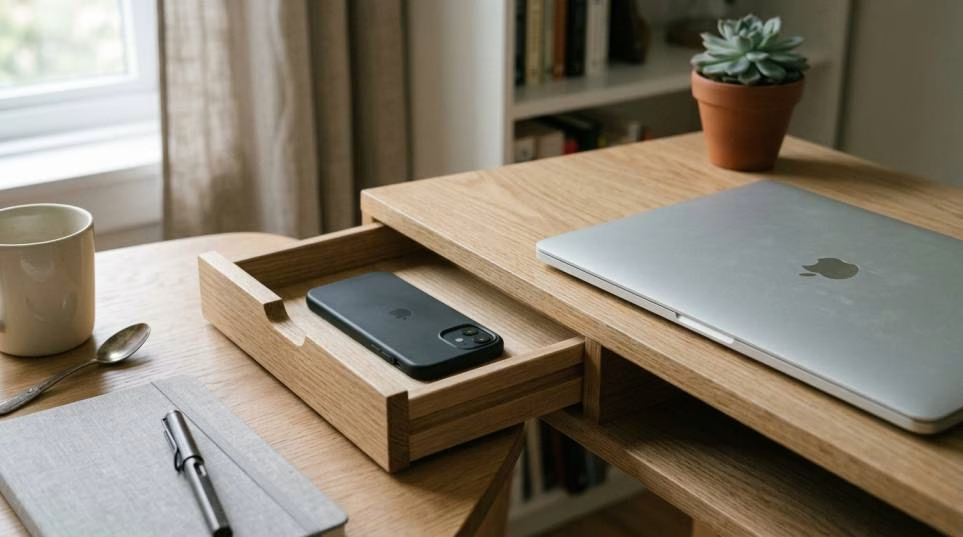
Your phone is designed, quite literally by teams of engineers, to pull your attention away from whatever you’re doing. Fighting that with willpower alone is a losing battle. You need friction instead.
Start with notifications. Turn off everything that isn’t a real emergency — that means most app badges, most email pings, most social alerts. If it’s not urgent enough to interrupt a face-to-face conversation, it’s not urgent enough to interrupt your deep work.
Then build distraction-free periods around your deep-work blocks specifically:
- Phone in another room, not just face-down
- Browser tabs limited to what the task actually needs
- Email and chat apps closed, not just minimized
Controlling social media is its own fight, since it’s built to be habit-forming by design. Time limits built into your phone help some. A dedicated blocker helps more, because it removes the decision entirely instead of relying on you to resist temptation in the moment.
Pro Tip: If you’ve tried the discipline route and it hasn’t stuck, an app like Freedom blocks distracting sites and apps across every device during set hours — turning “I’ll try not to check Instagram” into “I actually can’t.”
Habit 7: Stop Multitasking
Multitasking feels efficient. It isn’t. That’s not an opinion — it’s what the research keeps showing, and it’s worth taking seriously if you’re still juggling three tabs and calling it productivity.
Here’s the honest problem with multitasking: your brain isn’t actually doing two things at once. It’s rapidly switching between them, and each switch costs you time and mental sharpness. Answer a Slack message mid-report, and you’re not saving time — you’re paying a “switching tax” every single time you bounce back.
Single-tasking vs. multitasking, side by side:
| Single-Tasking | Multitasking | |
| Attention | Fully on one task | Split across several |
| Output quality | Higher, fewer errors | Lower, more mistakes |
| Speed (overall) | Faster to completion | Feels fast, actually slower |
| Mental fatigue | Lower | Higher |
Training yourself out of the habit takes deliberate practice, since multitasking is often a stress response as much as a work style:
- Pick one task and set a timer — 25 or 45 minutes, whatever fits the task
- When your brain wants to jump elsewhere, write the distraction down and return to it later
- Finish that timer before switching to anything else, no exceptions
Small wins here build fast. Once you feel how much more you get done in one focused hour versus a scattered one, going back to constant switching gets a lot less appealing.
Habit 8: Use a Reliable Task Management System
Here’s an uncomfortable truth: your memory is not a task manager, no matter how sharp you think it is. Relying on your brain to hold every commitment means you’re spending energy just trying not to forget things — energy that should go toward actually doing them.
To-do lists vs. task-management systems — and yes, there’s a real difference. A sticky-note list works for the day. It falls apart the moment you’re juggling multiple projects, deadlines, and recurring tasks across weeks. A proper system tracks all of that for you: due dates, priority, project context, and what’s coming next.
Choosing a system you’ll actually stick with matters more than choosing the “best” one. The most feature-rich app in the world is useless if it’s too complicated to open every day.
- Todoist — simple, fast, ideal if you want prioritized daily tasks without complexity
- Notion — flexible, good if you want tasks alongside notes, docs, and planning in one place
- ClickUp — built for teams and bigger projects with more moving parts
Pro Tip: Don’t evaluate a task manager by its feature list. Evaluate it by whether you’ll actually open it tomorrow. The simplest tool you use daily beats the most powerful one you abandon after a week.
Habit 9: Set Clear Goals
Habits without a direction are just motion. Goals are what turn “I’m staying busy” into “I’m actually getting somewhere” — they give every daily task a reason to exist.
Why goals create direction: without one, every task looks equally important, which is exactly how your day fills up with low-value work that feels productive but leads nowhere specific.
Breaking big goals into smaller actions is the part people skip, and it’s the part that matters most. “Grow the business” isn’t a task — it’s a direction. It needs to become something you can actually do this week.
A simple structure that works:
- Monthly goal — the big outcome you’re aiming for
- Weekly goals — the milestones that build toward it
- Daily goals — the specific actions you take today
A monthly goal to “launch a new product” might break into a weekly goal to “finish the landing page,” which breaks into a daily goal to “write the homepage copy.” Suddenly the big, vague thing has a next step you can start on right now.
Productivity goals work best when they’re specific and measurable — “write 1,000 words” beats “work on the book” every time, because you’ll know exactly when you’re done.
Habit 10: Break Large Tasks Into Smaller Steps
Ever stared at a huge project and felt your motivation just… evaporate? That’s not laziness. That’s your brain reacting to a task so big it doesn’t know where to start — and “I don’t know where to start” is one of the most reliable triggers for procrastination there is.
Why overwhelming tasks invite procrastination: a vague, giant task (“redesign the website”) offers no obvious entry point. Your brain avoids the discomfort of not knowing where to begin by finding something — anything — easier to do instead. Suddenly you’re reorganizing your desk instead of opening the project file.
The “next action” approach fixes this directly. Instead of asking “how do I finish this entire project,” ask “what’s the very next physical action I need to take?” Not the whole redesign — just: open the homepage file. That’s it. That’s the whole ask.
Turning a project into manageable steps:
- Write down the final outcome you want
- List every major step between here and there
- Break each step down until it’s small enough to start in under two minutes
- Do that one small thing — momentum handles the rest
Pro Tip: If a task still feels overwhelming after breaking it down, break it down again. There’s no such thing as “too small” for a first step — the goal is removing the excuse to procrastinate, not impressing anyone with how big your first move looks.
Momentum is the theme connecting the next batch of habits, too — starting with what your mornings are quietly costing or earning you.
Habit 11: Tackle Important Tasks Before Low-Value Tasks
Your energy isn’t flat across the day. It rises, peaks, and dips — and where you point that peak determines how much you actually get done.
Your best hours deserve your best work. For most people, that peak window sits somewhere in the morning, before meetings pile up and mental fatigue sets in. Spend that window on email and admin, and you’ve traded your sharpest thinking for tasks that didn’t need it.
The temptation to start easy is real, and it’s a trap. Clearing small, easy tasks first feels productive — you’re checking boxes, after all. But it’s often just procrastination wearing a productive-looking outfit. By the time you get to the task that actually matters, your peak energy is gone, and you’re tackling the hardest work with your weakest focus.
Protecting your peak hours takes intention:
- Identify when you naturally think clearest — track it for a week if you’re not sure
- Block that window (see Habit 3) for your single most important task
- Push email, meetings, and admin work to your lower-energy hours instead
This one habit alone can flip your entire day. Same hours worked, completely different results.
Habit 12: Control Email Instead of Letting Email Control You
Every time your inbox pings, part of your brain jumps to it — even if you don’t open the message. That’s not a minor annoyance. That’s a constant low-grade tax on your focus, paid all day long.
Stop checking constantly. Checking email every few minutes doesn’t make you more responsive. It makes you less productive, since it fragments every task you’re supposed to be doing into smaller, interrupted pieces.
Schedule specific windows for email instead — say, 9 a.m., 1 p.m., and 4 p.m. Outside those windows, it stays closed. Not minimized. Closed.
| Old approach | New approach |
| Check inbox constantly, all day | Check inbox 2–3 set times a day |
| Notifications on | Notifications off |
| Email open during focus work | Email closed during focus work |
| React to messages as they land | Process messages in a batch |
Separating communication from focused work protects the deep work you set up in Habit 5. Email is important. It’s also almost never urgent enough to justify constant interruption — and treating it that way is how a to-do list full of real priorities turns into a day spent reacting to other people’s requests.
Habit 13: Batch Similar Tasks Together
Every time you switch task types — not just tasks — your brain has to reload context. Writing, then a call, then data entry, then writing again means constant mental gear-shifting, and each shift costs you time you don’t get back.
Task batching solves this by grouping similar work together, so your brain stays in one mode instead of constantly resetting.
Common tasks you can batch:
- Answering emails (all at once, in your scheduled window)
- Making phone calls (back-to-back, same block)
- Social media posting or content scheduling
- Invoicing, expense tracking, or other admin work
- Meetings (clustered on specific days instead of scattered all week)
Why this actually saves mental energy: each task type uses a slightly different mode of thinking. Writing needs a different headspace than crunching numbers. Batch similar work together, and you settle into that mode once instead of forcing your brain to reload it a dozen times a day.
Pro Tip: Try “Meeting Tuesdays and Thursdays” instead of scattering calls across the week. It sounds small. It frees up entire uninterrupted days for deep work — and that difference is bigger than it looks on paper.
Habit 14: Learn to Say No
Here’s something successful people understand that gets missed constantly: every yes to something unimportant is a quiet no to something that actually matters. Your time is finite, whether you treat it that way or not.
Protecting your priorities means saying no — often, and without over-explaining yourself. Not from a place of being difficult. From a place of understanding that your time is finite and every commitment has a real cost, even the small ones.
When to actually say no:
- The meeting has no clear agenda or outcome tied to it
- The task doesn’t connect to your top priorities
- Someone else is genuinely better positioned to handle it
- You’re saying yes purely to avoid an awkward conversation
How this creates more time, practically: every no you give frees up real space for a yes to something that matters more. Decline three low-value meetings this week, and you’ve just recovered hours for the high-impact work sitting in Habit 1’s priority list.
Saying no gets easier with practice, and easier still once you see the actual time it hands back to you. It’s one of the most underrated productivity habits on this entire list — precisely because it doesn’t feel like productivity. It just quietly protects the time everything else on this list needs to work.
Habit 15: Delegate What Doesn’t Require Your Attention
Not everything on your plate needs to be there. Some of it just landed there because nobody moved it off yet.
What should you actually delegate? Anything that doesn’t need your specific expertise, judgment, or signature. Scheduling, data entry, first-draft formatting, routine follow-ups — tasks where someone else can do it at 80% of your quality in a fraction of your time.
Delegation vs. avoidance is worth being honest about. Delegating a task you don’t want to think through is avoidance wearing a nicer outfit. Delegating a task that genuinely doesn’t require your specific skills is leverage. The difference is whether the task needs you, specifically, or just needs to get done.
How delegation creates real leverage:
- Frees your peak hours (Habit 11) for work only you can do
- Builds capability in the people around you, whether that’s a team member or a hired freelancer
- Multiplies your output without multiplying your hours
You don’t need a team of twenty to start. Even outsourcing one recurring task — bookkeeping, scheduling, social media posting — hands back hours every single week.
Habit 16: Beat Procrastination With the Two-Minute Start
Starting is almost always harder than finishing. Once you’re moving, momentum carries you. It’s that first step that stalls people out.
Make the first step so easy it’s almost silly. Not “write the report” — that’s a wall. Instead: “open the document and write one sentence.” Two minutes, tops. Your brain resists big, undefined tasks. It rarely resists something this small.
Momentum does the rest of the work. Once you’ve written that one sentence, stopping usually feels harder than continuing. That’s not a coincidence — it’s a known pattern: starting is the hard part, and a task in motion tends to stay in motion.
- Pick the smallest possible entry point into the task
- Set a timer for two minutes and commit to nothing beyond that
- Notice how often you keep going once you’ve started
This is one of the most reliable ways to overcome procrastination, precisely because it doesn’t rely on motivation showing up first. It just needs you to start.
Habit 17: Take Strategic Breaks
Working nonstop feels productive. It isn’t, past a certain point — your focus degrades well before your energy fully runs out, and pushing through anyway just means lower-quality output for longer stretches.
Recovery isn’t the opposite of productivity. It’s part of it. A short, real break — walk away from the screen, stretch, get outside for five minutes — restores the focus that continuous work slowly drains.

The Pomodoro technique is one of the simplest ways to build this in:
| Cycle | Duration |
| Focused work | 25 minutes |
| Short break | 5 minutes |
| After 4 cycles | 15–30 minute break |
Twenty-five minutes is short enough to stay sharp the whole way through, and the break resets you before fatigue sets in.
Pro Tip: A physical timer — something like the TickTime Pomodoro Timer Cube — removes the temptation to “just check” your phone when your timer app is sitting on the same screen you’re trying to avoid.
Habit 18: Protect Your Sleep
No productivity habit on this list survives consistent sleep deprivation. None. Sleep isn’t a nice-to-have around your work — it’s the foundation the rest of this list sits on.
Sleep and concentration are directly linked. Cut sleep short, and your attention span, decision-making, and memory all take a measurable hit the next day — even if you don’t feel tired in the moment.
Building a consistent sleep routine:
- Go to bed and wake up at roughly the same time, weekends included
- Cut screens 30–60 minutes before bed if you can manage it
- Keep your room cool, dark, and quiet
Consistency matters more than any single “perfect” night. A predictable schedule trains your body to expect rest at the same time, which makes falling — and staying — asleep considerably easier.

Habit 19: Exercise Regularly
Movement and mental output are more connected than most people give them credit for. Exercise doesn’t just build fitness. It builds the energy and clarity your work actually runs on.
The connection between physical activity and productivity is well documented — regular movement improves mood, sharpens focus, and measurably reduces stress, all of which feed directly into better work.
Simple ways to build movement in without overhauling your life:
- A 10-minute walk between focus blocks
- Stretch breaks during long meetings or calls
- A short workout before your day starts, even 15–20 minutes
You don’t need an hour at the gym to feel the difference. Consistency here beats intensity — a short walk every day outperforms an occasional hard workout you can’t sustain.
Habit 20: Keep a Clean and Functional Workspace
Your environment shapes your focus more than you probably give it credit for. A cluttered desk isn’t just messy — it’s a constant low-level distraction, quietly competing with your work for attention.
Reducing visual clutter means clearing anything that isn’t part of the task in front of you. Stray papers, old coffee cups, browser tabs from three projects ago — all of it pulls a sliver of attention you didn’t mean to spend.
Building a workspace that supports deep work:
- Clear your desk at the end of each day, not the start
- Keep only current-project materials within reach
- Set up good lighting and a comfortable chair — discomfort is its own distraction
Pro Tip: If your back and shoulders are part of what’s breaking your focus by mid-afternoon, a FLEXISPOT standing desk lets you shift position without leaving your workspace — small movement, sustained focus.
Habit 21: Continuously Learn and Improve
Successful people rarely treat their skills as finished. They keep sharpening them — quietly, consistently, long after they’ve already “made it.”
Why does this matter for productivity, specifically? Because better skills mean the same task takes less time and produces better results. Learning isn’t separate from productivity. It’s a multiplier on everything else on this list.
Learning shows up in a few different forms:
- Reading — books, industry articles, case studies in your field
- Courses — structured skill-building, especially for tools you use daily
- Experimentation — trying a new method and seeing if it actually works better
- Reflection — genuinely thinking about what you did well and what fell flat
Turning this into a daily habit doesn’t require hours. Fifteen minutes of reading before bed, one podcast episode during your commute, one new tool tested per month — small, repeated inputs compound into real skill over a year in a way one weekend course never will.
Habit 22: Review Your Progress Regularly
Without a regular check-in, you can work hard for months and have no real sense of whether it’s actually working. A weekly review fixes that — and it takes less time than most people assume.
The weekly productivity review is a short, honest look back at the past seven days. Fifteen to twenty minutes, same time each week, three questions:
| Question | What you’re looking for |
| What worked? | Habits or approaches worth repeating |
| What wasted time? | Low-value work that snuck onto your calendar |
| What should change next week? | One specific adjustment, not five vague ones |
Keep it specific. “I got distracted a lot” isn’t useful. “I checked email during my morning focus block three times” is — because now you know exactly what to fix.
This single habit turns your calendar into a feedback loop instead of just a record of what happened. Every week gets a little sharper than the last.
Habit 23: Measure Where Your Time Goes
Most people are confident about how they spend their time. Most people are also wrong. Not lying — just genuinely unaware of where the hours actually go, because time has a way of quietly evaporating into things that never made the to-do list.
Why time tracking matters: you can’t fix what you can’t see. Track a normal week honestly, and you’ll almost certainly find at least one time drain you didn’t know was there — a Slack channel eating 40 minutes a day, a “quick check” of email that’s really eight separate checks.
Identifying hidden time drains usually surfaces a few repeat offenders:
- Meetings that could’ve been an email
- Constant app-switching (see Habit 7)
- Social media “just checking” that turns into 20 minutes
- Low-value admin work that quietly eats your peak hours
Using the data to actually improve your schedule is the whole point — tracking for its own sake changes nothing. Once you see the pattern, you can time-block around it, delegate it, or just cut it outright.
Pro Tip: Toggl Track runs quietly in the background and shows you exactly where your day went, with zero manual logging required. Most people are surprised — sometimes uncomfortably — by what the data actually shows.
Habit 24: Automate Repetitive Work
If you’re doing the exact same task the exact same way every single week, that’s not a habit you need discipline for. That’s a task a piece of software could probably do for you.
Start by identifying what’s repetitive: invoicing, scheduling, data entry, social media posting, routine follow-up emails. Anything with a predictable, repeatable pattern is a strong automation candidate.
Using technology and AI strategically is where this gets genuinely useful right now. AI tools can draft routine emails, summarize long documents, and handle scheduling logistics that used to eat real chunks of your day. This is exactly the space current productivity roundups keep circling back to, and it’s worth paying attention to.
Automation vs. unnecessary complexity, though — worth a real caution here. Automating a task that only happens once a year isn’t worth the setup time. Automating something you repeat weekly almost always is. The rule of thumb: if it’s repetitive, predictable, and time-consuming, automate it. If it’s rare or requires real judgment, leave it alone.
Pro Tip: Zapier connects the apps you already use so repetitive handoffs — say, a new form submission automatically creating a task — happen without you touching them.
Habit 25: Prepare for Tomorrow
We’re ending where a lot of this started: the evening. How you close today quietly determines how tomorrow opens.
A proper shutdown routine signals to your brain that work is actually done — not paused, not “I’ll just check one more thing,” but genuinely finished for the day.
Three things worth doing before you log off:
- Clear your workspace — physical desk, open tabs, loose notes. A clean stopping point makes tomorrow’s start easier.
- Review unfinished tasks — what’s still open, and does it actually need to move to tomorrow, or was it never that important to begin with?
- Decide tomorrow’s priorities — this is Habit 2, in practice, every single day.
Closing the loop this way means you’re not carrying today’s loose ends into tonight, and you’re not opening tomorrow with a blank page and a headache. You already know where to start.
Twenty-five habits, one simple idea underneath all of them: successful people aren’t working harder than everyone else. They’ve just built systems that make the right choice the easy one, day after day — and that’s a habit anyone can start building today.
How to Build These Productivity Habits That Actually Last
Reading a list of 25 habits and trying to install all of them Monday morning is a great way to burn out by Wednesday. That’s not how lasting change actually works, and it’s worth saying plainly before you close this tab and try anyway.
Don’t try to change everything at once.
Twenty-five new habits competing for your willpower at the same time means none of them get enough attention to actually stick. Pick two or three. That’s it. The rest can wait.
Start with one keystone habit
— the one that tends to pull others along with it once it’s in place:
- Daily planning (Habit 2) — once you’re planning, prioritizing gets easier automatically
- Time blocking (Habit 3) — protects everything else you’re trying to build
- Eliminating distractions (Habit 6) — clears the space every other habit needs
- Consistent sleep (Habit 18) — without this, none of the others hold up for long
Pick the one that addresses your biggest current bottleneck, not the one that sounds most impressive.
Make the habit easy to repeat. This is where most habit-building attempts quietly fail — not from lack of motivation, but from making the habit harder than it needs to be.
- Start smaller than feels necessary. A five-minute evening plan beats an ambitious hour-long weekly ritual you’ll skip by week two.
- Use environmental cues. Leave your planner on your keyboard. Put your workout clothes by the bed. Make the habit the obvious next move, not a decision you have to remember to make.
- Stack it onto something you already do. Plan tomorrow right after you close your laptop. Review your priorities right after your morning coffee. Attach the new habit to an existing routine instead of starting from nothing.
Track your progress, even simply. A calendar with an X for each day you followed through. A five-minute journal entry. A habit-tracking app if you like data. The method matters less than the fact that you’re actually watching it happen.
Focus on consistency, not perfection. Missing one day isn’t failure — it’s just a Tuesday. Abandoning the habit entirely because you missed a Tuesday, that’s the actual problem. Successful people miss days too. The difference is they pick the habit back up the next morning instead of writing off the whole system.
Productivity Tools That Can Help You Work Smarter
Let’s be clear about something before this section goes any further: no app on this list makes you productive. They make productive habits easier to sustain once you’ve already decided to build them. Tool first, habit second, and you’ll abandon both within a month.
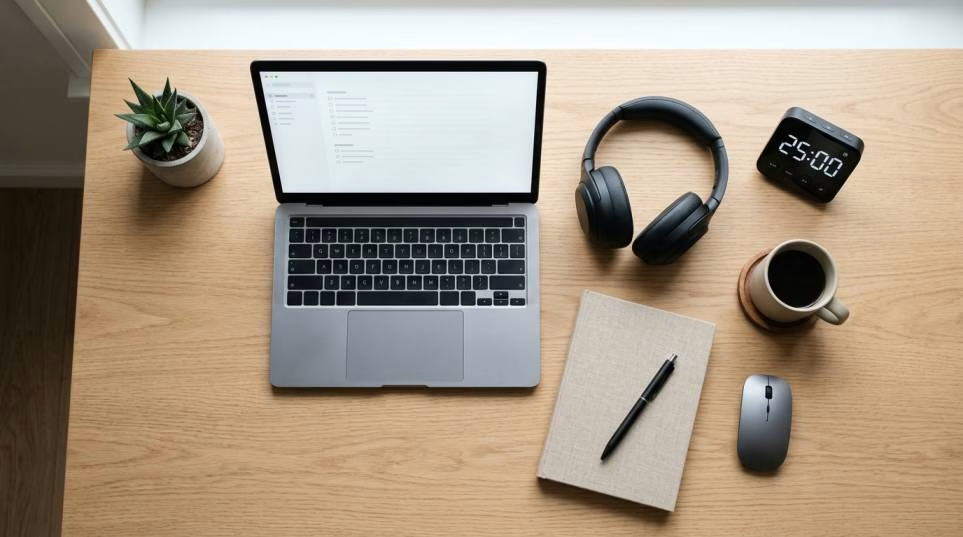
Best productivity apps for daily planning and task management:
| Tool | Best for |
| Todoist | Simple, prioritized daily task lists |
| Notion | Tasks, notes, and planning in one flexible space |
| ClickUp | Bigger projects with multiple moving parts |
| Sunsama | Daily planning pulled straight from your calendar |
| Motion | AI-driven scheduling that adapts as your day shifts |
| Reclaim | Automatically protecting focus-time blocks |
| Toggl Track | Seeing exactly where your time actually goes |
Best tools for eliminating distractions:
- Freedom — blocks distracting sites and apps across every device
- Built-in focus modes on your phone — a free starting point if you’re not ready to commit to an app
- Website blockers for your browser specifically, useful if your biggest drain is desktop, not mobile
Best productivity hardware, for the habits that live outside your screen:
- Noise-cancelling headphones (Habit 5) — manufacture quiet in a loud environment
- Digital notebooks — for people who think better with a pen but still want things organized digitally
- Focus timers — a physical Pomodoro cube removes the temptation to “just check” your phone
- Standing desks — support the movement your body needs during long focus blocks
The editorial point worth repeating: you don’t need a single one of these to become productive. Plenty of highly productive people run their entire system on a notebook and a calendar. Build the habit first. Bring in a tool only when it’s genuinely solving a specific problem you’re already running into — not because the app looked impressive in a roundup somewhere.
Common Productivity Mistakes That Successful People Avoid
Knowing what to do only gets you halfway there. The other half is knowing what quietly undoes all of it.
Trying to do everything. More tasks on your plate doesn’t mean more gets accomplished — it usually means everything gets a smaller, weaker slice of your attention. Successful people say no to plenty (Habit 14) precisely so the things they do say yes to get done properly.
Constantly checking email and messages. This is reactive work disguised as responsiveness. Every ping answered immediately trains you — and everyone around you — to expect instant replies, which keeps you perpetually one notification away from losing focus. Intentional work happens in blocks. Reactive work happens in fragments.
Multitasking. Worth repeating one more time: switching between tasks costs you real time and real quality, even though it feels efficient in the moment. The hidden cost isn’t just the switch itself — it’s the 20-plus minutes it can take to fully refocus afterward.
Working longer instead of working better.
More hours logged isn’t automatically more output produced. Past a certain point, extra hours just mean lower-quality work stretched over a longer day — the same problems Habit 17’s strategic breaks exist to prevent.
Using too many productivity systems at once. Ironically, productivity tools can become their own distraction. Three task managers, two calendars, and a notes app you never open isn’t a system — it’s clutter with better branding. Pick one system per function and actually commit to it.
Skipping rest and recovery. Productivity without recovery isn’t sustainable productivity — it’s a countdown to burnout. Sleep (Habit 18), breaks (Habit 17), and exercise (Habit 19) aren’t rewards for good work. They’re what makes good work possible in the first place.
Avoid these six, and the 25 habits above have a real shot at sticking — not just for a motivated week, but for good.

Frequently Asked Questions About Productivity Habits
What are the best productivity habits of successful people?
Daily planning, time blocking, deep work, eliminating distractions, and protecting sleep top the list consistently. None of them are complicated. They’re just applied every single day instead of occasionally.
What do highly successful people do every day?
They prioritize before reacting. Most start the day knowing their top 1–3 tasks already, protect focused time on their calendar, and close the day by prepping for tomorrow — the same loop, repeated daily.
How can I become more productive every day?
Start small. Pick one habit — daily planning works well as a first move — and repeat it consistently for a few weeks before adding a second. Productivity builds through repetition, not a single big overhaul.
What habits help successful people manage their time?
Time blocking, batching similar tasks, and tracking where time actually goes. Together, these turn a vague sense of “I’m busy” into a clear, visible picture of where the hours are really going.
How do successful people prioritize their tasks?
Most separate urgent from important and deliberately protect time for important-but-not-urgent work — the category that gets skipped by default unless you plan for it.
What is the most important productivity habit?
If forced to pick one: daily planning. It’s the habit that makes prioritizing, time blocking, and avoiding distractions all easier, because you’ve already decided what matters before the day starts pulling you elsewhere.
How do successful people avoid procrastination?
They shrink the first step until it’s almost impossible to avoid — “write one sentence” instead of “finish the report.” Starting small breaks the resistance that a big, vague task creates.
What morning habits make people more productive?
Reviewing top priorities, avoiding email as the first task of the day, and protecting the first focused hours for the work that actually matters most.
How do successful people stay focused at work?
They block distraction-free time, silence unnecessary notifications, and work in single-task sessions rather than juggling several things loosely at once.
Is multitasking bad for productivity?
Generally, yes. What feels like multitasking is usually rapid task-switching, and each switch costs focus and time you don’t get back. Single-tasking consistently produces better results, faster.
How does time blocking improve productivity?
It protects important work the same way a meeting protects your calendar. Once a task has a dedicated slot, it’s far less likely to get pushed aside by whatever feels urgent in the moment.
How can I build productive habits that last?
Start with one keystone habit, keep it small enough to repeat easily, and track it. Consistency matters more than intensity — showing up most days beats a perfect week followed by total abandonment.
How do successful people avoid burnout?
By treating rest as part of the system, not a break from it. Sleep, strategic breaks, and exercise aren’t rewards for good work — they’re what keeps the whole system running.
What productivity tools do successful people use?
Task managers like Todoist or Notion, time trackers like Toggl Track, and focus tools like Freedom show up often. But the tool always follows the habit — never the other way around.
Conclusion: Work Smarter, Not Harder
Here’s what all 25 of these habits really come down to: successful people aren’t productive because they work constantly. They’re productive because they protect their time, prioritize what actually matters, eliminate distractions on purpose, build routines they can repeat without relying on motivation, and keep refining the system as they go.
That’s it. That’s the whole secret — and it was never really a secret at all. It’s just less exciting than “hustle harder,” so it doesn’t get repeated nearly as often.
You don’t need all 25 habits starting tomorrow. Pick three. Maybe daily planning, time blocking, and protecting your sleep. Commit to those three for the next 30 days before you add anything else. Thirty days is long enough to feel the difference and short enough that it doesn’t feel like a life sentence.
You don’t need to completely redesign your life to become more productive. You need one better decision, one better routine, and one better use of your time — repeated, day after day, until it stops feeling like effort and starts feeling like who you are.
That’s really the whole idea behind working smarter instead of harder.
I’d genuinely like to know: which of these 25 habits are you already doing, and which one are you planning to start with? Drop it in the comments below — I read them, and I’d love to hear how it goes.
And if this gave you something useful, save it for the next time your to-do list gets away from you, and pass it along to someone who could use the reminder too.