

How to Stop Procrastinating: 15 Proven Ways to Overcome Procrastination for Good
You know exactly what you need to do. The deadline’s not a mystery. You’ve got the time. And yet here you are, refreshing your email, hunting for keys you don’t need yet, or promising you’ll start “right after this coffee.” That’s the loop that brings most people here, trying to figure out how to stop procrastinating once and for all.
This isn’t about laziness. Real procrastination kicks in when a task feels hard, boring, unclear, or just too big to face, and avoidance beats discomfort. You reach for anything else, and for a few minutes, it actually WORKS. Then the guilt shows up, and the task is still there, dread stapled on top. Putting things off doesn’t erase the work — it just adds interest to the debt. And the fact you’re still here, looking for answers, already puts you ahead of most people who’ve given up.
Below are 15 proven, practical ways to overcome procrastination — the kind you can use today, not someday. Some take two minutes. Others reshape your whole day. They work whether you’re stalling on a work project, a workout, or an email you’ve been dodging for a week. You don’t need to feel ready. You just need to start.
What Is Procrastination and Why Does It Happen?
Procrastination isn’t a character flaw. It’s a coping mechanism — your brain trying to dodge something uncomfortable, even though the dodge makes life harder later. Once you get why it happens, it stops feeling shameful and starts feeling fixable.
Procrastination vs. Laziness
These two get lumped together constantly, but they’re not the same thing.
- Laziness means you don’t want to do the work. No urgency, no guilt.
- Procrastination means you do want to do the work — you just keep avoiding it, and it eats at you the whole time.
That’s why some of the most capable, hardworking people you know are chronic procrastinators. They’re not short on effort. They’re avoiding the discomfort a task stirs up, not the task itself.
Pro Tip: If you feel guilty about not starting, that guilt is proof it’s procrastination, not laziness. Lazy people don’t feel guilty.
The Psychology Behind Procrastination
Procrastination psychology comes down to a handful of repeat offenders:
| Trigger | What It Looks Like |
| Fear of failure | “What if I try and it’s not good enough?” |
| Perfectionism | Waiting for the “right” conditions to start |
| Overwhelm | The task feels too big to even approach |
| Low motivation | No urge, so no action |
| Instant gratification | Scrolling feels better right now than working |
| Unclear priorities | Too many tasks, no clear starting point |
Notice none of these is “you’re not trying hard enough.” They’re all about managing discomfort, not character.
Pro Tip: If instant gratification is your main trigger, environment beats willpower. Put the phone in another room instead of face-down on the desk — removing the temptation works better than resisting it.
The Procrastination Cycle
Procrastination isn’t one bad moment. It’s a loop:
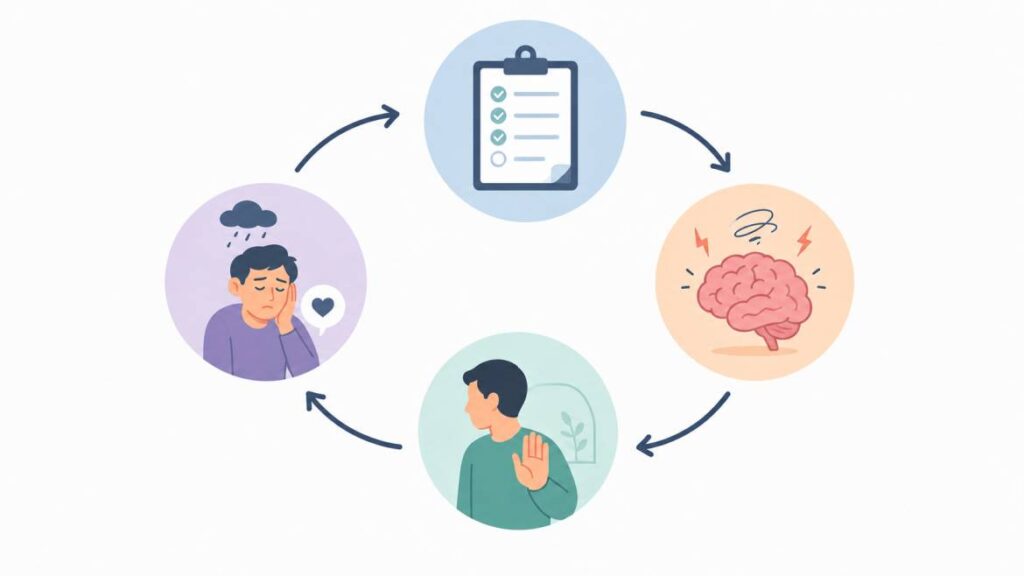
Task → discomfort → avoidance → temporary relief → guilt/stress → more avoidance
You feel discomfort, so you avoid the task. Avoidance brings quick relief — which is exactly why it works so well. But guilt shows up right behind it, and that stress makes the next attempt even harder. Break one link in that chain, and the whole cycle loses its grip.
Why Do I Procrastinate So Much?
If you’ve asked yourself this at 11pm while staring at an unfinished task, you’re not alone. Here’s what’s usually going on underneath.
You Feel Overwhelmed
When a project feels like a mountain, your brain would rather do nothing than risk picking the wrong first step. Learning how to stop procrastinating when overwhelmed starts with shrinking the mountain — pick one visible task and ignore the rest for now.
Pro Tip: Write down every task swirling in your head, then circle just one. A weekly planner (the Clever Fox Weekly Planner is a solid option) turns the swirl into a short, visible list.
The Task Feels Too Difficult
Difficult tasks trigger the same avoidance response as scary ones. If you’re wondering how to stop procrastinating on difficult tasks, break the task down until the first step feels almost too easy to skip.
You Are Waiting for Motivation
Motivation shows up after you start, not before. Procrastination and motivation have a backwards relationship — action creates the feeling, not the other way around. Waiting for it to strike first just means waiting indefinitely.
You Want Everything to Be Perfect
Procrastination and perfectionism go hand in hand. If “good enough” feels unacceptable, starting feels risky — so you don’t. Done beats perfect, every time.
You Have Too Many Distractions
Phone notifications, group chats, and “quick” social media checks are built to steal your attention — that’s their entire business model. The usual suspects:
- Push notifications
- Group chats and Slack pings
- “Just checking” social media habits
- Too many open browser tabs
- Unnecessary email refreshing
Every one of these is a tiny invitation to avoid what actually matters.
Now that you know why procrastination happens, it’s time for the part you came here for — 15 strategies that actually get you moving.
How to Stop Procrastinating: 15 Proven Strategies
You know why procrastination happens. Now let’s fix it. These 15 strategies aren’t theory — they’re the exact moves that get people unstuck, starting with the smallest one first.
1. Start With the Two-Minute Rule
Big tasks feel heavy before you even touch them. That heaviness is resistance, and resistance drops fast once you’re actually moving.
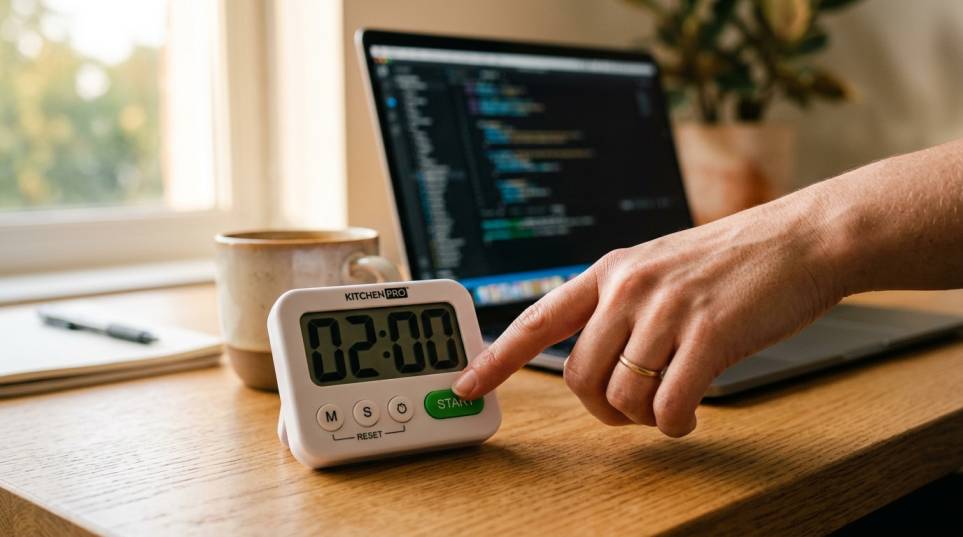
Here’s the rule: commit to just two minutes. Open the document. Write one sentence. Do one push-up. Nothing more.
Two minutes sounds too small to matter, and that’s exactly the point — it’s too small for your brain to fight. Most of the time, once you start, you keep going past the two-minute mark without noticing.
Pro Tip: If you’re wondering how to start tasks you don’t want to do, stop asking yourself to “finish” them. Ask yourself to start them for 120 seconds. That’s it.
2. Break Large Tasks Into Smaller Steps
Big projects stall because your brain can’t grab onto “big.” It needs something small enough to hold.
Say you need to write a business plan. As one task, it’s overwhelming. Broken down, it looks like this:
- Research your target market
- Draft your executive summary
- List startup costs
- Outline your marketing plan
- Write your financial projections
- Get feedback from one trusted person
- Revise section by section
- Format the final document
Eight manageable steps instead of one intimidating blob. Learning how to stop procrastinating on big projects usually just means learning how to slice them properly.
Pro Tip: If a step still feels big, break it again. Keep splitting until the next action takes less than 20 minutes.
3. Choose Your Most Important Task First
Not all tasks deserve equal attention first thing in the day. Some just carry more weight.
Brian Tracy built an entire book around this idea — Eat That Frog! The “frog” is your hardest, most important task. Eat it first, before your willpower runs thin and your inbox starts pulling you in ten directions.
Do your frog task before checking email. Before meetings. Before anything optional. Everything after that feels lighter by comparison.
This is one of the simplest productivity tips out there, and one of the most underused. If you’re serious about learning how to get things done, this single habit will outperform most productivity apps you’ll ever download.
4. Set a Specific Deadline
“I’ll do it soon” isn’t a deadline. It’s a wish. Your brain doesn’t act on wishes.
Compare these two:
| Vague Commitment | Specific Deadline |
| “I’ll finish it soon” | “I’ll finish it by 3pm Thursday” |
| “I’ll get to it this week” | “I’ll get to it Tuesday morning” |
| “Eventually” | “By end of day, no exceptions” |
A specific date and time gives your brain a target to organize around. Vague timing gives it nothing to hold onto, so the task just floats — which is exactly how to stop delaying tasks turns into how to stop putting things off for weeks.
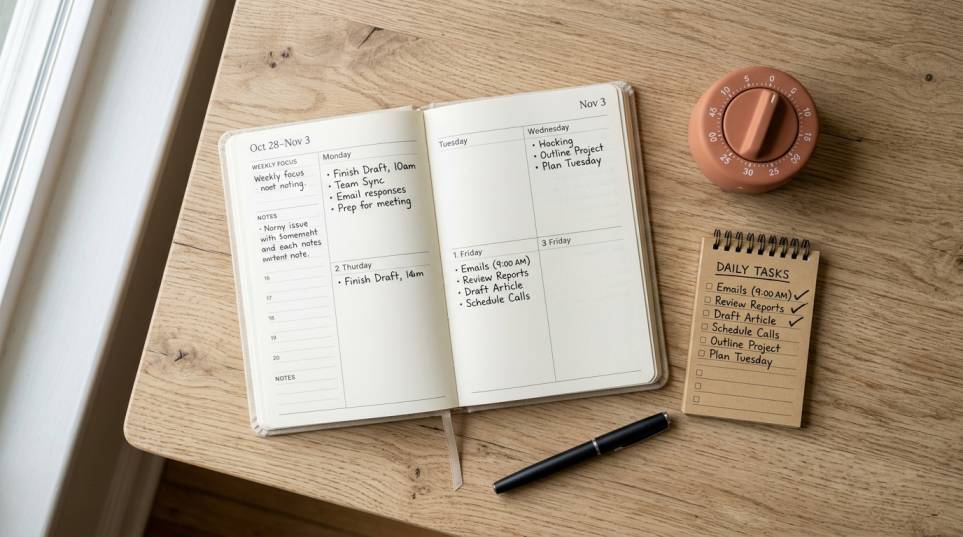
5. Use Time Blocking
An open-ended to-do list is easy to ignore. A calendar block isn’t.
Time blocking means assigning your task to a specific slot — “9:00 to 10:30, write the report” — instead of leaving it to float somewhere in “today.” When the clock hits 9:00, you already know exactly what to do and where to start.
This is one of the most reliable time management tips going, mainly because it removes decisions. You’re not asking “what should I work on now?” fifteen times a day. You already decided, in advance, when your energy was higher.
Pro Tip: Block time for your hardest task, not your easiest one. Save the easy stuff for your low-energy hours.
6. Try the Pomodoro Technique

Long, undefined work sessions feel exhausting before they even start. Short ones don’t.
The Pomodoro Technique breaks work into 25-minute focused sprints, followed by a 5-minute break. After four sprints, take a longer break — 15 to 30 minutes.
It works because it removes the “how long will this take” dread. You’re not committing to hours. You’re committing to 25 minutes, and everyone can find 25 minutes.
If you’re after ways how to improve focus or how to stay focused, this method is one of the most researched productivity tips available. A simple kitchen timer works fine, or a dedicated Pomodoro timer if you want something built for the job.
7. Remove Your Biggest Distractions
You can have all the motivation in the world and still lose the fight if your phone is buzzing every four minutes.
The usual suspects:
- Phone notifications — turn them off during focus blocks, not just silence them
- Social media — log out, don’t just close the tab
- Unnecessary browser tabs — close everything unrelated to the task
- Email interruptions — check it at set times, not constantly
None of these require willpower. They require removing the temptation before it shows up. That’s the real secret behind how to stop wasting time — most wasted time isn’t a discipline problem, it’s an environment problem.
8. Stop Waiting for Motivation
Here’s something that surprises most people: motivation usually shows up after you start, not before.
You’ve been taught the order runs motivation → action. It’s backwards. Action creates momentum, and momentum creates motivation. Waiting to “feel like it” before starting is why procrastination and motivation seem so tangled — you’re waiting on a feeling that only arrives once you’re already moving.
Stop waiting. Start small, and let the motivation catch up.
9. Use the “Just Start” Method
When you genuinely don’t know how to begin, complexity is usually the problem. Simplify it down to almost nothing.
Count down from 5. Open the file. Complete one tiny action.
That’s the whole method. No planning, no perfect setup, no “right mood.” You count, you open, you do one small thing. By the time you’ve done that one thing, starting the next one is easier.
This is one of the fastest answers to how to stop procrastinating right now — it skips every mental negotiation and gets you moving in under 10 seconds.
10. Lower the Standard From Perfect to Done
Perfectionism doesn’t push you toward better work. It usually just delays the work entirely.
Procrastination and perfectionism feed each other: you wait for the perfect moment, the perfect first sentence, the perfect plan — and none of those exist. Meanwhile, the task sits untouched.
Lower the bar on purpose. Aim for “done and decent” instead of “flawless.” You can always revise a finished draft. You can’t revise a blank page.
11. Create Accountability
Left alone, deadlines are easy to bend. Deadlines shared with another person are much harder to ignore.
Build accountability with:
- An accountability partner
- Your manager
- A friend who checks in
- A study partner
- A weekly progress report
Knowing someone else is expecting an update changes your behavior, even if they never say a word about it. This is one of the most effective ways how to break the procrastination habit, because it adds social weight to a task that previously only existed inside your own head.
Pro Tip: Pick someone who’ll actually follow up, not someone who’ll just nod and forget. The accountability only works if it’s real.
12. Track Your Progress
What gets tracked gets done. It’s a cliché because it’s true.
Options that work well:
- A daily checklist
- A dedicated habit tracker
- A weekly review session
- A simple completed-task count
Seeing your progress stacking up — even in small amounts — reinforces the habit and shows you it’s working. A weekly planner like the Clever Fox Weekly Planner or a daily planner built around this exact loop makes tracking almost automatic instead of one more thing to remember.
Consistent tracking is how productive habits actually stick, and it’s one of the most overlooked ways how to become more disciplined without relying on raw willpower.
13. Reward Progress
Discipline runs better with a little fuel. Small rewards, tied to real progress, keep you moving without turning into a new distraction.
Finish a focused block? Take a proper coffee break. Hit a milestone? Watch one episode, guilt-free. The reward has to be smaller than the task and it has to come after, not before.
This is a simple productivity tip, but it works because it makes progress feel good in the moment, not just in some distant “someday” payoff — which is ultimately what learning how to overcome procrastination comes down to.
14. Build a Routine That Reduces Decisions
Every decision you make during the day drains a little bit of mental energy. By 4pm, you’ve got less left than you did at 8am — which is exactly when procrastination sneaks back in.
Reduce the number of decisions with:
- Consistent work hours
- A set morning routine
- Evening preparation for tomorrow
- Scheduled deep-work periods, same time daily
Atomic Habits by James Clear covers this idea well — habits stick when they require less decision-making, not more willpower. Routine removes the “should I start now or later” question entirely, which is a big part of how to build discipline that actually lasts.
Pro Tip: Protect one deep-work block on your calendar like it’s a client meeting. Don’t let anything move it.
15. Make Starting Easier Tomorrow
The easiest way to beat tomorrow’s procrastination is to prepare for it today.
Before you close your laptop, decide what the very first task of tomorrow will be. Open the file. Leave a note. Set the coffee maker. Anything that removes friction between waking up and starting.
This one habit is often the difference between people who eventually figure out how to stop procrastinating for good and people who keep restarting from zero every single day.
Quick Reference: 15 Strategies at a Glance
| # | Strategy | Best For |
| 1 | Two-Minute Rule | Starting instantly |
| 2 | Break Tasks Into Steps | Big, overwhelming projects |
| 3 | Eat the Frog First | Daily prioritization |
| 4 | Specific Deadlines | Vague, floating tasks |
| 5 | Time Blocking | Structuring your day |
| 6 | Pomodoro Technique | Staying focused |
| 7 | Remove Distractions | Phone/social media habits |
| 8 | Stop Waiting for Motivation | Low-energy days |
| 9 | Just Start Method | Total mental blocks |
| 10 | Perfect to Done | Perfectionism |
| 11 | Create Accountability | Long-term follow-through |
| 12 | Track Progress | Building momentum |
| 13 | Reward Progress | Sustaining effort |
| 14 | Reduce Daily Decisions | Long-term discipline |
| 15 | Prepare Tomorrow Tonight | Breaking the cycle for good |
You don’t need to use all 15 at once. Pick two or three that match where you’re stuck right now, and build from there.

How to Stop Procrastinating at Work
Work procrastination has its own flavor. It’s not just about motivation — it’s meetings, Slack pings, and a to-do list that never actually shrinks. Here’s how to handle it.
Prioritize the Three Most Important Tasks
Trying to tackle everything on your plate guarantees you’ll finish nothing properly. Pick your top three tasks each morning, before your inbox has a say in the matter.
Everything else is secondary. If it doesn’t make the top three, it waits.
Pro Tip: Write your three tasks down the night before. Deciding at 8am, half-awake, rarely produces your best list.
Reduce Email and Chat Interruptions
Every ping pulls your attention off the task in front of you — and getting back to full focus after an interruption takes longer than most people realize.
Set specific check-in times instead of leaving notifications on all day:
- Check email at three set times (morning, midday, end of day)
- Mute non-urgent Slack or Teams channels during focus blocks
- Turn off badge notifications on your phone during work hours
This is one of the simplest productivity tips for anyone learning how to overcome procrastination at work, mainly because it costs nothing and takes two minutes to set up.
Break Large Work Projects Into Milestones
A quarterly project feels abstract until you attach dates to it. Milestones turn “finish by Q3” into something you can actually act on this week.
| Project Stage | Milestone Example |
| Research | Complete by Week 1 |
| First draft | Complete by Week 3 |
| Stakeholder review | Complete by Week 5 |
| Final revisions | Complete by Week 6 |
| Delivery | Complete by Week 7 |
Each milestone becomes its own small deadline, so the whole project stops living entirely in “someday.”
Use Calendar Time Blocking
The same time-blocking principle from earlier applies here, with one addition: block it on your shared calendar, not just a personal notepad.
A blocked calendar slot signals to coworkers that you’re unavailable, which cuts down on the “got a sec?” interruptions that quietly eat your morning. It’s one of the more underused time management tips inside most workplaces.
Create Accountability With Deadlines
Internal deadlines you set for yourself are easy to move. Deadlines tied to someone else are not.
Loop in your manager or a teammate on your timeline. A quick “I’ll have this to you by Thursday” does more to keep you on track than any productivity app. Knowing someone’s expecting the update is often the real answer behind how to stop procrastinating at work — accountability, not willpower.
How to Stop Procrastinating When Everything Feels Like Too Much

Overwhelm doesn’t respond to the same fixes as ordinary procrastination. When everything feels urgent at once, you need to shrink your focus first — not push harder.
Stop Looking at the Entire Project
Staring at the whole mountain is what freezes you in the first place. Look away from it. Focus only on the next action — not the next ten, just the next one.
Write Everything Down
Your brain isn’t built to hold ten unfinished tasks in working memory. It just cycles through them, over and over, which feels like productivity but isn’t.
Get it all out of your head and onto paper. A notebook, a notes app, a weekly planner — it doesn’t matter which. What matters is offloading the mental clutter so your brain can stop rehearsing it.
Pro Tip: Once it’s written down, your brain treats it as “captured” and stops nagging you about it — that alone often lowers the overwhelm before you’ve done a single task.
Pick One Priority
Trying to solve everything simultaneously guarantees you solve nothing. From your written list, circle one thing. Just one. Everything else can wait its turn.
Give Yourself a Short Starting Window
Don’t commit to finishing. Commit to five or ten minutes. That’s enough to build momentum without triggering the “this is too big” response that caused the freeze in the first place.
Small starting windows are one of the fastest ways how to stop procrastinating when overwhelmed — momentum, once it starts, tends to keep going on its own.
How to Stop Procrastinating for Good
Everything so far handles procrastination in the moment. This section is about making it stop coming back.
Replace Motivation With Systems
Motivation is unreliable — it shows up some days and disappears on others. Systems don’t care how you feel. A system runs on autopilot: same time, same routine, same next step, whether you’re inspired or not.
Atomic Habits by James Clear is worth a read here — the whole premise is that systems beat goals, because goals only matter on the day you hit them, while systems shape what you do every day in between.
Build Consistent Daily Habits
Small, repeated habits are how to stop procrastinating for good actually gets built, one ordinary day at a time. Pick one or two from earlier — the two-minute rule, time blocking, tracking progress — and repeat them daily until they stop requiring effort.
Make Distractions Harder to Access
Willpower fades by the afternoon. Friction doesn’t. Delete distracting apps from your home screen. Log out of social media on your work computer. Put your phone in a drawer during focus blocks.
The harder a distraction is to reach, the less often you’ll reach for it — without needing to rely on discipline at all.
Review Your Progress Every Week
A short weekly review — ten minutes, no more — keeps you honest about what’s actually working. Ask three questions:
- What did I finish this week?
- What did I keep avoiding?
- What’s the very first task for Monday?
Expect Occasional Setbacks
Here’s something worth saying plainly: you will procrastinate again. Everyone does. The goal was never to become someone who never procrastinates — that person doesn’t exist.
The real goal is reducing unnecessary delay and recovering fast when old habits creep back in. One slow week doesn’t undo the progress you’ve made. What matters is getting back to your system the next day, not the next month.
A 15-Minute Routine to Beat Procrastination Every Day

Everything you’ve read so far works better with structure around it. This routine takes about 15 minutes total, split across your day, and it’s built to be repeated — not perfected.
Morning (5 minutes)
Start the day by deciding, not reacting.
- Identify your most important task — your one “frog” for the day
- Define the first action — not the whole task, just the opening move
- Schedule a work block — put it on your calendar, not just your to-do list
Pro Tip: Do this before opening email. Once your inbox is open, someone else’s priorities start setting your day instead of you.
During Work (varies)
This is where the actual output happens.
- Remove distractions — phone away, notifications off, tabs closed
- Work in focused intervals — 25 minutes on, 5 minutes off works well here
- Record completed tasks — even a rough checklist keeps momentum visible
Watching tasks pile up in the “done” column does something a to-do list alone can’t: it shows you progress you can actually see, in real time.
Evening (5–10 minutes)
Close the day the same way you opened it — with a plan, not a shrug.
- Review the day — what actually got done?
- Identify unfinished priorities — what’s still hanging?
- Prepare tomorrow’s first task — open the file, leave the note, set it up
This last step matters more than it looks. A prepared first task removes the friction that usually causes tomorrow’s procrastination before it even starts.
Fifteen minutes, repeated daily, builds the kind of consistency no single “hack” ever will.
7 Mistakes That Keep You Procrastinating
Some habits quietly work against everything above. Watch for these.
| # | Mistake | Why It Backfires |
| 1 | Waiting until you feel motivated | Motivation follows action — it rarely leads it |
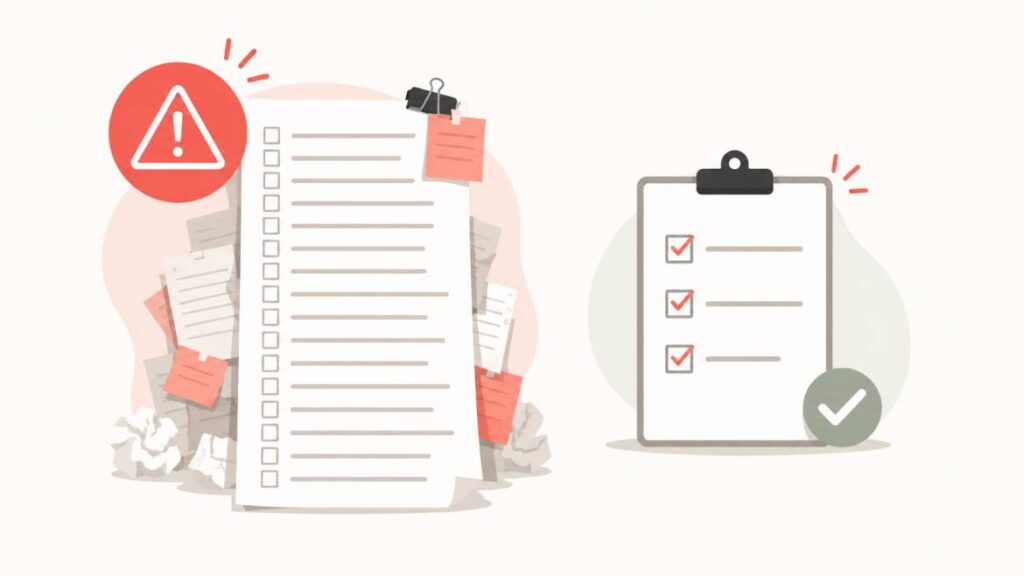
| 2 | Making unrealistic to-do lists | A 20-item list guarantees a discouraging day |
| 3 | Trying to multitask | Splitting focus slows every task down, not just one |
| 4 | Starting without a clear next step | No clear action means no clear starting point |
| 5 | Chasing perfection | Perfect doesn’t exist, so the task never feels “ready” |
| 6 | Keeping distractions within reach | Willpower loses to a phone sitting on the desk |
| 7 | Giving up after one unproductive day | One bad day treated as failure often becomes a bad week |
That last one deserves a second look. A single off day is normal — everyone has them. The real damage happens when one skipped session turns into “well, I already broke my streak,” and the whole system gets abandoned over one slow afternoon.
Pro Tip: If you catch yourself doing two or three of these regularly, don’t try to fix all seven at once. Pick the one costing you the most time, fix that first, then move to the next.
Frequently Asked Questions About Procrastination
Why do I procrastinate even when I know what I need to do?
Knowing what to do and feeling ready to do it are two different things. Procrastination isn’t about information — it’s about avoiding the discomfort a task brings up, even when you understand exactly what’s required.
How can I stop procrastinating right now?
Use the two-minute rule. Commit to just two minutes on the task, right now, with no pressure to finish. Starting is almost always the hardest part.
What is the fastest way to overcome procrastination?
The “Just Start” method works fastest: count down from five, open the file, complete one tiny action. It skips the mental negotiation entirely.
Is procrastination the same as laziness?
No. Laziness means you don’t want to do the work. Procrastination means you want to do it and keep avoiding it anyway — usually with a good amount of guilt attached.
How do I stop procrastinating at work?
Prioritize your three most important tasks each morning, block time on your calendar for the hardest one, and reduce email or chat interruptions during focus periods.
How do I stop procrastinating when I feel overwhelmed?
Stop looking at the whole project. Write everything down to clear your head, then pick just one priority and give yourself a short five- to ten-minute window to start.
How do I stop procrastinating without motivation?
Don’t wait for it. Action creates motivation far more reliably than motivation creates action. Start small, and the motivation tends to catch up once you’re already moving.
Does perfectionism cause procrastination?
Often, yes. Waiting for the perfect moment or the perfect first draft keeps the task frozen indefinitely. Lowering the standard from perfect to done usually breaks the stall.
How long does it take to break a procrastination habit?
There’s no fixed timeline — it depends on the person and the habit. What matters more than speed is consistency: small daily actions, repeated over weeks, tend to outperform any single big push.
What is the best productivity technique for procrastination?
There isn’t one single best technique — it depends on what’s causing the delay. The Pomodoro Technique works well for focus issues, time blocking works well for structure, and the two-minute rule works well for simply getting started.
Tools and Books That Can Help You Stop Procrastinating
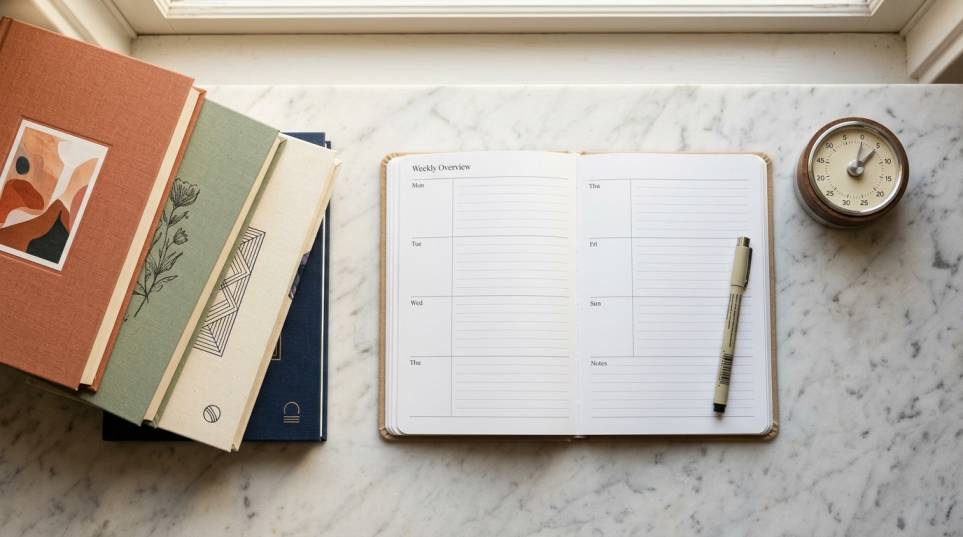
None of this requires buying anything — every strategy above works with nothing but a timer and a piece of paper. That said, a few tools make the process easier to stick with.
| Type | Option | Why It Helps |
| Book | Eat That Frog! — Brian Tracy | Built entirely around tackling your hardest task first |
| Book | Atomic Habits — James Clear | Covers building systems that don’t rely on motivation |
| Book | The Now Habit — Neil Fiore | Digs into the psychology behind chronic avoidance |
| Planner | Daily productivity planner | Keeps your top task visible instead of buried in a list |
| Planner | Weekly goal planner | Useful for the weekly review from Section 8 |
| Tool | Habit tracker | Makes progress visible — Section 12’s biggest lever |
| Tool | Pomodoro timer | Removes the guesswork from focused work blocks |
If you’re a reader, start with Eat That Frog! — it’s short, direct, and maps almost exactly onto Strategy #3. If systems matter more to you than motivation, Atomic Habits is the stronger pick.
Pro Tip: Don’t buy all seven at once. Pick whichever matches the mistake costing you the most time right now, and start there.
This section may contain affiliate links. If you purchase through them, this site may earn a small commission at no extra cost to you.
Stop Waiting and Start With One Small Action

Here’s what all 15 strategies really come down to: procrastination is a habit, and habits can change. Not overnight, and not perfectly — but they change.
You don’t need to feel motivated before you start. You don’t need the perfect plan, the perfect mood, or the perfect moment. Motivation shows up after action, not before it. Waiting for it first is how tasks sit untouched for weeks.
What actually works is smaller than that. One small action, repeated, breaks the avoidance cycle better than any amount of willpower or inspiration ever could. That’s it. That’s the whole mechanism behind every strategy in this article.
So don’t close this tab and file it away for “later.” Later is where procrastination lives.
Choose one task you’ve been putting off. Break it into the smallest possible first step. Set a 10-minute timer.
Start now.