
7 Best Passive Income Ideas for 2026 That Actually Work (Beginner-Friendly)
What if your bank account grew while you traveled, slept or doing something else you love? Sounds like a dream, right? Passive income is not a dream, It’s a documented, proven reality for millions of persons who got tired of trading every hour for a dollar.
I get it. You’ve probably scrolled past a dozen “passive income” articles or videos that turned out to be glorified pyramid schemes or required $50,000 upfront. Frustrating doesn’t even cover it.
But here’s what I want you to know: the right passive income ideas don’t require a trust fund, a finance degree, or quitting your day job. Some of the methods in this guide require literally $0 to start. Others need just a few hundred dollars and a free afternoon.
Your financial future isn’t decided by your current circumstances; it’s decided by the actions you take today.
In this guide, I’m breaking down the 7 best passive income ideas for 2026 that actually work, even if you’re a complete beginner. You’ll learn exactly how much money you need to start, realistic earning potential, and step-by-step instructions for each method. I’ll also show you the common mistakes that kill most people’s progress before they ever see their first passive dollar.
Let’s build something that pays you back.
What Is Passive Income and Why It Matters in 2026
Definition of Passive Income
Let’s clear something up right away, passive income is NOT “do nothing and get rich.” Anyone selling you that fantasy is lying.
Passive income is money you earn with little to no sustained effort AFTER the initial setup work is done. You put in the time, money, or energy upfront. Then the income flows, whether you’re working, sleeping, or binge-watching Netflix.
Here’s how it stacks up against other income types:
| Income Type | Effort Required | Example |
| Active Income | Full ongoing effort | 9-to-5 job, freelancing |
| Side Hustle | Regular part-time effort | Driving for Uber, tutoring |
| Passive Income | Heavy upfront, minimal ongoing | Dividends, digital products, rentals |
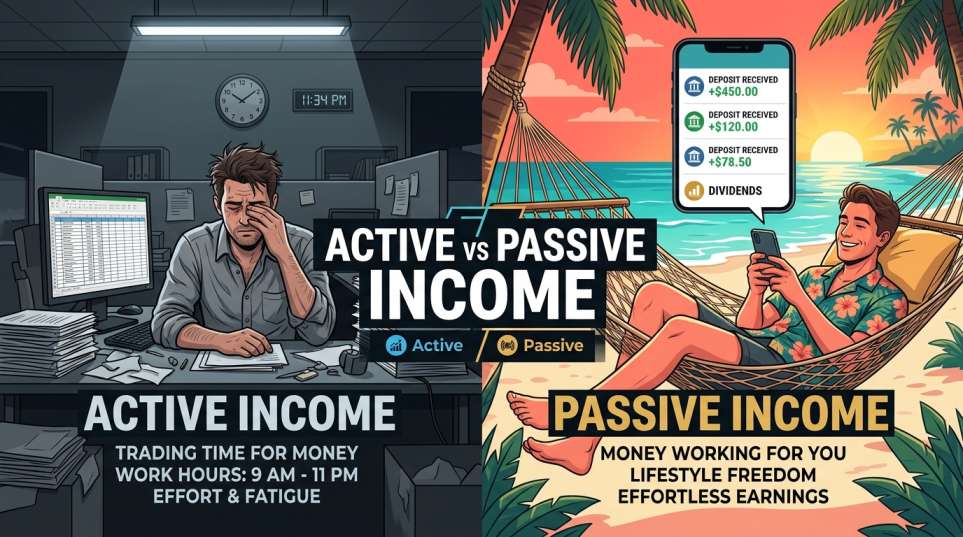
See the difference? With active income, you stop working, you stop earning. With passive income, the system keeps running even when you don’t.
And in 2026, this distinction matters more than ever. Inflation keeps biting. Job security isn’t what it used to be. The people building real financial freedom aren’t just working harder — they’re building income streams that work FOR them around the clock.
The State of Passive Income in 2026
Here’s a wild stat: search interest for “passive income” hit a 5-year high in 2026, according to Google Trends data. That’s not a coincidence, it’s a signal. More Americans are waking up to the fact that one paycheck is a risky way to live.
So what’s trending RIGHT NOW?
- AI-powered tools — People are using AI to create content, products, and automated systems faster than ever
- Digital products — E-books, templates, and online courses with zero inventory and near-100% margins
- Dividend investing — Stocks and ETFs that pay you just for holding them
Americans aged 18–55 are leading this shift. From college students selling Notion templates on Etsy to mid-career professionals stacking dividend ETFs in M1 Finance, everyday people — not Wall Street insiders — are building real passive cash flow.
The barrier to entry has never been lower. And the timing? It couldn’t be better.
Benefits of Building Passive Income Streams
Still on the fence? Let me break down exactly what you gain when you start building passive income:
- 💰 Earn money while you sleep — Your income isn’t tied to your hours
- 🏠 Work from anywhere — Most passive streams are fully remote-friendly
- 📈 Build wealth without a 9-to-5 — Compound growth works 24/7
- 🛡️ Diversify beyond your paycheck — If one income source dries up, you’re not broke
Beyond the lifestyle perks, there’s a financial strategy here too. Many passive income streams, like dividend ETFs and REITs, come with serious tax advantages, including qualified dividend rates and depreciation write-offs. And when you reinvest your earnings? Compound growth starts doing the heavy lifting.
The bottom line: passive income isn’t just a “nice to have.” In 2026, it’s a financial survival strategy.
#1: Dividend Stocks – The Gold Standard of Passive Income

If passive income had a Hall of Fame, dividend stocks would be the first inductee. They’re proven, beginner-friendly, and genuinely hands-off once you set them up.
Why Dividend Stocks Are Perfect for Beginners
Dividend-paying companies share a portion of their profits with shareholders — you get paid just for owning the stock. No hustle required.
- Consistent cash flow with minimal effort after setup
- No prior investing experience needed
- Average dividend yield sits between 2–5% annually, not flashy, but reliable and compounding
I started with a modest position in a dividend ETF and watched the quarterly deposits hit my account like clockwork. It’s a small thrill every time, money that arrived while I was doing literally nothing.
How to Start Earning Passive Income from Dividend Stocks
Here’s the exact playbook:
- Open a brokerage account — M1 Finance is my top pick (zero fees, automatic investing)
- Choose dividend stocks or ETFs — Start with broad ETFs like VIG or VYM before picking individual stocks
- Set up DRIP (Dividend Reinvestment Plan) — Automatically reinvest dividends to accelerate compound growth
- Withdraw or reinvest — Once your portfolio grows, start taking the cash or keep compounding
💡 Pro Tip: Start with ETFs, not individual stocks. They spread your risk across hundreds of companies automatically — perfect when you’re just getting started.
Top Dividend Stocks & ETFs for 2026
| Investment | Type | Dividend Yield | Best For |
| Vanguard VIG | ETF | 1.8% | Dividend growth investors |
| Vanguard VYM | ETF | 2.9% | High-yield seekers |
| Ares Capital (ARCC) | BDC | 8–10% | Aggressive income investors |
| Brookfield Infrastructure | Stock | 4–5% | Long-term distribution growth |
Earning Potential & Risks
| Metric | Details |
| Startup Cost | $100–$1,000 |
| Monthly Income | $50–$500+ (scales with investment) |
| Time to First Dollar | 1–3 months (first dividend cycle) |
| Risk Level | Low to Medium |
Real risks to know: Markets fluctuate, companies can cut dividends, and inflation can erode your real returns. Diversifying across ETFs, rather than betting on one stock, significantly reduces this exposure.
- ✅ Best for: Long-term wealth building
- ✅ Passive Score: 9/10 — fully automated after setup
- ✅ Recommended Platform: M1 Finance (zero fees, automatic rebalancing)
#2: High-Yield Savings Accounts – Safe & Instant Passive Income
If dividend stocks are the gold standard, high-yield savings accounts (HYSAs) are the bedrock, boring, beautiful, and bulletproof. This is the one passive income stream where you literally cannot lose.
Why High-Yield Savings Accounts Are the Safest Option
Traditional banks are quietly robbing you. The average brick-and-mortar savings account pays 0.01% APY. That means $10,000 sitting in your Chase savings earns you a whopping $1 a year. ONE DOLLAR.
High-yield savings accounts? They’re currently paying up to 4.50% APY in 2026. Same money. Same zero effort. VASTLY different result.
Here’s what makes HYSAs truly risk-free:
- FDIC-insured up to $250,000 — your money is federally protected, full stop
- No market exposure — zero volatility, zero stress
- Guaranteed monthly returns — interest deposits automatically, every single month
This isn’t investing. It’s smarter saving. And for beginners who aren’t ready to touch the stock market yet, this is literally the best place to start.
How to Set Up a High-Yield Savings Account
The setup takes less time than ordering pizza. Here’s all you do:
- Compare APY rates — Check Ally, Marcus by Goldman Sachs, and LevelUp Savings
- Open your account online — Takes 5–10 minutes, no branch visit required
- Transfer funds from your checking account — Start with whatever you have
- Sit back — Interest posts automatically every month
That’s genuinely it. No strategy meetings. Market research. Or stress.
💡 Pro Tip: Set up an automatic monthly transfer from your checking account — even $50/month. You won’t miss it, and your balance (and interest) compounds quietly in the background.
Best High-Yield Savings Accounts in 2026
| Bank | APY | Minimum Deposit | Best For |
| LevelUp Savings | 4.50% | $0 | Highest rate seekers |
| Ally Bank | 4.10% | $0 | No-fee simplicity |
| Marcus by Goldman Sachs | 4.05% | $0 | Trusted brand, easy transfers |
| EverBank | Competitive | $0 | No-fee alternative |
Ally Bank is my personal go-to for its clean interface and zero fees. But if you want the absolute highest rate right now, LevelUp Savings , named Motley Fool’s best of 2025, is hard to beat.
Earning Potential
| Metric | Details |
| Startup Cost | $0–$100 |
| Monthly Income | $5–$200+ (scales with balance) |
| Time to First Dollar | 30 days (first interest payment) |
| Risk Level | Zero — FDIC-insured |
- ✅ Best for: Complete beginners, risk-averse investors
- ✅ Passive Score: 10/10 — the most genuinely passive thing on this entire list
- ✅ Use it as your emergency fund base while your other income streams build
#3: Create & Sell Digital Products – Earn Forever After One-Time Work
Here’s a passive income model I genuinely love — because you do the work ONCE and collect the money indefinitely. No inventory. Employees. Or shipping drama. Just pure digital leverage.
Why Digital Products Are the Trending Passive Income of 2026

The economics here are almost unfair — in the best way.
- Create once, sell forever — your product doesn’t wear out or run out
- Near-100% profit margin after platform fees
- Zero overhead — no warehouse, no packaging, no logistics
- AI tools have cut creation time in half — what took weeks now takes days
Someone selling a $15 Notion template on Etsy can wake up to 10 sales overnight with zero additional work. I’ve seen creators go from $0 to $3,000/month in under six months — all from a handful of digital files.
Best Digital Products to Sell in 2026
| Product Type | Examples | Avg. Price Range |
| Notion Templates | Planners, dashboards, habit trackers | $7–$35 |
| E-books & Guides | How-to books, niche tutorials | $9–$47 |
| Printable Planners | Budget trackers, meal planners | $3–$15 |
| Stock Graphics | Icons, social media kits | $5–$25 |
| Spreadsheet Templates | Excel, Google Sheets budgets | $10–$40 |
💡 Pro Tip: Start with what you already know. Are you great at budgeting? Sell a Google Sheets budget template. Obsessed with productivity? Build a Notion dashboard. Your expertise is your product.
How to Create & Sell Digital Products (Step-by-Step)
- Identify your niche — What do you know that others would pay to learn or use?
- Create your product — Use free tools: Canva for design, Notion for templates, Google Docs for e-books
- Set up your shop — Etsy for built-in traffic, Gumroad for simplicity
- Market your product — Pinterest and TikTok drive FREE organic traffic aggressively in 2026
- Automate delivery — Platforms handle file delivery automatically after purchase
Top Platforms for Selling Digital Products
| Platform | Best For | Fee Structure |
| Etsy | Printables, templates (90M+ buyers) | ~6.5% transaction fee |
| Gumroad | Creators, courses, files | 10% flat fee |
| SendOwl | Advanced automation | Monthly subscription |
| Shopify + Downloads | Full brand control | Monthly fee + transaction |
For beginners, Etsy + Gumroad is the ideal combo. Etsy gives you immediate traffic. Gumroad gives you full creator control and zero upfront cost.
Earning Potential
| Metric | Details |
| Startup Cost | $0–$100 |
| Monthly Income | $100–$5,000+ (highly scalable) |
| Time to First Dollar | 2–4 weeks |
| Risk Level | Low — time investment, not financial |
- ✅ Best for: Creatives, educators, niche experts
- ✅ Passive Score: 8/10 — occasional updates and light marketing needed
- ✅ AI Tools: Use ChatGPT to write your product descriptions and Canva to design everything
#4: Affiliate Marketing Blog – Build Long-Term Passive Income
Of all the passive income streams in this guide, affiliate marketing has the highest ceiling. I’m talking $10,000+/month from blog posts you wrote once, years ago. That’s the power of SEO-driven content working around the clock.

Why Affiliate Marketing Is a Top Passive Income Stream
The model is brilliantly simple. You recommend products you already use, someone clicks your link and buys, and you earn a commission. No product to create. Customer service emails. Or inventory headaches.
What makes it genuinely passive:
- Recurring commissions — Software and subscription products pay you every month a customer stays
- SEO traffic compounds — A well-ranked post drives clicks for years without extra work
- Scalable — More posts = more commissions, with no extra cost per click
The honest caveat? This one takes time. Expect 3–6 months before your first real dollar. But the bloggers who push through that window? They build income machines that run indefinitely.
How to Start an Affiliate Marketing Blog (Beginner-Friendly)
- Choose your niche — Personal finance, tech, health, and home are top earners in 2026
- Set up a WordPress blog — Use Bluehost or SiteGround for hosting ($3–$5/month)
- Join affiliate programs — Start with Amazon Associates, ShareASale, and Impact
- Write SEO-optimized posts — Target keywords like “best passive income ideas 2026” with affiliate links naturally embedded
- Drive traffic — Google SEO is the long game; Pinterest and social media accelerate early traction
💡 Pro Tip: Don’t wait until you have 50 posts to join affiliate programs. Apply to Amazon Associates from day one, even modest early traffic builds your application history.
Best Affiliate Programs for 2026
| Program | Commission Rate | Best For |
| Amazon Associates | 1–10% per sale | Any niche, massive product range |
| ShareASale | Varies (up to 30%+) | Lifestyle, finance, home niches |
| Impact | High-ticket + recurring | SaaS, fintech, premium brands |
| HubSpot Affiliate | 30% recurring | Marketing & business bloggers |
💡 Pro Tip: Prioritize programs with recurring commissions — like HubSpot or SaaS tools via Impact. One referred customer can pay you monthly for years.
Monetization Strategies Beyond Affiliate Links
Smart bloggers don’t rely on one revenue stream. Stack these on top of affiliate income:
- Google AdSense — Passive display ad revenue from every page view
- Sponsored posts — Brands pay $500–$5,000 per dedicated post as your traffic grows
- Digital products — Sell your own e-books or courses directly to your audience
- Email list — Build with ConvertKit, then monetize with affiliate offers and product launches
Earning Potential
| Metric | Details |
| Startup Cost | $100–$300 (hosting, domain, theme) |
| Monthly Income | $500–$10,000+ (after 6–12 months) |
| Time to First Dollar | 3–6 months |
| Risk Level | Medium — time investment, not financial |
- ✅ Best for: Writers, SEO enthusiasts, content creators
- ✅ Passive Score: 7/10 — consistent content needed early, then it compounds
- ✅ SEO Tip: Target long-tail keywords like “affiliate marketing passive income blog” for faster early rankings
#5: Print-on-Demand (POD) – Sell Custom Products Without Inventory

What if you could run an e-commerce store with zero upfront inventory costs and zero risk of unsold stock? That’s exactly what print-on-demand delivers, and in 2026, it’s easier to launch than ever.
Why POD Is Perfect for Beginner Entrepreneurs
- $0 inventory risk — products only print after someone buys
- Infinitely scalable — 10 orders or 10,000 orders, same effort from you
- AI design tools make professional-looking products accessible to anyone
- Global fulfillment — platforms like Printful ship worldwide automatically
Best Print-on-Demand Products in 2026
Not all POD products are equal. These consistently top the earnings charts:
| Product | Avg. Profit Margin | Difficulty to Design |
| T-shirts & Hoodies | $8–$15/unit | Low |
| Mugs & Drinkware | $5–$10/unit | Low |
| Journals & Notebooks | $6–$12/unit | Low |
| Wall Art Prints | $10–$20/unit | Medium |
| Phone Cases | $4–$8/unit | Low |
Top Print-on-Demand Companies for 2026
- Printful — Premium quality, branding options, fulfillment across NA & Europe
- Printify — 900+ products, lower base costs = better margins
- Gelato — Best for global sellers, eco-friendly options
- Spring (Teespring) — Built-in social audience, great for TikTok/Instagram creators
How to Set Up a POD Store (Step-by-Step)
- Sign up for Printful or Printify — both are free to start
- Connect to Etsy or Shopify — Etsy for instant traffic, Shopify for brand control
- Create designs — Use Canva (free) or AI tools like Midjourney for standout visuals
- Upload products and set pricing — aim for 30–40% profit margins minimum
- Market consistently — Pinterest and TikTok drive enormous free traffic to POD stores
💡 Pro Tip: Niche DOWN hard. “Funny mugs” is crowded. “Funny mugs for pediatric nurses” is a goldmine. Specific audiences buy faster and more loyally.
Earning Potential
| Metric | Details |
| Startup Cost | $0–$100 |
| Monthly Income | $200–$3,000+ (scalable) |
| Time to First Dollar | 2–4 weeks |
| Risk Level | Low — zero inventory risk |
- ✅ Best for: Creatives, designers, marketers
- ✅ Passive Score: 7/10 — upfront design work, then largely automated
- ✅ Most Profitable Products: T-shirts, mugs, and notebooks consistently lead sales
#6: REITs & Real Estate Crowdfunding – Passive Real Estate Investing

Real estate has built more millionaires than almost any other asset class. But buying property? That’s expensive, stressful, and anything BUT passive. REITs flip that script entirely.
Why REITs Are the Best Passive Real Estate Option
A REIT (Real Estate Investment Trust) lets you own a slice of income-producing real estate — apartment complexes, shopping centers, data centers, without buying a single brick.
- Start with as little as $10 via crowdfunding platforms
- 3–5% average dividend yield, paid quarterly
- Trades like a stock — liquid, flexible, no realtor fees
- Professional management handles everything, tenants, maintenance, leases
You get all the income benefits of real estate ownership with none of the 2am “the toilet is broken” phone calls. That’s the deal.
How to Invest in REITs for Passive Income
- Open a brokerage account — M1 Finance or Fidelity both work great
- Choose REIT ETFs or individual REITs — ETFs first for beginners (instant diversification)
- Set up automatic monthly investments — even $50/month compounds meaningfully
- Collect quarterly dividends — reinvest or withdraw as cash flow
💡 Pro Tip: New to REITs? Start with VNQ (Vanguard Real Estate ETF), it holds 160+ REITs in one fund, so you’re diversified from day one without picking individual companies.
Top REITs & Real Estate Platforms for 2026
| Platform/Fund | Min. Investment | Type | Best For |
| Fundrise | $10 | Crowdfunding | True beginners |
| VNQ (Vanguard REIT ETF) | ~$100 | ETF | Broad diversification |
| RealtyMogul | $5,000 | Crowdfunding | Accredited investors |
| First National Realty Partners | $50,000 | Commercial RE | High-net-worth investors |
For most beginners, Fundrise is the move. Ten dollars gets you into a diversified real estate portfolio managed by professionals. It’s genuinely remarkable.
REITs vs. Traditional Rental Property
| Feature | REITs/Crowdfunding | Rental Property |
| Startup Cost | $10–$1,000 | $20,000–$50,000+ |
| Management | Fully passive | Tenants, repairs, headaches |
| Liquidity | High — sell anytime | Low — months to offload |
| Passive Score | 9/10 | 5/10 |
The table says it all. Traditional rentals can generate strong income, but they’re closer to a second job than passive income, especially early on.
Earning Potential
| Metric | Details |
| Startup Cost | $10–$1,000 |
| Monthly Income | $20–$500+ (scales with investment) |
| Time to First Dollar | 1–3 months (quarterly dividends) |
| Risk Level | Medium — market fluctuations apply |
- ✅ Best for: Anyone wanting real estate exposure without buying property
- ✅ Passive Score: 9/10 — fully automated after setup
- ✅ Recommended Platform: Fundrise ($10 minimum, zero hassle)
#7: YouTube Automation & Content Creation – Earn from Ads & Sponsorships
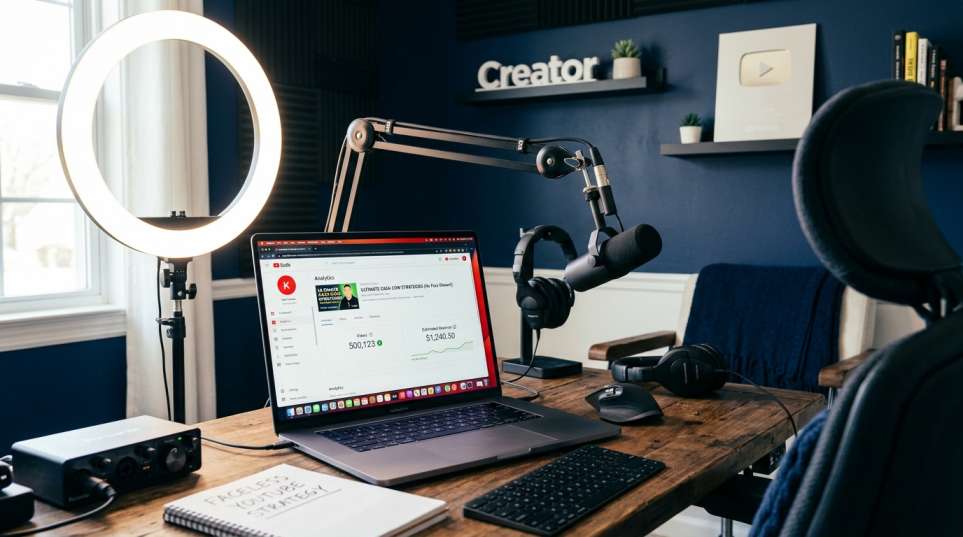
Here’s the thing about YouTube most people miss, a video you upload TODAY can earn money three years from now. It just keeps working. That’s the kind of passive leverage that makes this platform genuinely special.
Why YouTube Is a Top Passive Income Platform in 2026
- Videos earn for years after a single upload
- Multiple monetization streams — ads, sponsorships, affiliates, digital products
- No face required — faceless automation channels are thriving in 2026
- AI tools now handle scripting, voiceovers, and editing at near-zero cost
How to Start a YouTube Automation Channel
- Pick a profitable niche — finance, tech, health, education, AI tools
- Hire freelancers for scripts, voiceovers, and editing via Fiverr or Upwork
- Upload 1–2 videos per week — consistency beats perfection early on
- Hit monetization threshold — 1,000 subscribers + 4,000 watch hours
- Stack revenue streams — AdSense + sponsorships + affiliate links in descriptions
💡 Pro Tip: Don’t wait for monetization to add affiliate links. Drop them in your video descriptions from video one. Early commissions keep you motivated through the slow growth phase.
Best YouTube Niches for Passive Income in 2026
| Niche | CPM Range | Competition Level |
| Personal Finance & Investing | $10–$30 | Medium-High |
| AI & Automation Tools | $8–$20 | Medium (growing fast) |
| Tech Reviews & Tutorials | $6–$15 | High |
| Health & Fitness | $5–$12 | Medium |
| Educational How-To Content | $4–$10 | Low-Medium |
Finance and AI niches pay the HIGHEST ad rates. If you can create content in either space, you’re playing in the most lucrative YouTube territory available right now.
YouTube Monetization Streams
| Source | Earning Range |
| AdSense | $1–$10 per 1,000 views |
| Sponsorships | $500–$10,000 per video |
| Affiliate Links | Varies by program |
| Digital Products | $9–$497 per sale |
Earning Potential
| Metric | Details |
| Startup Cost | $0–$500 (equipment + freelancers) |
| Monthly Income | $500–$20,000+ (highly scalable) |
| Time to First Dollar | 6–12 months to monetization |
| Risk Level | Medium — significant time investment upfront |
- ✅ Best for: Content creators, marketers, educators
- ✅ Passive Score: 7/10 — front-loaded effort, then compounding returns
- ✅ SEO Tip: Optimize every title, description, and tag, YouTube is the world’s second-largest search engine
Bonus: 5 More Passive Income Ideas for 2026
The 7 core methods above are enough to build serious income. But if you want MORE options — or something that fits your specific situation, these five bonus streams are absolutely worth your attention.
#8: Amazon KDP Self-Publishing
Amazon’s Kindle Direct Publishing lets you publish e-books and low-content books, journals, planners, puzzle books, notebooks, and earn 35–70% royalties on every sale. Forever.
- Startup cost: $0 — Amazon’s platform is completely free
- Time to first dollar: 2–4 weeks after publishing
- Best part: Low-content books (lined journals, habit trackers) require ZERO writing skill
💡 Pro Tip: Use Canva to design interiors for journals and planners in a few hours. Upload to KDP, price at $7–$12, and let Amazon’s 300M+ shoppers do the work.
#9: Turo Car Rental
Your car sits parked 95% of the time. Turo lets you rent it out and earn $500–$1,500/month from an asset you already own.
- Startup cost: $0 — you already have the car
- Setup time: Under 30 minutes to list your vehicle
- Real risk: Vehicle wear and potential damage (Turo’s protection plans help mitigate this)
This works especially well in high-traffic cities, near airports, or tourist destinations.
#10: Membership Community
Build once, get paid monthly. Platforms like Patreon, Kajabi, and Memberful let you charge members for exclusive content, coaching calls, templates, or community access.
- Revenue model: Recurring monthly subscriptions ($5–$97/month per member)
- 100 members at $20/month = $2,000/month, compounding as you grow
- Best for: Creators, educators, coaches with an existing audience
#11: Peer-to-Peer Lending
Platforms like LendingClub let you act as the bank, lending money to individuals and earning 5–8% annual returns on your capital.
- Startup cost: $1,000+ recommended for adequate diversification
- Key risk: Borrower default, spread across many loans to reduce exposure
- Best for: Investors comfortable with slightly higher risk for higher returns than savings accounts
#12: Rent Out Digital Assets
Own a website, domain, or online property? You can rent or sell digital assets through platforms like Flippa and Empire Flippers.
- Aged domains rent for $50–$500/month to businesses needing SEO authority
- Monetized websites generate ad revenue passively
- Best for: Tech-savvy individuals with existing digital properties
| Bonus Stream | Startup Cost | Monthly Income Potential | Passive Score |
| Amazon KDP | $0 | $100–$2,000+ | 8/10 |
| Turo Car Rental | $0 | $500–$1,500 | 8/10 |
| Membership Community | $0–$100 | $500–$10,000+ | 7/10 |
| P2P Lending | $1,000+ | 5–8% annual return | 8/10 |
| Rent Digital Assets | $0 | $50–$500/month | 9/10 |
How to Choose the Right Passive Income Idea for You
Twelve options is overwhelming. So let’s cut through the noise and find YOUR best starting point.
Factors to Consider When Choosing
| Factor | Questions to Ask Yourself |
| Budget | Can you invest $0, $100, or $1,000+ upfront? |
| Time Horizon | Do you need income in 30 days or are you okay with 6–12 months? |
| Skills | Are you a writer, designer, investor, or teacher? |
| Risk Tolerance | Do you want guaranteed returns or are you okay with market exposure? |
| Passive Level | How hands-off do you REALLY need this to be? |
Honest answer to those five questions and the right stream becomes obvious.
Best Passive Income Ideas by Audience
- Complete beginners (no experience): High-yield savings → dividend stocks → digital products
- Students with limited cash: Affiliate marketing, print-on-demand, Amazon KDP
- Busy working professionals: REITs, dividend ETFs, high-yield savings
- Creatives: Digital products, print-on-demand, YouTube automation
- Risk-averse investors: Ally Bank HYSA, Vanguard VIG/VYM, index funds
- ✅ Start with 1–2 streams — master them before adding more
- ✅ Diversify gradually — multiple streams = multiple safety nets
- ✅ Match your choice to your skills and budget — the best stream is the one you’ll actually stick with
Common Passive Income Mistakes to Avoid
You’ve got the roadmap. Now let’s make sure you don’t blow it with mistakes that kill most beginners’ progress before they ever see real results.
Top 7 Mistakes Beginners Make
1. Expecting instant results. Passive income takes 3–12 months to build. Anyone promising overnight riches is selling you a fantasy.
2. Chasing too many streams at once. Spreading across five methods from day one means you master none. Pick ONE. Go deep. Then expand.
3. Falling for scams. Red flags: “guaranteed returns,” upfront fees before you earn, no clear explanation of how money is made, pressure to recruit others.
4. Ignoring SEO. Content without SEO is a tree falling in an empty forest. No traffic = no income.
5. Not tracking metrics. You can’t improve what you don’t measure. Track monthly income, traffic, and conversion rates from day one.
6. Quitting at month three. Most people abandon ship right before the compound growth kicks in. The 6-month mark is where everything changes.
7. Not reinvesting early profits. That first $200/month? Put it back in. Compound growth only works if you feed it.
💡 Pro Tip: Screenshot your first passive income dollar, no matter how small. Pin it somewhere visible. That psychological anchor keeps you going through the slow months when most people quit.
How to Spot Passive Income Scams
The passive income space attracts predators. Here’s your scam radar:
- 🚩 Promises of “guaranteed returns” with zero risk
- 🚩 Upfront fees required before you earn a single dollar
- 🚩 Vague explanation of how money is actually generated
- 🚩 No verifiable testimonials or track record
- 🚩 Pressure to recruit others — classic pyramid scheme DNA
- ✅ Stick to proven methods — dividend stocks, affiliate marketing, digital products
- ✅ Research every platform before committing time or money
- ✅ Start small, prove the model, THEN scale
Step-by-Step Guide to Building Your Passive Income Portfolio
Enough theory. Here’s your exact 12-month execution roadmap, broken into three phases designed to build real, compounding passive cash flow.
Month 1–3: Laying the Foundation
This phase is about setting up infrastructure. Don’t rush for income yet, build the systems first.
- Open a brokerage account — M1 Finance or Wealthfront for automated investing
- Set up a high-yield savings account — Ally Bank (4.10% APY, zero fees)
- Invest $100–$500 in dividend ETFs — Start with Vanguard VIG or VYM for instant diversification
- Create one digital product OR launch an affiliate blog, pick one, go deep
- Learn SEO basics — keyword research, on-page optimization, content structure
💡 Pro Tip: Automate EVERYTHING in month one. Auto-invest into your ETFs. Auto-transfer to your HYSA. Automation removes willpower from the equation entirely.
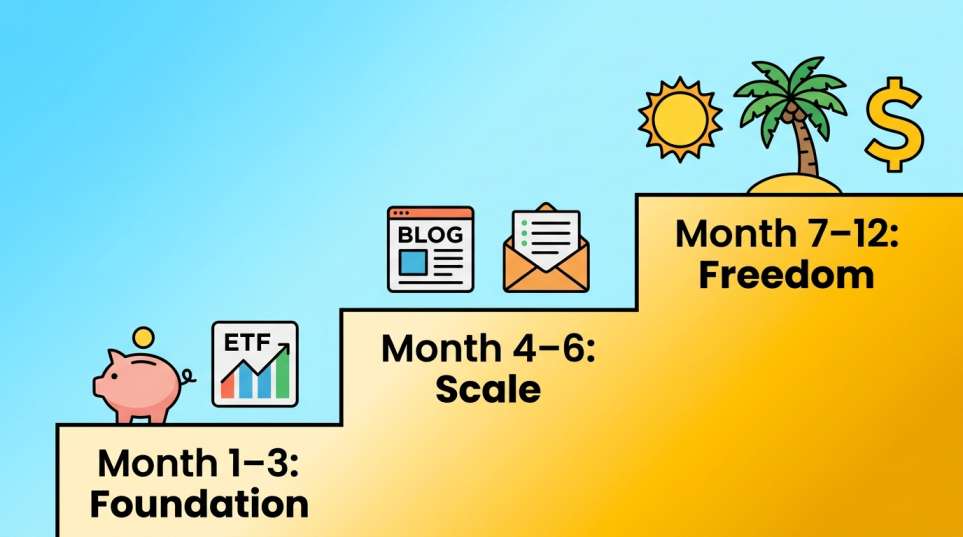
Month 4–6: Scaling Your Income
Your foundation is set. Now you accelerate.
- Reinvest all dividends and profits — activate DRIP on your brokerage account
- Add 1–2 more income streams — print-on-demand, YouTube automation, or Amazon KDP
- Build your email list — use ConvertKit to capture and monetize your blog or digital product audience
- Double down on SEO — optimize existing content for high-value keywords
- Track monthly earnings — log every dollar across every stream
| Income Stream | Expected Month 6 Income |
| Dividend ETFs | $10–$50/month |
| High-Yield Savings | $20–$80/month |
| Digital Products | $100–$500/month |
| Affiliate Blog | $50–$300/month |
| Total (conservative) | $180–$930/month |
Month 7–12: Achieving Financial Freedom
This is where the compound effect gets LOUD.
- Diversify across 5+ streams — no single source should represent more than 40% of income
- Target $1,000–$5,000/month — realistic for committed beginners by month 12
- Automate investments and content processes — schedule posts, auto-invest, batch-create products
- Hire freelancers for delegation — use Fiverr for design, writing, video editing
- Plan long-term — map a path to early retirement or FIRE (Financial Independence, Retire Early)
💡 Pro Tip: At month nine, audit every stream. Double down on the two performing best. Cut or pause anything with negative ROI. Focus beats diversification at this stage.
- ✅ Goal: $1,000/month passive income within 12 months, completely achievable
- ✅ Track progress with a simple spreadsheet updated every 1st of the month
- ✅ Celebrate every milestone — first $100, first $500, first $1,000. Each win compounds your motivation as much as your money
Frequently Asked Questions
1. What is the best passive income idea for beginners in 2026?
The best starting point depends on your budget. If you have $0, start with a high-yield savings account (Ally Bank, 4.10% APY) and a free digital product on Gumroad or Etsy. If you have $100–$500, add dividend ETFs via M1 Finance. These three together give you immediate, low-risk passive cash flow while you learn the ropes.
2. Can I really make passive income with no money upfront?
YES — and I don’t say that lightly. Digital products, affiliate blogs, Amazon KDP, and print-on-demand all have $0 startup costs. You’re trading time, not money. The investment is effort upfront; the payoff is income on autopilot later.
3. How much money do I need to start earning passive income in 2026?
Anywhere from $0 to $1,000 depending on the method:
| Budget | Best Starting Options |
| $0 | Digital products, Amazon KDP, affiliate blog |
| $100–$500 | Dividend ETFs, high-yield savings, POD store |
| $500–$1,000 | REITs via Fundrise, expanded dividend portfolio |
| $1,000+ | Diversified portfolio across 3–5 streams |
4. What passive income streams actually work in 2026?
The ones with the strongest track records right now: dividend stocks, high-yield savings accounts, digital product sales, affiliate marketing blogs, and REITs. These aren’t trends, they’re proven systems that thousands of Americans actively use to generate real monthly cash flow.
5. Is passive income truly passive or do I need to work hard at first?
Honest answer: you work HARD upfront, then coast. Building a blog, creating a digital product, or growing a dividend portfolio all require real effort in months one through six. After that? The system runs largely without you. Think of it as front-loaded work with back-loaded rewards.
6. What are the safest passive income investments for 2026?
Safety ranking from lowest to highest risk:
- High-yield savings accounts (FDIC-insured, zero market risk)
- Dividend ETFs like Vanguard VIG/VYM (low volatility, diversified)
- REITs via Fundrise (real estate exposure, moderate risk)
- Digital products & affiliate marketing (time risk, not financial risk)
If safety is your priority, start with Ally Bank’s HYSA and build from there.
7. How long does it take to start earning passive income?
Depends entirely on the method:
- High-yield savings: 30 days (first interest payment)
- Digital products/POD: 2–4 weeks after launch
- Dividend stocks: 1–3 months (first dividend cycle)
- REITs: 1–3 months (quarterly distributions)
- Affiliate blog/YouTube: 3–12 months (SEO takes time)
Start with fast-return streams while building long-term ones simultaneously.
8. Can I make $1,000/month in passive income as a beginner?
Absolutely — but set a realistic timeline of 9–12 months. Stack two or three streams: $200/month from dividend ETFs, $300/month from digital products, $300/month from affiliate commissions, and $200/month from a HYSA adds up fast. The key is starting NOW, not waiting for the “perfect” moment.
9. What are the best passive income ideas for working professionals?
Time is your constraint, so choose high-passive-score streams:
- REITs via Fundrise — 10-minute setup, quarterly dividends
- Dividend ETFs via M1 Finance — automated investing, zero management
- High-yield savings — literally zero ongoing effort
- Digital products — create once on weekends, earn indefinitely
These four require minimal ongoing time — perfect for busy schedules.
10. How do I avoid passive income scams in 2026?
Five non-negotiable red flags to walk away from immediately:
- Guaranteed returns with “no risk”
- Upfront payment before you earn anything
- Vague or evasive explanation of the income model
- Pressure to recruit friends and family
- No verifiable proof of results or transparent testimonials
Stick to established platforms — M1 Finance, Fundrise, Etsy, Teachable, Amazon. If it’s not a household name or verifiable business, proceed with extreme caution.

Final Thoughts: Your Passive Income Journey Starts Today
Here’s a quick recap of everything we covered — the 7 best passive income ideas for 2026 that actually work:
- ✅ Dividend Stocks — Consistent cash flow, fully automated
- ✅ High-Yield Savings Accounts — Zero risk, instant returns
- ✅ Digital Products — Create once, earn forever
- ✅ Affiliate Marketing Blog — Long-term SEO-driven income
- ✅ Print-on-Demand — Custom products, zero inventory
- ✅ REITs & Real Estate Crowdfunding — Real estate without the landlord stress
- ✅ YouTube Automation — Ad and sponsorship income for years
Here’s the truth nobody tells you: $100/month in passive income is $1,200/year. That’s a flight somewhere beautiful. A month of groceries. Three months of streaming subscriptions. Small numbers compound into life-changing ones.
Financial freedom isn’t reserved for the wealthy or the lucky. It’s built, quietly, consistently, one stream at a time, by ordinary people who decided their paycheck wasn’t their only option.
The best time to start building passive income was ten years ago. The second-best time? Right now. Today. This moment.
Pick one idea from this list. Set it up this week. Your future self will thank you louder than you can imagine.