
Highest‑Paying Remote Jobs in 2026: Top Careers, Salaries & Skills (Work from Anywhere)
What if your laptop was your office — and your salary still had six figures on it?
That’s not a fantasy anymore. In 2026, the highest-paying remote jobs aren’t just for Silicon Valley insiders or tech bros in hoodies. They’re for you — wherever you are, whatever time zone you’re in, whether you’re in Ottawa, Austin, London, or literally a café in Bali with decent WiFi.
Here’s something I want you to sit with for a second: remote work has completely rewritten the salary rulebook. Companies are now paying $100k, $150k, even $220k+ for the right talent — and they don’t care if you’re showing up in person. All they care about is what you can do.
I put this guide together because I kept seeing the same recycled lists everywhere — vague job titles, zero salary data, and zero real talk about what it actually takes to land these roles.
In this guide, you’ll discover the top highest-paying remote jobs in 2026, real salary ranges backed by current U.S. labor data, the exact skills employers are hunting for, and practical paths to break in — even if you don’t have a degree or years of experience.
Your income doesn’t have to be tied to your zip code anymore. Let’s get into it.
1. What Are the Highest-Paying Remote Jobs in 2026?
Let’s be real — “remote job” used to mean answering emails from your couch for $15/hour. Those days are GONE.
In 2026, remote work has matured into a full-blown global talent economy. Companies aren’t just tolerating remote workers anymore — they’re competing for them. And that competition? It’s driving salaries UP. Way up.
But not every remote job pays well. So before we get into the list, let’s talk about what’s actually happening in the market right now — and exactly how I defined “highest-paying” for this guide.
1.1 How Remote Salaries Are Changing in 2026

The remote work landscape looks very different from what it was even two years ago. Here’s the honest picture:
Full-remote vs. hybrid — who’s winning?
After the post-pandemic “return to office” wave, the dust has settled into three camps:
- Full-remote roles — Still thriving, especially in tech, sales, and marketing. These roles often come with the highest compensation because companies pull from a global talent pool.
- Hybrid roles — Common in finance, healthcare, and operations. Solid pay, but usually tied to a metro area.
- Remote-first companies — Startups and SaaS companies built around async work. These tend to offer the best combination of salary, flexibility, and growth.
According to data from LinkedIn and Glassdoor, fully remote tech roles in the U.S. pay 8–20% more on average than their in-office counterparts. Why? Because companies save on real estate and pass some of that value to talent — plus, they need people who can perform without hand-holding.
Why some remote roles pay MORE than in-office jobs:
- No geographic pay caps — a company in San Francisco can hire you at SF rates without you living there
- Higher productivity expectations mean higher compensation
- Specialized skills are harder to find locally, so remote opens the talent pipeline
- Remote-first cultures reward output over presence — and output-based workers earn more
“Remote work has decoupled geography from earning potential — and that’s the biggest financial shift of our generation.”
That’s not hype. That’s just what’s happening.
1.2 Criteria for Including a “Highest-Paying” Role in This Guide
I used a clear framework to decide what makes the cut here — here’s exactly how I defined a “highest-paying remote job” for this guide:
| Criteria | Minimum Standard |
| Base Salary | $100,000+ annually (U.S. remote rates) |
| Demand | Actively hiring on major job boards (LinkedIn, Indeed, We Work Remotely) |
| Market Consistency | In demand across both U.S. AND Canadian companies |
| Entry Realism | A clear, achievable path to land the role (no “you need 15 years” nonsense) |
| Growth Ceiling | Top-of-band potential of $150k–$220k+ for senior/specialized talent |
Every job on this list clears ALL five of these bars. No exceptions.
What I intentionally left out:
- Side hustles disguised as “jobs”
- Freelance gigs with inconsistent income
- Entry-level roles that cap at $60k–$80k
- Anything requiring a niche license that’s hard to get remotely
Why does this matter to you? Because too many “remote job” lists mix $20/hour customer service gigs with $180k engineering roles like they’re the same thing. They’re not. This guide is strictly for careers that can genuinely change your financial life.
💡 Pro Tip: When you’re job hunting, filter for roles labeled “Remote – USA” or “Remote – Worldwide” specifically. “Remote-friendly” often means hybrid or “remote sometimes.” The phrasing matters — and knowing it saves you hours of wasted applications.
Now that you know how we’re measuring this, let’s get into the actual jobs. Section 2 is where it gets exciting — the full ranked list of the top 10 highest-paying remote careers in 2026, with salary ranges, required skills, and what companies are actually hiring.
Ready? Let’s go. ⬇️
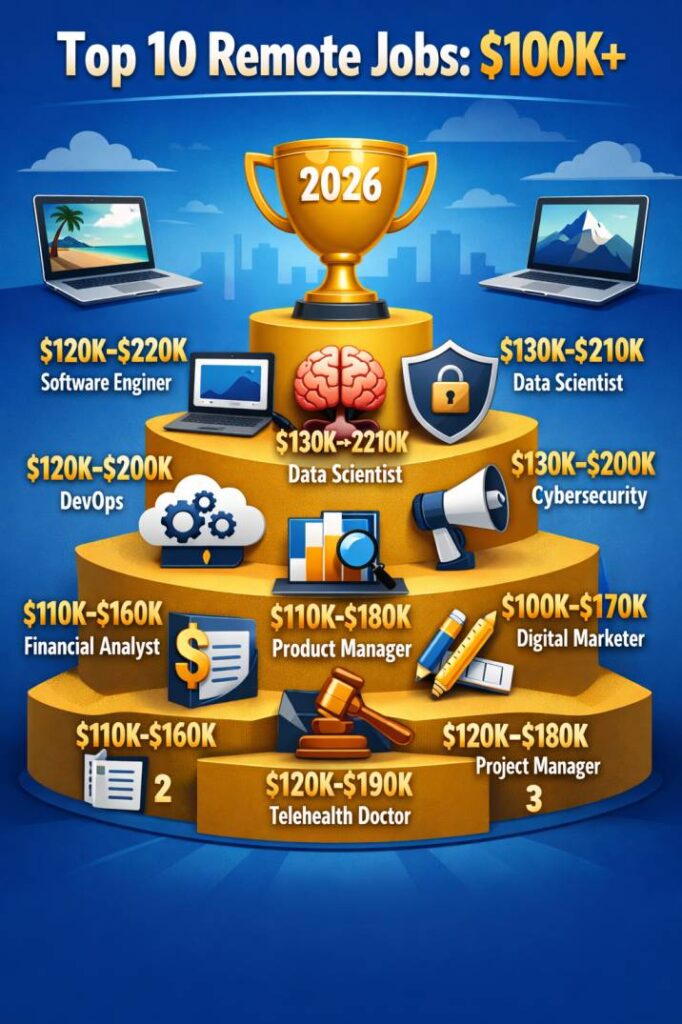
2. Top 10 Highest-Paying Remote Jobs in the U.S. (2026 List)
This isn’t a recycled list from 2022. Every role below is ranked based on current U.S. labor data, live job board activity (LinkedIn, Indeed, We Work Remotely, Glassdoor), and real salary reporting from platforms like Levels.fyi and Bureau of Labor Statistics projections. These are the roles paying the most — right now, in 2026.
Here’s your quick-scan overview before we dive deep:
| # | Role | Salary Range (U.S. Remote) |
| 1 | Software Engineer | $120k–$220k |
| 2 | Data Scientist / ML Engineer | $130k–$200k+ |
| 3 | Cloud & DevOps Engineer | $125k–$190k |
| 4 | Cybersecurity Engineer | $120k–$180k |
| 5 | Product Manager | $120k–$170k |
| 6 | UX/UI Designer (Senior) | $100k–$150k |
| 7 | Account Executive / Sales Rep | $90k–$150k base + OTE |
| 8 | Marketing Manager (Digital) | $95k–$150k |
| 9 | Engineering Manager / Tech Lead | $150k–$220k+ |
| 10 | Data Engineer / AI Engineer / Solutions Architect | $120k–$200k+ |
Now let’s break each one down.
2.1 Remote Software Engineer (High-Salary Specializations)
💰 Salary Range: $120k–$220k
Software engineering remains the undisputed king of remote work. Companies will pay a serious premium because great engineers are hard to find — and even harder to keep.
Top-paying sub-specialties:
- AI/ML Engineering — highest demand right now
- Backend Engineering (Node.js, Go, Python, Java)
- Cloud-native development (AWS, Azure, GCP)
- Security Engineering — niche, high-paying
Why the premium? Simple. One great remote engineer can replace two average in-office ones. Companies know this, and they pay accordingly.
💡 Pro Tip: Specialize, don’t generalize. A “full-stack developer” earns less than a “backend engineer with AWS and Kubernetes experience.” Niche down and your salary jumps fast.
2.2 Remote Data Scientist & Machine Learning Engineer
💰 Salary Range: $130k–$200k+
Data is the new oil — and the people who refine it? They’re getting PAID. ML engineers and data scientists are among the fastest-growing and highest-compensated remote roles in 2026.
Industries actively hiring remotely:
- Fintech, SaaS, healthcare, e-commerce, and big tech
Must-have skills:
- Python, R, SQL
- ML frameworks: TensorFlow, PyTorch, Scikit-learn
- Cloud data platforms: Snowflake, BigQuery, Databricks
The gap between “data analyst” and “ML engineer” is about $40k–$60k annually. If you’re already in data, upskilling into ML is one of the highest-ROI moves you can make.
2.3 Remote Cloud & DevOps Engineer
💰 Salary Range: $125k–$190k
Every company running software in 2026 needs cloud infrastructure. That need doesn’t go away — it grows. Remote DevOps and cloud engineers are in constant demand across enterprise, startup, and everything in between.

Key skills employers want:
- Cloud architecture (AWS, Azure, GCP certifications help a LOT)
- CI/CD pipelines, Docker, Kubernetes
- Infrastructure as Code (Terraform, Ansible)
Companies like Amazon, Microsoft, and thousands of SaaS startups hire these roles fully remote. Entry-level cloud engineers start around $90k. Senior architects? Comfortably over $150k.
2.4 Remote Cybersecurity Engineer
💰 Salary Range: $120k–$180k
Cyber threats aren’t slowing down — and neither is hiring in this space. Remote cybersecurity roles are booming because security work is inherently digital and doesn’t require physical presence.
Common certifications that unlock higher pay:
- CISSP, CEH, CompTIA Security+, CISM
- Familiarity with SOC operations, SIEM tools (Splunk, IBM QRadar)
💡 Pro Tip: Even without a CS degree, you can break into cybersecurity through certifications and platforms like TryHackMe or Hack The Box. Many companies care more about skills than diplomas here.
2.5 Remote Product Manager & Product Owner
💰 Salary Range: $120k–$170k
Product management is one of the best-kept secrets for non-engineers who want tech-level salaries. You don’t code — you lead the people who do.
Core skills:
- Stakeholder management, roadmap planning, data analytics
- Basic UX understanding (you don’t design, but you need to communicate)
- Tools: Jira, Notion, Mixpanel, Amplitude
Breaking in from non-tech roles: Many successful PMs come from marketing, operations, or customer success. The key is showing you understand the product, the user, and the business — not that you can write code.
2.6 Remote UX/UI Designer
💰 Salary Range: $100k–$150k (Senior Level)
Good design isn’t cosmetic — it’s a business driver. Companies building digital products know that poor UX kills retention. That’s why senior remote designers command serious salaries.
Tools you need to know: Figma (non-negotiable), Sketch, prototyping tools, basic user research methods.
Strong portfolio > fancy degree. Full stop.
2.7 Remote Account Executive / Sales Rep
💰 Salary Range: $90k–$150k base | OTE up to $200k+
Remote sales is one of the most underrated paths to six figures — especially in SaaS and B2B tech. Your base is solid, but commissions are where it gets life-changing.
Best industries for remote AEs: SaaS, cybersecurity, fintech, HR tech, and enterprise software.
2.8 Remote Marketing Manager (Performance & Digital)
💰 Salary Range: $95k–$150k
Performance marketers who can prove ROI are in high demand. Companies want people who understand paid ads, SEO, content strategy, and analytics — not just one of them.
Skills that command top pay: Google Ads, Meta Ads, SEO strategy, HubSpot/Salesforce, and data-driven decision making.
2.9 Remote Engineering Manager & Tech Lead
💰 Salary Range: $150k–$220k+
This is the top of the food chain for remote tech professionals. You’re managing distributed teams, driving technical strategy, and bridging engineering and business — all without an office.
The jump from individual contributor (IC) to manager typically adds $30k–$50k to your salary. The tradeoff? More meetings, more accountability, more impact.
2.10 Other High-Paying Remote Roles Worth Knowing
These didn’t crack the top 9 — but they absolutely deserve a mention:
| Role | Salary Range | Why It Pays Well |
| Remote Data Engineer | $120k–$170k | Data infrastructure is mission-critical |
| Remote AI Engineer | $140k–$200k+ | Fastest-growing role in tech right now |
| Remote Solutions Architect | $130k–$190k | Bridges technical and sales/client teams |
| Remote Strategy/Finance Consultant | $100k–$180k | High-value advisory, often project-based |
Now that you know which roles pay the most, the next question is obvious — what does it actually take to qualify for them? Section 3 covers the exact skills, tools, and certifications that unlock these salaries. ⬇️
3. Remote Jobs That Pay $100k+ in 2026 (Work From Anywhere)
Six figures used to feel like a ceiling. In 2026’s remote job market, it’s becoming the floor for specialized talent. But here’s the thing — not everyone lands these roles. There are patterns that separate the $100k+ earners from the rest, and once you see them, you can reverse-engineer your own path.
3.1 Common Traits of Six-Figure Remote Roles
After analyzing hundreds of remote job listings, I noticed the same characteristics showing up in every high-paying role. Here’s what they share:
They require specialized, high-impact skills. Generalists earn average salaries. Specialists earn exceptional ones. The $100k+ roles demand expertise that’s hard to replace — think ML engineering, cloud security, enterprise sales, or senior product strategy.
They operate on global or U.S.-pegged pay scales. Many of these roles pay U.S. market rates regardless of where you live. That’s a massive wealth opportunity — especially if your cost of living is lower than San Francisco or New York.
They typically require 3–5+ years of relevant experience. Most (not all) of these roles aren’t entry-level. BUT — and this is important — relevant experience doesn’t always mean years at a big company. A strong portfolio, certifications, and proven results can compress that timeline significantly.
Quick traits checklist for $100k+ remote roles:
- Specialized technical or strategic skill set
- Strong, documented track record of results
- Comfort with async communication and remote tools
- Ability to work independently with minimal supervision
3.2 Remote Jobs That Pay $150k or More

Want to go beyond $100k? These roles exist — and more companies are offering them remotely than ever before.
| Role | Typical Remote Salary | Company Type |
| Senior Cloud Architect | $155k–$210k | Enterprise tech, AWS/Azure partners |
| AI / ML Engineer (Senior) | $160k–$220k+ | Big tech, AI startups, SaaS |
| Principal Software Engineer | $170k–$230k | FAANG, high-growth startups |
| Engineering Manager | $150k–$220k | Mid-to-large tech companies |
| Top-Tier SaaS Account Executive | $120k base + $80k–$100k OTE | Enterprise SaaS, fintech |
The companies writing these checks are mostly large tech firms (Google, Meta, Stripe, Salesforce), high-growth Series B/C startups, and enterprise SaaS companies scaling their remote teams globally.
💡 Pro Tip: Use Levels.fyi to verify real compensation data for tech roles — including base, bonus, and equity. It’s far more accurate than generic salary sites like PayScale.
4. Skills Needed for the Highest-Paying Remote Jobs in 2026
Knowing which jobs pay well is one thing. Knowing exactly what skills get you hired is what actually changes your bank account. Here’s the honest breakdown.
4.1 Must-Have Technical Skills
These are the hard skills employers consistently list in $100k+ remote job descriptions:
| Skill Category | Specific Tools / Languages |
| Programming | Python, JavaScript, Go, Java, TypeScript |
| Cloud Platforms | AWS, Google Cloud (GCP), Microsoft Azure |
| Data Tools | SQL, Tableau, Apache Spark, dbt, Snowflake |
| Security | SIEM tools, network security fundamentals, CISSP concepts |
| DevOps/Infra | Docker, Kubernetes, Terraform, CI/CD pipelines |
You don’t need ALL of these. Pick the cluster that matches your target role and go deep — not wide.

4.2 Soft Skills Remote Companies Value
This is where most candidates lose the job — not on technical rounds, but on culture fit and remote-readiness. Companies hiring remotely specifically screen for:
- Written communication — Clear, concise Slack messages and documentation beat long, rambling emails every time
- Self-management — Can you deliver without someone checking on you daily? They need to trust your answer is yes
- Async discipline — Respecting time zones, updating project trackers, and communicating proactively without being asked
- Ownership mindset — Remote workers who treat problems like their own get promoted; bystanders get managed out
4.3 How to Build Skills Fast
You don’t need a four-year degree. You need focused, strategic upskilling.
Best platforms to build job-ready skills:
- Coursera / edX — University-backed certifications (Google, IBM, Meta)
- Udemy — Affordable, practical, project-based courses
- A Cloud Guru / Linux Foundation — Cloud and DevOps certifications
- Simplilearn / DataCamp — Data science and analytics tracks
Certifications that directly unlock higher pay:
- AWS Certified Solutions Architect
- Google Professional Data Engineer
- CompTIA Security+ / CISSP
- PMP (Project Management Professional)
Build proof, not just knowledge. Personal projects, open-source contributions, and a polished GitHub or portfolio site often matter MORE than a certificate alone. Employers want evidence — give them something to look at.
💡 Pro Tip: Don’t study everything at once. Pick ONE role from the Section 2 list, identify its top 3 required skills, and spend 90 days building those specifically. Focused beats scattered — every single time.
Up next in Section 5: remote jobs that pay well even without a degree or experience — and the realistic paths to get there. ⬇️
5. Remote Jobs in the U.S. That Pay Well (No Degree or No Experience)

Let me say this clearly: you do not need a four-year degree to earn $100k remotely. I’ve seen it happen too many times to pretend otherwise. What you do need is a marketable skill, proof you can use it, and the discipline to show up consistently.
5.1 Remote Jobs That Pay Well Without a Degree
The degree requirement is quietly disappearing from high-paying remote job listings. Google, Apple, IBM, and hundreds of startups have officially dropped the degree requirement for many roles. Here’s what’s actually working in 2026:
| Path | How to Get There | Realistic Salary Range |
| Software Development | Coding bootcamp (4–6 months) + portfolio | $70k–$130k |
| UX/UI Design | Online courses + strong portfolio | $75k–$130k |
| Cybersecurity | CompTIA Security+ cert + home lab projects | $70k–$120k |
| SaaS Sales (AE) | SDR role → AE promotion within 12–18 months | $80k–$150k OTE |
| Content/SEO Marketing | Portfolio + results-driven case studies | $60k–$110k |
| Cloud Engineering | AWS/GCP certifications + hands-on projects | $90k–$160k |
The honest expectation? Your first role may start lower — $60k–$80k. But with 12–24 months of experience and results on your resume, you climb fast. The ceiling is real. So is the runway.
💡 Pro Tip: Bootcamps like General Assembly, App Academy, and Springboard offer job guarantees or income-share agreements. If you’re serious about switching careers, these structured programs beat self-study for accountability and speed.
5.2 Remote Jobs That Pay Well With Little or No Experience
Starting from zero? These entry-level remote roles are your launchpad — not your destination.
Best entry-level remote roles with growth potential:
- Junior Developer / QA Tester — $50k–$75k starting; grows fast with specialization
- Technical Support Specialist — $45k–$65k; direct path into product, sales engineering, or DevOps
- Junior Digital Marketer — $40k–$60k; scale fast with paid ads or SEO results
- Virtual Assistant (Executive-Level) — $35k–$55k; often transitions into operations or project management
- Junior Data Analyst — $55k–$75k; direct pipeline into data science roles
How to stand out with zero experience:
- Build a portfolio over a resume — GitHub repos, Figma case studies, SEO audit samples, or a live website all speak louder than a blank work history
- Complete micro-projects for small businesses or nonprofits — real problems, real solutions, real proof
- Document your learning publicly on LinkedIn — hiring managers notice candidates who show their work
6. How to Get a High-Paying Remote Job in 2026 (Your Roadmap)
Finding the job is only half the battle. Getting selected for it requires a deliberate strategy. Here’s exactly what works in 2026.
6.1 Crafting a Remote-Friendly Resume and LinkedIn Profile

Your resume needs to signal one thing immediately: this person can work remotely and deliver results.
What to include:
- Label past remote or hybrid roles explicitly — write “Remote” next to the job location
- Highlight async tools you’ve used: Slack, Notion, Jira, Asana, Loom
- Lead with measurable outcomes, not job duties (“Increased pipeline by 40%” beats “Responsible for sales activities”)
- LinkedIn: turn on Open to Work with “Remote” selected, and write a headline that includes your specialty + “Remote” (e.g., “Senior Data Engineer | Remote | AWS | Python”)
6.2 Where to Apply for High-Paying Remote Jobs
Top job boards for high-salary remote roles:
| Platform | Best For |
| LinkedIn Jobs (Remote filter) | Tech, marketing, sales, PM roles |
| Indeed Remote | Broad search across industries |
| FlexJobs | Curated, scam-free U.S. remote listings |
| We Work Remotely | Tech and design-focused roles |
| Crossover | High-salary remote contracts ($60–$100+/hr) |
| Upwork | Freelance-to-full-time high-income paths |
💡 Pro Tip: Apply directly on company career pages after spotting roles on job boards. It bypasses ATS stacking and often gets you in front of a human faster.
6.3 Acing the Remote Interview Process
Remote interviews have their own format. Here’s how to prepare:
- Coding tests — Practice on LeetCode, HackerRank, or Codewars; focus on medium-difficulty problems
- Case studies — For PM, marketing, or strategy roles; show structured thinking, not just smart ideas
- Sales interviews — Expect a mock pitch or “sell me this product” moment; practice out loud, not just in your head
- Every role — Expect a question like “How do you stay productive working remotely?” Prepare a specific, honest answer with a real routine or system you use
Remote companies hire people they trust to self-manage. Your job in the interview is to prove — confidently — that you’re that person.
Next up: Section 7 covers remote jobs that pay well globally, including specific opportunities for African professionals and international workers earning in USD. ⬇️
7. Work-From-Anywhere Jobs in the U.S. (Location Flexibility)

“Work from anywhere” sounds like a travel blogger’s tagline. But in 2026, it’s an actual hiring policy — and understanding what it really means can save you from a nasty surprise after you’ve already accepted an offer.
7.1 What “Work From Anywhere” Really Means
Not all remote jobs are created equal. Here’s how companies actually structure location flexibility:
| Policy Type | What It Means | Watch Out For |
| Fully Remote (Global) | Work from any country, any time zone | May require overlap hours (e.g., 9am–12pm EST) |
| Fully Remote (U.S. Only) | Remote, but must be a U.S. resident | Common with roles tied to U.S. payroll/compliance |
| Geo-Bound Remote | Remote, but within specific states | Tax and labor law reasons — very common |
| Remote-First Hybrid | Mostly remote, occasional on-site sprints | Usually 2–4 times per year |
| True Work-From-Anywhere | No location restrictions, async-first | Rare but growing — usually startups |
The key things to verify before accepting any remote role:
- Does the company hire in your state or country?
- Are there required core hours in a specific time zone?
- Is there any travel expectation (quarterly offsites, client visits)?
- Is compensation adjusted by location, or is it a flat global rate?
That last point matters enormously. Some companies pay San Francisco rates regardless of where you live — others apply a “location multiplier” that cuts your salary if you’re outside a major metro. Always ask directly.
💡 Pro Tip: Search for “remote-first” companies, not just “remote-friendly” ones. Remote-first means the entire company is built around distributed work — better tooling, better async culture, and usually better pay equity regardless of location.
7.2 U.S. Companies Hiring for Work-From-Anywhere Roles
These are the types of companies and specific names consistently leading in remote hiring with competitive compensation:
Big Tech (High pay, structured remote programs):
- Google, Microsoft, Salesforce, HubSpot, Atlassian
Remote-First Startups (High growth, equity upside):
- GitLab (fully distributed, no HQ), Automattic (WordPress parent), Zapier, Doist, Buffer
Enterprise SaaS (Consistent remote hiring at scale):
- Workday, ServiceNow, Twilio, Datadog, HashiCorp
What makes these companies great for remote workers:
- Documented async communication culture
- Equity + competitive base salaries
- Results-based performance reviews — not “hours logged”
- Global hiring pipelines that include Africa, Latin America, and Southeast Asia
8. Remote Job FAQs
What are the highest-paying remote jobs in the U.S. in 2026?
The top roles are Software Engineer ($120k–$220k), ML/Data Scientist ($130k–$200k+), Cloud & DevOps Engineer ($125k–$190k), Engineering Manager ($150k–$220k+), and Senior Cybersecurity Engineer ($120k–$180k).
Do remote jobs in the U.S. and Canada pay as much as office jobs?
Often MORE. Fully remote tech roles pay 8–20% above in-office equivalents on average, because companies compete globally for talent and save significantly on office overhead.
Can I get a high-paying remote job without prior remote experience?
Yes — but frame your existing experience remotely. Highlight self-management, async tools you’ve used, and independent delivery. Every recruiter wants proof you won’t need hand-holding.
What skills do I need for the highest-paying remote jobs in 2026?
Technically: Python, cloud platforms (AWS/GCP/Azure), SQL, and security fundamentals. Professionally: written communication, async discipline, and the ability to deliver results without supervision.
Which U.S. and Canadian companies pay the most for remote roles?
Google, Stripe, Shopify, Salesforce, Microsoft, GitLab, Twilio, and Datadog consistently rank among the highest-paying remote employers in North America.
Are high-paying remote jobs 100% remote or hybrid?
Both exist. Senior tech and sales roles are often fully remote. Some leadership and client-facing roles involve occasional travel. Always confirm the policy before signing.
How do I prove I can work independently in a remote job?
Speak to specific systems you use — time-blocking, project trackers, async update rituals. Concrete examples beat vague claims every time.
Are there high-paying remote jobs that don’t require a degree?
Absolutely. Software development via bootcamp, cloud engineering through certifications, SaaS sales, UX design, and cybersecurity are all viable six-figure paths without a traditional degree.
What is the average salary for remote data scientists and AI engineers in 2026?
Remote Data Scientists average $130k–$175k. AI/ML Engineers command $140k–$220k+ depending on seniority and company size.
Which industries are hiring the most for high-paying remote roles?
Technology, fintech, healthcare tech, enterprise SaaS, cybersecurity, and e-commerce lead remote hiring volume in 2026 — with no signs of slowing down.
One final section to go — the conclusion ties everything together with a clear action plan so your reader knows exactly what to do next. ⬇️
9. Essential Tools and Products for High-Paying Remote Work
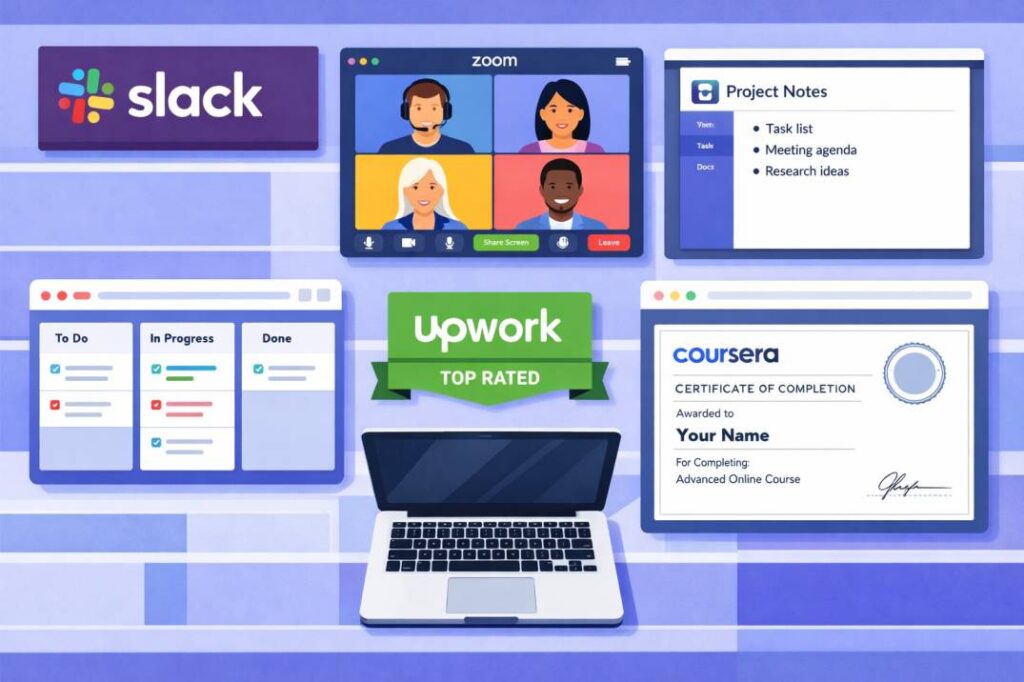
The right tools don’t just make remote work possible — they make you look like a professional who’s done this before. Companies hiring remotely expect you to hit the ground running. Here’s your complete toolkit.
9.1 Communication & Collaboration Tools
These are non-negotiable. If you don’t know them, learn them before your first interview.
| Tool | Best For | Cost |
| Slack | Async team messaging, channel-based comms | Free / $7.25+/mo |
| Zoom | Video calls, interviews, team standups | Free / $14.99+/mo |
| Microsoft Teams | Enterprise remote environments | Included in Microsoft 365 |
| Google Workspace | Docs, Sheets, Gmail, Meet — all-in-one | $6+/user/mo |
💡 Pro Tip: Master Slack etiquette — threading replies, using status updates, and writing clear async messages. Remote teams notice candidates who communicate efficiently in writing. It’s a skill, not a default.
9.2 Project Management & Productivity Tools
Remote workers who stay visible and organized get promoted. These tools keep you both.
- Notion — All-in-one workspace for notes, wikis, and project tracking. Beloved by remote-first teams
- Asana — Task and project management for cross-functional remote teams
- Trello — Visual Kanban boards; great for individual and small-team workflows
- Jotform — Forms, approvals, and workflow automation without coding
Why this matters: When your manager can’t see you working, your documented output becomes your presence. Tools that show progress, deliverables, and communication are how remote workers stay promotable — not invisible.
9.3 Freelance & Job-Finding Platforms
Whether you’re job hunting or building freelance income alongside employment, these platforms are where the money is:
| Platform | Best For | Earning Potential |
| LinkedIn Jobs | Full-time remote roles across all industries | $60k–$220k+ |
| FlexJobs | Curated, scam-free U.S. remote listings | $50k–$180k |
| Crossover | High-salary remote contracts | $60–$100+/hr |
| Upwork | Freelance projects; build to retainer income | $30–$200+/hr |
| Fiverr Pro | Premium freelance services with verified badge | $50–$500+/project |
💡 Pro Tip: On Upwork, your first 90 days determine your trajectory. Price competitively to win 5-star reviews fast, then raise your rates once your profile has social proof. Don’t race to the bottom — race to the top.
9.4 Learning & Upskilling Platforms
Your fastest path to a higher salary is a skill upgrade. These platforms deliver it:
- Coursera — University-backed certificates from Google, IBM, Meta, and Stanford
- Udemy — Affordable, project-based courses; look for bestsellers with 10k+ reviews
- Simplilearn — Structured bootcamp-style programs in data, cloud, and cybersecurity
- Udacity Nanodegrees — Project-heavy, career-focused tracks with mentor support
10. Conclusion: Is a High-Paying Remote Job Right for You in 2026?
Here’s where we land.
The highest-paying remote jobs in 2026 are real, accessible, and actively hiring. They’re not reserved for Ivy League graduates or Silicon Valley insiders. They’re for people — just like you — who are willing to build the right skills, position themselves correctly, and go after opportunities with intention.
Quick recap of what we covered:
- The top 10 highest-paying remote roles — from Software Engineering ($120k–$220k) to Sales AEs earning $200k+ OTE
- The skills that unlock six-figure remote salaries — technical and soft
- How to get hired — resume strategy, job boards, and interview preparation
- Paths to high income with no degree or no experience
- The tools and platforms that make remote work sustainable and profitable
So — is 2026 the right year to make your move? YES. Unambiguously. The remote job market is mature, the salaries are real, and the barriers to entry have never been lower for skilled, motivated professionals.
Here’s your action plan — keep it simple:
- Pick 1–2 target roles from the Section 2 list that align with your background or interests
- Identify your skill gap — be honest; then close it with focused, 90-day upskilling
- Build proof — portfolio, GitHub, LinkedIn, certifications
- Apply consistently through FlexJobs, LinkedIn, We Work Remotely, and Crossover
- Show up ready — remote interviews reward preparation and self-awareness
Your income doesn’t have to be limited by where you live, who you know, or what school you attended.

Your next highest-paying remote job might be just one skill upgrade away. Start today. Not Monday. TODAY. 🚀