

Financial Discipline: 15 Smart Money Habits That Build Lasting Wealth
I know a guy who makes $180,000 a year and can’t cover a $500 emergency without panicking. I also know a school teacher pulling in $52,000 who just bought her second rental property. Same country, same economy, wildly different outcomes, and the gap between them comes down to one thing: financial discipline.
It’s not the paycheck. Financial discipline is the daily habits and choices that decide whether your money builds something or just disappears. You can earn a fortune and still end up broke, or you can earn modestly and still retire wealthy. The difference sits in what you do with every dollar between payday and the next one.
Here’s the good news: this isn’t about luck, timing the market, or some secret only rich people know. It’s a skill. You can learn it starting today, no matter what your bank account looks like right now.
In this guide, I’m walking you through 15 smart money habits that actually move the needle, the same ones I’ve watched turn broke months into building years. Some are about saving, some are about mindset, and a few will probably surprise you. Doesn’t matter if you’re making minimum wage or six figures. These habits work at every income level, and you’re about to see exactly why.
What Is Financial Discipline?

A Simple Definition
Financial discipline isn’t about being cheap. That’s the biggest myth out there, and it trips up more people than almost anything else on this list.
Being cheap means squeezing every penny out of life, skipping things that actually matter to you, and calling it “smart.” Financial discipline is different. It’s the ability to make deliberate choices with your money — even when those choices aren’t fun in the moment — because you’re playing a longer game than the person next to you.
Here’s what that looks like in real life: you can afford the $200 dinner. You choose the $60 one instead, not because you’re broke, but because you’d rather put that $140 toward your down payment fund. That’s not deprivation. That’s a decision.
The psychology behind it comes down to one skill: delayed gratification. Your brain is wired to want rewards now, not in five years. Disciplined people have simply trained themselves to tolerate that discomfort. It gets easier with practice — I promise you that.
Pro Tip: Every time you’re tempted to make an impulse purchase, wait 24 hours. Most of the urge disappears by tomorrow.
Financial Discipline vs. Budgeting
People use these terms like they’re interchangeable. They’re not. Here’s how they actually break down:
| Term | What It Is | What It’s Missing Alone |
| Budgeting | Tracking income and expenses on paper or in an app | Doesn’t guarantee you’ll actually follow it |
| Saving | Setting money aside for future use | Doesn’t tell you how much or why |
| Financial Planning | A long-term strategy for goals like retirement or homeownership | Can exist on paper without daily action |
| Financial Discipline | The consistent behavior that makes all three actually work | This is the engine — everything else is the map |
You can have a beautiful budget in an app like YNAB or Monarch Money and still blow through it every month if you don’t have the discipline to stick with it. The tool isn’t the problem. The habit is what makes the tool useful.
Why Financial Discipline Is the Foundation of Wealth
Income Alone Doesn’t Build Wealth
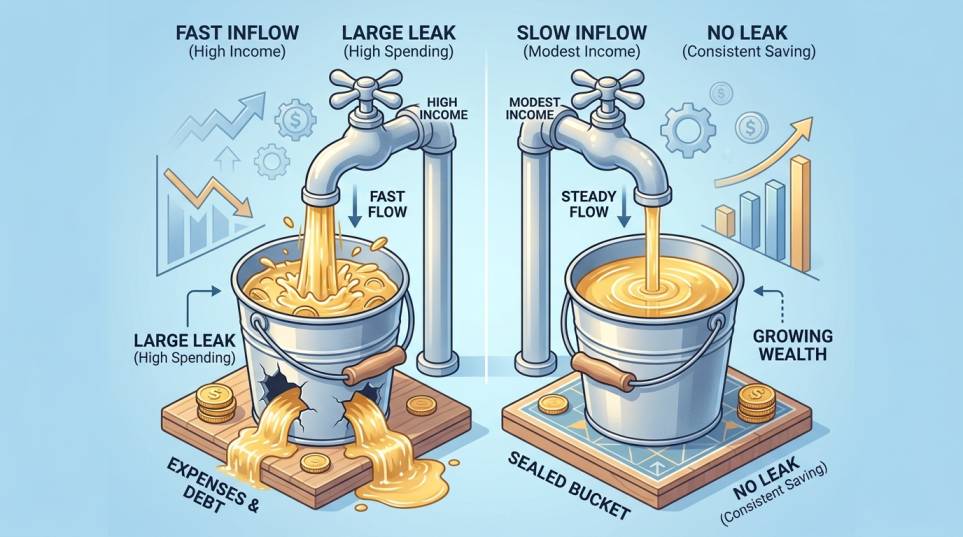
I’ve watched people earning $150K a year live paycheck to paycheck, and I’ve watched people earning $45K a year retire comfortably. Income is not the deciding factor. It never was.
Here’s the trap most high earners fall into: lifestyle inflation. Every raise gets absorbed by a nicer car, a bigger apartment, or more frequent takeout. The paycheck grows, but so does the spending, and the gap between them — the part that actually builds wealth — stays exactly the same, or shrinks.
The real divide isn’t earning versus not earning. It’s spending versus investing. Every dollar you bring in gets one of two jobs: it either leaves your life for good, or it goes to work for you. Wealthy people obsess over that second option. Broke people, even high-income ones, rarely think about it at all.
Wealth Is Built Through Consistency
This is the part nobody wants to hear because it’s not flashy: wealth isn’t built through one big win. It’s built through small, boring, repeated decisions.
Think of your financial habits like compound interest, because they work the exact same way. A single $50 decision doesn’t matter much. But that same $50 decision, made every week for ten years, compounds into something huge — both the money itself and the discipline behind it.
Consider this:
- Compound interest grows your money passively over time, but only if you consistently feed it.
- Compound habits grow your discipline the same way — one good decision makes the next one easier.
- Small daily choices (skipping the extra subscription, packing lunch twice a week) add up faster than most people expect.
- Long-term thinking means judging a decision by where it puts you in 10 years, not by how it feels today.
None of this requires a windfall. It requires showing up consistently, even on the days it feels pointless. Especially on those days, actually — that’s where the compounding really happens.
Next up, I’ll walk you through the 15 specific habits that turn all of this into something you can actually do starting this week.
15 Financial Discipline Habits That Build Lasting Wealth
These aren’t theories. These are the exact habits that separate people who build wealth from people who just talk about it. Start with one. Master it. Then move to the next.
1. Spend Less Than You Earn
This sounds obvious, but most broke people violate this rule every single month. Not because they’re bad with math — because they let lifestyle creep in quietly.
Here’s the rule: your total expenses, including savings, should never exceed your income. Not “close to.” Never.
If you’re currently spending everything you make (or more), your first job isn’t to earn more. It’s to find the gap between what comes in and what goes out, and widen it. Everything else on this list depends on that gap existing.
Pro Tip: Calculate your “true” monthly spending, including subscriptions and irregular costs like car repairs. Most people underestimate it by 15-20%.
2. Create and Stick to a Budget
A budget isn’t a cage. It’s a permission slip. It tells you exactly how much you can spend guilt-free, because everything else is already accounted for.
The “stick to it” part is where people fail, and it’s usually because the budget was unrealistic in the first place. A budget that bans coffee runs and takeout entirely won’t survive week three.
Apps like YNAB or Monarch Money make this easier by syncing your accounts and flagging overspending in real time, so you’re not relying on willpower alone to catch mistakes.
Pick a method that matches your personality:
| Method | Best For | How It Works |
| 50/30/20 Rule | Beginners | 50% needs, 30% wants, 20% savings/debt |
| Zero-Based Budget | Detail-oriented people | Every dollar gets a job, balance hits zero |
| Envelope System | Overspenders | Cash in labeled envelopes, spend only what’s there |
3. Pay Yourself First
Most people save whatever’s left after spending. Disciplined people flip that order entirely.
The moment your paycheck lands, a portion moves straight to savings or investments before you touch a cent of it. What’s left is what you get to live on.
This works because it removes the decision from your hands. You’re not relying on willpower at the end of the month, when your motivation is lowest and your bank balance is thinnest. You’re automating the win before temptation even shows up.
Pro Tip: Set up an automatic transfer for the day after payday, not the day of. Give your paycheck 24 hours to clear first.
4. Build an Emergency Fund
Here’s why the guy earning $180K panics over a $500 bill: he has no buffer. One surprise, and he’s reaching for a credit card at 22% interest.
An emergency fund breaks that cycle. It’s the difference between a bad week and a financial crisis.
How much you need depends on your situation:
- Single income, stable job: 3 months of expenses
- Variable income or self-employed: 6 months of expenses
- Sole provider for a family: 6-9 months of expenses
Start small. Even $1,000 covers most minor emergencies and stops you from reaching for a credit card the next time your car needs a repair.
5. Eliminate High-Interest Debt
Debt at 20%+ interest is actively working against everything else you’re trying to build. No investment reliably beats that rate, so paying it off is the highest-return move available to you.
Two proven strategies, and both work — pick based on what motivates you:
| Method | How It Works | Best For |
| Avalanche | Pay minimums on all debts, throw extra at the highest interest rate | Saving the most money overall |
| Snowball | Pay minimums on all debts, throw extra at the smallest balance | Staying motivated through quick wins |
Either method beats doing nothing. The “best” one is whichever you’ll actually stick with.
6. Avoid Lifestyle Inflation
Every time your income jumps, there’s a quiet pressure to upgrade everything — the apartment, the car, the wardrobe. It feels earned. It also quietly erases your raise.
Here’s a simple rule that fixes this: when you get a raise, save or invest at least half of it before you let your spending catch up. You still get to enjoy the extra income. You just don’t let all of it disappear into a bigger lifestyle.
The people who build real wealth on high incomes aren’t the ones who never upgrade anything. They’re the ones who upgrade slower than their income grows.
7. Track Every Dollar
You can’t fix what you don’t measure. Most people have no idea where 15-20% of their money actually goes each month, and that blind spot is exactly where financial discipline breaks down.
Tracking doesn’t mean logging every $4 coffee in a spreadsheet forever. It means knowing your numbers well enough to catch problems early. Apps like Rocket Money or Quicken Simplifi can automate most of this by categorizing transactions for you.
Pro Tip: Do a full expense review once a week for the first month. After that, monthly check-ins are usually enough to stay on track.
8. Save Before You Spend
This one’s closely tied to “pay yourself first,” but it applies to windfalls too: bonuses, tax refunds, side-hustle income, birthday cash.
The instinct is to treat unexpected money as “extra” and spend it freely. Disciplined people treat it as an opportunity — a chance to fund a goal faster without touching their regular budget at all.
Try this: the next time unexpected money lands in your account, save or invest 70% of it and enjoy the rest guilt-free. You get to celebrate, and your future self gets a boost too.
9. Invest Consistently
Saving keeps your money safe. Investing makes it grow. You need both, but too many people stop at saving because investing feels intimidating.
It doesn’t have to be. Platforms like Fidelity, Vanguard, or Charles Schwab let you start with small, automatic contributions into diversified index funds — no stock-picking expertise required.
The habit that matters more than the amount is consistency. Investing $200 every month for 20 years will outperform most attempts to time the market with a lump sum. Set it, automate it, and let compound growth do the heavy lifting.
10. Set Clear Financial Goals
“I want to save more” isn’t a goal. It’s a wish. Goals need numbers and deadlines attached, or they quietly evaporate by February.
Compare these two:
- Vague: “I want to pay off debt.”
- Clear: “I will pay off my $4,000 credit card balance in 10 months by paying $400/month.”
The second version tells you exactly what to do every single month. That clarity is what keeps discipline alive when motivation fades, which it will.
11. Delay Gratification
This is the psychological engine behind every habit on this list. Every dollar you don’t spend today is a dollar working for your future instead.
The famous marshmallow test showed kids who waited for a second marshmallow tended to do better in life later on. Your finances work the same way. The person who waits, saves, and invests almost always outpaces the person who grabs the reward now.
Pro Tip: Before any purchase over $100, ask: “Will this matter to me in a year?” If the honest answer is no, that’s your signal.
12. Increase Your Financial Literacy
You can’t manage what you don’t understand. Interest rates, tax brackets, investment fees, credit scores — these aren’t optional knowledge if you want to build wealth. They’re the operating manual.
A few books changed how I think about money entirely:
- The Psychology of Money — how emotions drive financial decisions more than logic does
- Atomic Habits — how tiny, consistent actions compound into major results
- The Millionaire Next Door — how most wealthy people live far below their means
Thirty minutes a week reading or listening to solid financial content compounds into real expertise within a year.
13. Create Multiple Income Streams
Relying on one paycheck is risky, no matter how stable that job feels right now. Layoffs happen. Industries shift. Multiple income streams give you options.
This doesn’t mean quitting your job to chase five side hustles at once. It means gradually adding one stream at a time: freelance work, rental income, dividends, a small online business. Even $300-500 a month from a side stream can accelerate your savings rate dramatically.
Start with something that uses skills you already have. That’s the fastest path to your first extra dollar.
14. Review Your Finances Monthly
Discipline without review is just guessing. A monthly check-in — even 20 minutes — keeps small problems from becoming big ones.
During your review, ask:
- Did I stay within budget this month?
- Did I hit my savings target?
- Are any subscriptions or expenses creeping up?
- Am I still on track for my goals?
This habit alone catches most financial mistakes before they snowball into real damage.
15. Stay Consistent Even When Progress Feels Slow
Here’s the honest truth: wealth-building is slow in the beginning and feels almost invisible for the first year or two. That’s exactly when most people quit — right before the compounding starts to show.
The people who actually build lasting wealth aren’t smarter or luckier than everyone else. They just kept showing up after the excitement wore off. That’s the whole secret, and it’s available to you starting today.
Common Money Habits That Keep People Broke
Now that you know what builds wealth, let’s flip the script. These habits quietly sabotage everything, and most people don’t even notice they’re doing them.

Living Beyond Your Means
This is the root cause behind almost every other habit on this list. If your spending matches or exceeds your income, no budgeting app in the world will save you.
Impulse Buying
That “add to cart” moment feels harmless in isolation. Multiply it by every week of the year, and it’s often the single biggest leak in someone’s budget.
Relying on Credit Cards
Credit cards aren’t the enemy — carrying a balance is. At 20%+ interest, a $2,000 balance can cost you hundreds in interest before you’ve paid off a cent of the original debt.
Never Tracking Expenses
You can’t fix a leak you can’t see. People who avoid checking their bank balance usually aren’t lazy — they’re anxious about what they’ll find. Ironically, that avoidance makes the problem worse.
Ignoring Investments
Keeping all your money in a savings account feels safe. It’s actually costly. Inflation quietly erodes cash sitting idle, while invested money has a chance to outpace it over time.
Waiting for “More Money”
“I’ll start saving once I get a raise” is one of the most common excuses out there, and it rarely holds up. People who can’t manage $3,000 a month usually can’t manage $6,000 a month either — the habits don’t change just because the number does.
Keeping Up With Other People
Comparing your finances to your neighbor’s new car or your coworker’s vacation photos is a losing game. You’re comparing your bank balance to someone else’s highlight reel, not their actual financial reality.
Pro Tip: Unfollow or mute social accounts that consistently trigger comparison spending. It sounds small. It works.
How to Build Financial Discipline (Step-by-Step)
Knowing what to avoid is half the battle. Here’s the actual roadmap for building the habit, one step at a time.

Step 1: Know Where Your Money Goes
Pull up your last three months of bank statements. Categorize every expense — housing, food, subscriptions, entertainment. This single exercise usually reveals more than any budgeting advice ever could.
Step 2: Create a Realistic Budget
Use what you learned in Step 1 to build a budget that reflects how you actually live, not how you wish you lived. A budget that ignores your $150 monthly takeout habit is a budget you’ll abandon by week two.
Step 3: Automate Saving
Set up automatic transfers to savings and investment accounts on payday. Removing the decision removes the temptation to skip it “just this once.”
Step 4: Reduce Financial Temptations
Unsubscribe from retail emails. Delete saved card info from shopping apps. Add a 24-hour wait rule for anything over $100. Small friction points make a bigger difference than most people expect.
Step 5: Set Weekly Money Check-ins
Ten minutes every Sunday. Check your accounts, review upcoming bills, confirm you’re on budget. This keeps small issues small instead of letting them snowball for a month unnoticed.
Step 6: Celebrate Small Wins
Paid off a credit card? Hit a savings milestone? Acknowledge it. Discipline that never celebrates progress burns out fast. You’re allowed to enjoy the wins along the way.
Financial Discipline at Every Stage of Life
Your financial priorities shift as your life does. Here’s how the same core discipline applies differently depending on where you are.
| Life Stage | Primary Focus | Key Actions |
| 20s | Building habits | Start saving early, avoid debt, build your first emergency fund |
| 30s | Growing wealth | Invest consistently, plan family finances, consider home ownership |
| 40s-50s | Protecting wealth | Maximize retirement contributions, preserve assets, diversify investments |

In Your 20s
This is the decade where habits get set for life, and most people don’t realize it until later. You likely have fewer obligations now than you ever will again, which makes it the ideal time to build the foundation.
Focus on:
- Building habits — budgeting, tracking, saving. The specific numbers matter less than the consistency right now.
- Saving — even small amounts. $100/month starting at 25 outgrows $300/month starting at 35, thanks to compound growth.
- Avoiding debt — especially high-interest credit card debt that can follow you for a decade if left unchecked.
In Your 30s
Life gets more complex here — careers advance, families often grow, and expenses multiply. This is where discipline gets tested the hardest.
Focus on:
- Investing — this is typically the decade to get serious about retirement accounts and building a real portfolio.
- Family finances — budgeting for childcare, education savings, and shared financial goals with a partner if applicable.
- Home ownership — if it fits your goals, this is often when saving for a down payment becomes realistic.
In Your 40s and 50s
Retirement stops being abstract and starts becoming a number on a calendar. The habits you built earlier either pay off now, or the gaps become obvious.
Focus on:
- Retirement — maximize contributions to 401(k)s and IRAs. Catch-up contributions become available at 50, and they matter.
- Wealth preservation — protecting what you’ve built matters as much as growing it. Diversification becomes more important than aggressive risk-taking.
- Increasing investments — if you started late, this is the decade to be intentional about closing the gap.
Pro Tip: No matter your age, the best time to start was yesterday. The second-best time is today. Don’t let “I’m behind” become an excuse to stay behind.
Tools That Make Financial Discipline Easier
Discipline doesn’t mean doing everything manually with a notepad and willpower. The right tools remove friction, and less friction means fewer chances to fall off track.
Budgeting Apps

These apps do the heavy lifting of categorizing spending and flagging problems before they snowball.
| App | Best For | Standout Feature |
| YNAB | Hands-on budgeters | Zero-based budgeting, every dollar assigned a job |
| Monarch Money | Couples and families | Shared budgeting with real-time syncing |
| Quicken Simplifi | Detailed tracking | Custom spending plans and net worth tracking |
| Rocket Money | Passive users | Automatically finds and cancels unused subscriptions |
If you’re brand new to budgeting, start with whichever app has the lowest learning curve for you. The best app is the one you’ll actually open every week.
Investment Platforms
Once your emergency fund and high-interest debt are handled, these platforms make consistent investing simple:
- Fidelity — strong for beginners, zero-fee index funds available
- Vanguard — pioneer of low-cost index investing, ideal for long-term buy-and-hold strategies
- Charles Schwab — solid all-around platform with robust research tools and no account minimums on many funds
All three let you automate monthly contributions, which matters more than which one you pick. Consistency beats platform choice every time.
Books
Sometimes the best tool isn’t an app — it’s a shift in how you think about money entirely.
- The Psychology of Money — explains why smart people make dumb financial decisions, and how emotions override logic more than we admit
- Atomic Habits — not a finance book specifically, but the framework for building any lasting habit, financial or otherwise
- The Total Money Makeover — a no-nonsense, step-by-step plan for getting out of debt fast
- The Millionaire Next Door — reveals that most actual millionaires live modestly and drive used cars, not the lifestyle you’d expect
Pro Tip: Pick one book, not all four at once. Finish it, apply one idea from it, then move to the next.
Benefits of Financial Discipline

Here’s what’s waiting on the other side of consistency. This isn’t hype — these are the realistic, well-documented payoffs of sticking with the habits above.
Financial freedom. This is the big one. It means your money works for you instead of the other way around, and your choices stop being dictated by your next paycheck.
Lower stress. Money is consistently ranked as one of the top sources of stress in surveys across the U.S. Discipline doesn’t eliminate financial stress entirely, but it shrinks it dramatically. Knowing you have a cushion changes how you sleep at night.
Better relationships. Money fights are one of the most common sources of tension between couples. Shared discipline and clear financial goals remove a huge source of that friction.
Greater confidence. There’s a specific kind of calm that comes from knowing your numbers. You stop avoiding your bank app and start checking it without dread.
More investment opportunities. Discipline builds the capital you need to say yes to opportunities — a good deal on a property, a chance to invest in something promising — instead of watching them pass by because you’re not ready.
Earlier retirement. Every dollar you save and invest in your 20s and 30s does more work than the same dollar saved later, thanks to compounding. Discipline early often means freedom sooner.
Wealth accumulation. This is the natural result of everything above compounding over years, not months.
Generational wealth. Discipline doesn’t just benefit you — it changes what you can pass down. Kids raised around healthy money habits tend to repeat them, creating a ripple effect that outlasts your own lifetime.
Common Myths About Financial Discipline

Let’s clear up the excuses that keep good people stuck. Chances are, you’ve believed at least one of these.
“I Don’t Earn Enough”
This is the most common myth, and it’s rarely true. Financial discipline isn’t about the size of your income — it’s about the gap between what you earn and what you spend. Plenty of people on modest incomes build real wealth by protecting that gap fiercely. Plenty of high earners destroy it by ignoring it entirely.
“Budgets Are Restrictive”
A good budget isn’t a cage — it’s a plan that includes fun money on purpose. The restriction people feel usually comes from an unrealistic budget, not budgeting itself. Build one that reflects your actual life, and it stops feeling like punishment.
“I’ll Start Later”
Later rarely arrives on its own. The habits that work at $3,000 a month are the same habits that work at $8,000 a month. If discipline hasn’t kicked in yet, more income won’t magically create it — it usually just raises the amount being mismanaged.
“Investing Is Only for Rich People”
This one’s outdated. Platforms like Fidelity and Vanguard let you start investing with as little as $1 through fractional shares. You don’t need $10,000 to begin. You need consistency and time, both of which are available to you right now, regardless of your current balance.
Pro Tip: If any of these myths sound familiar, that’s not a character flaw — it’s just a belief that hasn’t been tested yet. Pick one habit from this article and prove the myth wrong for yourself.

Frequently Asked Questions
What is financial discipline?
Financial discipline is the ability to make consistent, deliberate choices with your money — spending less than you earn, saving before you spend, and sticking to your goals even when it’s not convenient.
Why is financial discipline important?
Because income alone doesn’t build wealth. Without discipline, even a high salary gets absorbed by lifestyle inflation. With it, even a modest income can grow into real financial security over time.
How can I become financially disciplined?
Start small. Track your spending for a month, automate your savings, and set one clear goal with a number and a deadline attached. Discipline builds through repetition, not willpower alone.
What are the habits of financially successful people?
They spend less than they earn, invest consistently, avoid high-interest debt, and review their finances regularly. None of it is glamorous. That’s exactly why it works.
Can you build wealth on a low income?
Yes. Wealth is built through the gap between income and spending, not the size of the income itself. Someone earning $45,000 who saves 20% will often out-build someone earning $150,000 who saves nothing.
Is budgeting enough?
Budgeting is a starting point, not the finish line. It tells you where your money should go. Discipline is what makes sure it actually gets there, month after month.
How much should I save each month?
A common target is 20% of your income, split between savings and investments. If that feels out of reach right now, start at 5-10% and increase it as your income grows or your expenses shrink.
How do I stop overspending?
Track every dollar for a month to find your leaks. Then add friction to impulse spending — a 24-hour wait rule, unsubscribing from retail emails, and automating your savings before you can spend it.
What is the fastest way to improve my finances?
Eliminate high-interest debt first. No investment reliably beats a 20%+ credit card rate, so paying that down gives you the fastest, most guaranteed return available.
How long does it take to build wealth?
Realistically, years, not months. Most people see meaningful traction after 2-3 years of consistent habits, with the biggest gains showing up later as compounding kicks in. There’s no shortcut here, and I won’t pretend there is one.
Conclusion
Let’s bring this back to where we started: the six-figure earner panicking over a $500 bill, and the teacher quietly building a real estate portfolio on $52,000 a year.
The gap between them was never about income. It was about habits. Financial discipline is the skill that decides which side of that story you end up on, and it’s a skill you can build starting today, regardless of your current bank balance.
Here’s what to remember:
- Wealth isn’t created by luck. It’s built through decisions, repeated consistently over years.
- Income matters less than habits. A modest salary with discipline beats a large one without it, every time.
- Financial discipline is a lifelong skill. It doesn’t max out. It gets refined as your life and goals change.
- Small, consistent actions beat occasional big wins. The $50 you save every week matters more than the one big bonus you save once a year.
Now here’s my challenge to you, because reading this article won’t change anything on its own:
- Choose one habit from this list and commit to it this week. Don’t try all 15 at once — pick the one that’ll make the biggest difference for you right now.
- Review your spending from last month. Pull up your statements and find where your money actually went.
- Set one measurable goal, with a number and a deadline attached. “Save more” doesn’t count. “Save $200/month for 12 months” does.
- Share this article with someone who needs to hear this, or bookmark it and come back to it as you work through the habits.
You don’t need a bigger paycheck to change your financial future. You need the discipline to work with what you already have, starting now.
So tell me — which of these 15 habits do you already have locked in, and which one is your biggest struggle? Drop a comment below and let me know. I read every one, and honestly, this is where the best conversations on this blog happen.