

Personal Finance Basics Everyone Should Understand
You work hard for your money and pay your bills, yet your savings never seem to grow and your bank balance still looks like it left on vacation without you. Sound familiar? You are not alone. Many hard working people earn money, cover their bills, and still struggle to feel financially secure. The difference rarely comes down to how much you earn. It comes down to how well you understand and manage your money. That is exactly what personal finance basics teach you.
Personal finance is a collection of practical skills. They help you make informed financial decisions, manage your everyday expenses, prepare for emergencies, and work toward a more secure future. You do not need a finance degree or a six figure income to learn them. You need a plan and the guts to start today, even if you start small. Small moves, repeated every month, beat big promises you never keep. YES, you CAN take control of your money.
In this guide, I walk you through:
- How to create a realistic budget and control your spending.
- How to save money and build an emergency fund.
- How to manage debt and understand your credit score.
- How to set financial goals and calculate your net worth.
- How to understand investing, compound interest, and retirement savings.
- How to avoid common financial mistakes.
And yes, we will talk about budgets without making you feel like you are on a diet.
Here is the best part. Financial success starts with a few essential principles, and they work whether you are 22 or 52, and whether you earn a little or a lot. Ready? Let’s start with what personal finance really means.
1. What Are Personal Finance Basics, and Why Do They Matter?
Nobody hands you a money manual at graduation. Most of us pick this stuff up by accident. Let’s fix that on purpose.
1.1 What Does Personal Finance Mean?
Personal finance is how you earn, spend, save, borrow, and invest your money. Seven pieces make up the whole picture:
- Income: what comes in.
- Expenses: what goes out.
- Savings: what you keep for later.
- Debt: what you owe.
- Insurance: what shields you from big surprises.
- Investments: what grows your money over time.
- Retirement planning: what pays you when you stop working.
These pieces work like gears. Income feeds your expenses. What remains feeds savings and debt payments. Insurance protects those savings. Investments and retirement accounts then grow them.
Here is what most people miss: earning money and managing money are two different skills. A big salary with no plan still ends at zero. A modest paycheck with a plan builds real wealth.
Pro tip: Want to understand why smart people make dumb money moves? Read The Psychology of Money by Morgan Housel. It covers the behavior side of money, which matters as much as the math.
1.2 Why Is Financial Literacy Important for Everyday Life?
Financial literacy means you know enough to make good money decisions. It pays you back in three ways:
- Security: you know where you stand, so one bad month does not wreck you.
- Calm: money stress drops when you have a plan.
- Protection: you spot a bad loan, a sneaky fee, or a “guaranteed return” before it costs you.
The car repair still stings. It just stops being a crisis.
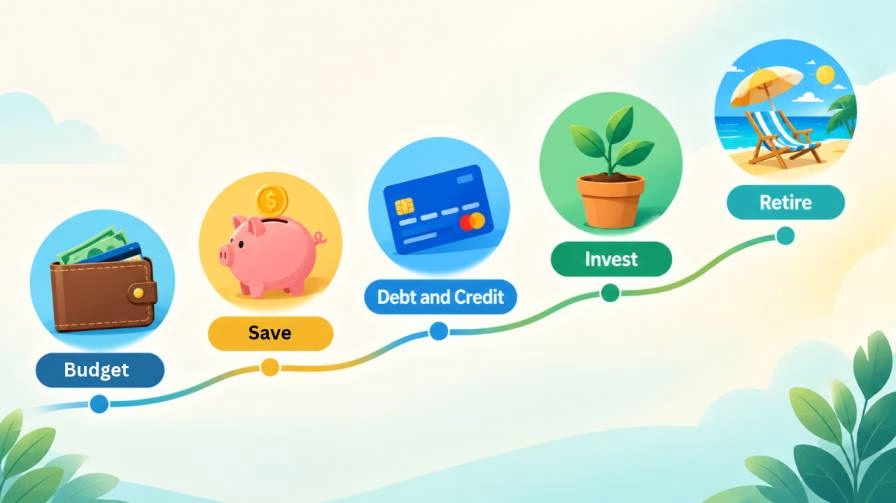
1.3 What Are the Five Main Areas of Personal Finance?
Everything in this guide fits into five areas:
| Area | The question it answers | Where we cover it |
| Budgeting and cash flow | Where does my money go? | Section 2 |
| Saving and emergency planning | What protects me from surprises? | Section 3 |
| Debt and credit | What do I owe, and how do lenders see me? | Sections 4 and 5 |
| Investing and wealth building | How does my money grow? | Section 7 |
| Financial planning and retirement | Where am I headed? | Sections 6 and 8 |
Ready? Start with the area that touches your life every single day: your budget.
2. How Do You Create a Budget That Works for Your Income?
2.1 What Is a Budget, and Why Do You Need One?
A budget is a plan for your money. It tracks your income, expenses, savings, and debt payments. You tell your money where to go, instead of wondering where it went.
A budget is NOT a diet. It does not ban fun. It makes your spending intentional.
Do you earn a modest or irregular income? You need a budget even more. If your pay swings, build the plan on your lowest typical month. Send anything extra to savings or debt.
2.2 How Do You Make a Monthly Budget Step by Step?
Follow these six steps:
- Calculate your monthly take home pay. Use what lands in your account after taxes.
- List your fixed expenses. Rent, insurance, and loan payments stay the same each month.
- Estimate your variable expenses. Groceries, transportation, and utilities change. Check your last three months of bank statements.
- Identify your discretionary spending. Dining out, streaming, and hobbies live here.
- Allocate money to savings and debt repayment. Pay yourself first, before the wants.
- Review and adjust. Life changes. Your budget should too.
Pro tip: Give every dollar a job. “Save it” counts as a job.
2.3 What Is the 50/30/20 Budget Rule?

The 50/30/20 rule splits your after tax income into three buckets: 50% for needs, 30% for wants, and 20% for savings and debt repayment. Say you take home $4,000 a month:
| Bucket | Share | Monthly amount |
| Needs (rent, groceries, utilities) | 50% | $2,000 |
| Wants (dining out, hobbies) | 30% | $1,200 |
| Savings and debt repayment | 20% | $800 |
Treat the rule as a starting line, not a law. I like it because it gives beginners a clear first split. If rent eats 45% of your pay, your split might look more like 60/20/20. That is fine. Adjust for housing costs, debt, and family obligations. The best budget is the one you actually follow.
2.4 How Can You Track Spending and Control Unnecessary Expenses?

A plan you never check is just a wish. Track your spending with a spreadsheet or a budgeting app. Here are three worth knowing:
- YNAB: zero based budgeting, where you assign every dollar a job.
- Goodbudget: envelope style budgeting, with a category for each chunk of money.
- Honeydue: built for couples who share finances.
Costs vary, and apps ask to link your bank accounts. Check pricing and read the privacy policy first.
Then hunt for leaks:
- Subscriptions: audit every one and cancel the forgotten ones.
- Impulse buys: wait 24 hours before any non essential purchase.
- Recurring bills: call your internet and insurance providers and ask for a better rate.
- Fees: bank and ATM charges add up fast.
Review your spending weekly and adjust your budget monthly. Ten minutes does it.
3. How Much Should You Save Every Month?
3.1 Why Is Saving Money Important for Financial Stability?
Savings pay for planned purchases, emergencies, and future goals. Without them, every surprise lands on a credit card.
Save consistently. Do not wait for leftover money, because leftovers rarely show up. Move money to savings the day your paycheck lands. Small, regular amounts build the habit: $25 a week adds up to $1,300 a year.
How much should you save? No single percentage fits everyone. The 50/30/20 rule points to 20% for savings and debt repayment. Start with an amount you can keep up after essentials and minimum debt payments. Raise it as your income grows.
3.2 How Do You Build an Emergency Fund?

An emergency fund is cash for true surprises: car repairs, urgent medical bills, or job loss. A sneaker sale does not count.
The common long term target is three to six months of essential living expenses. Essentials include housing, utilities, groceries, insurance, and minimum debt payments. If those cost $2,500 a month, your target runs from $7,500 to $15,000.
That number can feel huge. So start smaller: save your first $500, then one month of essentials, then keep building toward three.
Your right amount depends on job stability, dependents, and insurance coverage.
Pro tip: Celebrate each milestone. Momentum beats perfection.
3.3 Where Should You Keep Your Emergency Savings?
Keep emergency money easy to reach and low risk. Skip the stock market. Prices can drop right when you need cash.
Good homes for it:
- A savings account at an FDIC insured bank.
- A savings account at an NCUA insured credit union.
- A high yield savings account, which usually pays more interest than a traditional one.
Deposit insurance generally covers $250,000 per depositor, per insured institution, per ownership category. Before you open an account, check the fees, minimum balance, withdrawal limits, and interest rate. Confirm the institution carries insurance.
3.4 How Can You Save Money Consistently on a Tight Budget?
Tight budget? You still have moves:
- Cut the painless stuff. Unused subscriptions, bank fees, and duplicate services cost you money and give nothing back.
- Automate it. Schedule a transfer for payday. Even $20 counts.
- Plan your groceries. Write a list and never shop hungry. That is how a $40 trip becomes a $90 trip.
- Raise it slowly. Each time you get a raise or a bill drops, bump your savings up by one percentage point.
You will not feel a one point change. Your future self will.
4. How Can You Manage Debt and Avoid Financial Trouble?
4.1 What Types of Debt Should You Understand?
Not all debt behaves the same way:
| Debt type | How it works | Watch out for |
| Credit card | Revolving balance, interest often above 20% | Minimum payments stretch repayment for years |
| Student loan | Federal or private, with different terms | Repayment options differ by loan type |
| Auto loan | The vehicle backs the loan | Long terms can leave you owing more than the car is worth |
| Personal loan | Fixed payments over a fixed term | Fees and rates vary with your credit |
| Mortgage | The home backs the loan, longest term | Total interest over decades |
Three numbers decide what a loan costs you: the interest rate, the repayment period, and the minimum payment. A lower monthly payment over a longer term often costs MORE in total interest.
Also ask what the loan buys. A degree or a home can build your future. A vacation on credit just builds a bill.
4.2 What Is the Best Way to Pay Off Debt?

Two methods dominate:
| Method | How it works | Strength | Trade off |
| Debt avalanche | Put extra money toward the highest interest rate first | Saves the most interest | Early wins feel slow |
| Debt snowball | Put extra money toward the smallest balance first | Quick wins keep you motivated | Can cost more interest |
With either method, keep paying the minimum on every other debt.
So which one? My take: pick the one you will finish. If numbers motivate you, choose the avalanche. If you have quit plans before, choose the snowball.
4.3 How Can You Avoid Unnecessary Debt?
- Check affordability first. Ask whether the payment fits your budget today, not your hoped for budget.
- Pay your card in full each month when you can. A $5,000 balance at 22% APR costs roughly $92 a month in interest alone.
- Build your emergency fund. Cash covers the surprise, so the card does not have to.
4.4 How Can You Balance Debt Repayment With Saving Money?
Always keep your minimum payments current. Then work through this order:
- Build a starter emergency fund. Many people aim for $500 to $1,000.
- Attack high interest debt.
- Grow your emergency fund to its full size.
Your situation may shift that order. If your employer matches retirement contributions, that match is part of your pay, so consider capturing it even while you pay down debt. Weigh your interest rates, obligations, and circumstances before you decide.
5. What Is a Credit Score, and How Can You Improve It?
5.1 What Is a Credit Score in the United States?
A credit score is a number, usually between 300 and 850, that estimates how risky it may be to lend you money. Two models dominate in the U.S.: FICO and VantageScore.
Lenders may check your score when you apply for a loan or a credit card. A higher score often means better approval odds and lower rates.
5.2 What Factors Affect Your Credit Score?
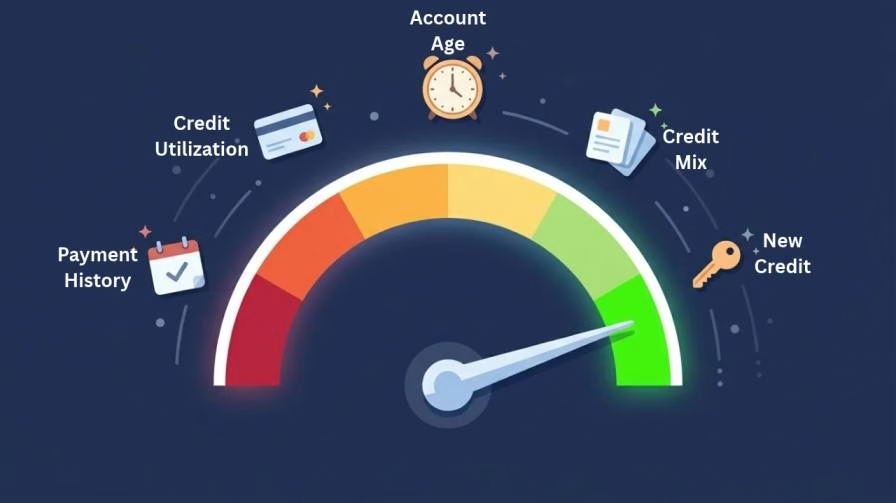
| Factor | What it means | FICO’s published weight |
| Payment history | Do you pay on time? | 35% |
| Credit utilization | How much of your limit you use | 30% |
| Length of credit history | How old your accounts are | 15% |
| Credit mix | The types of credit you hold | 10% |
| New credit | Recent applications and new accounts | 10% |
Weights vary by model. VantageScore weighs these factors differently, but payment history and utilization lead both.
5.3 How Can You Improve Your Credit Score Over Time?
- Pay every bill on time. Set autopay for at least the minimum.
- Keep card balances low compared with your limits. Under 30% is the common rule of thumb, and lower is better.
- Apply for new credit only when you need it.
- Check your credit reports for errors.
- Stay consistent. Scores move over months, not days.
Pro tip: Keep your oldest card open if it has no annual fee. Its age helps your history.
5.4 How Can You Check Your Credit Report for Free?
A credit report lists your credit history. A credit score is a number calculated from that history.
Get your free reports at AnnualCreditReport.com. It is the official site, and it covers all three major bureaus: Equifax, Experian, and TransUnion. The bureaus currently offer free reports weekly.
Spot a mistake? Write to the credit bureau that shows it, and to the company that reported it. Explain the error and attach proof. The bureau generally must investigate within 30 days.
6. How Do You Set Financial Goals and Calculate Your Net Worth?
6.1 How Do You Set Realistic Financial Goals?
Sort your goals by time:
| Horizon | Timeframe | Examples |
| Short term | Under 1 year | Vacation fund, starter emergency fund |
| Medium term | 1 to 5 years | Pay off a credit card, save a home down payment |
| Long term | 5+ years | Retirement |
Vague goals fail. “Save more” goes nowhere. “Save $3,000 in 12 months by moving $250 a month” gives you an amount, a deadline, and a check you can run every month.
6.2 What Is Net Worth, and How Do You Calculate It?
Net worth = Total assets minus Total liabilities.
Assets include cash, savings, investments, retirement accounts, and property. Liabilities include loans, mortgages, and credit card balances. Here is a simple example:
| Assets | Amount | Liabilities | Amount |
| Checking and savings | $8,000 | Credit card | $4,000 |
| Retirement account | $18,000 | Car loan | $9,000 |
| Car | $15,000 | Student loan | $12,000 |
| Total | $41,000 | Total | $25,000 |
Net worth: $41,000 minus $25,000 equals $16,000.
Pro tip: Monarch Money and Empower Personal Dashboard can track your net worth automatically once you link your accounts. Check pricing and privacy terms first.
6.3 How Often Should You Review Your Financial Position?
Review your spending every month. Review your goals and net worth every three months.
Your net worth will dip sometimes, especially when markets drop. One bad month does not mean failure. One good month does not mean you have won. Watch the trend over a year or more.
6.4 How Can You Create a Financial Plan for the Next Five Years?
- List your major goals: a home, a car, a degree, a growing family, a stronger retirement.
- Estimate what each one costs.
- Rank them, then divide each cost by the number of months you have. A $15,000 goal over 60 months takes $250 a month.
- Review the plan whenever your income, family, or circumstances change.
7. How Does Compound Interest Work, and When Should You Start Investing?
7.1 What Is Compound Interest?
Compound interest means your interest earns interest. Your money earns a return, then that return earns its own return. Think of a snowball rolling downhill. It picks up more snow the bigger it gets.
One distinction matters. A savings account at an insured bank pays a stated interest rate. Investment returns move up and down, and nobody guarantees them.
7.2 How Can Compound Interest Help Your Money Grow?
Here is a hypothetical: you invest $200 a month at a 7% average annual return, compounded monthly.
| Years | You contribute | Balance |
| 10 | $24,000 | About $34,600 |
| 20 | $48,000 | About $104,200 |
| 30 | $72,000 | About $244,000 |
Look at year 30. Your own money makes up $72,000. Growth supplies the rest.
This is an illustration, not a promise. Real results depend on your starting amount, your deposits, your rate of return, fees, taxes, and time. Time is the biggest lever you control.
7.3 What Should Beginners Know Before Investing?
Learn three terms first. Risk and return go together: higher potential return means a higher chance of loss. Diversification spreads your money so one flop does not sink you. Costs matter because fees chip away at returns year after year.
Then meet the basic building blocks:
| Investment | What it is |
| Stocks | Small ownership shares in a company |
| Bonds | Loans you make to a company or government |
| Mutual funds | Pooled baskets of investments that a manager runs |
| ETFs | Baskets that trade on an exchange like a stock |
Before you invest, pay down high interest debt, build a starter emergency fund, and keep out any money you need within a few years. Never buy something you cannot explain in a sentence.
Pro tip: Broke Millennial Takes On Investing by Erin Lowry teaches the basics in plain language.
7.4 What Is the Difference Between Saving and Investing?
| Saving | Investing | |
| Purpose | Short term needs and emergencies | Long term goals |
| Access | Easy | Can take time, and prices may be down |
| Risk | Low | You can lose money |
| Return | Modest | Higher potential, not guaranteed |
Match the tool to the goal. Your emergency fund belongs in savings. Retirement 30 years from now belongs in investments.
8. How Should You Start Saving for Retirement?
8.1 Why Is Retirement Planning Important Even When You Are Young?
Time does the heavy lifting. Using the same 7% hypothetical, $200 a month from age 25 to 65 grows to about $525,000. Start at 35 and you land near $244,000. Same monthly amount. Ten extra years more than doubles the result.
Employer contributions add to the pile.
Started late? Start anyway. Contribute what you can today and adjust as your situation changes.
8.2 What Is the Difference Between a 401(k) and an IRA?
| Feature | 401(k) | Traditional IRA | Roth IRA |
| Where you get it | Through your employer | You open it yourself | You open it yourself |
| Taxes | Traditional version: you contribute pre tax and pay tax at withdrawal. Some plans offer a Roth version | Contributions may be deductible, and you pay tax at withdrawal | You contribute after tax, and qualified withdrawals come out tax free |
| Employer match | Possible | No | No |
| Eligibility | Your employer must offer a plan | You need earned income | You need earned income, and income limits apply |
| Early withdrawals | Generally a 10% penalty plus taxes before age 59½, with exceptions | Same general rule | Different rules for contributions and earnings |
Contribution limits and rules change often. Check IRS.gov for the current numbers before you set up your plan.
8.3 How Much Should You Contribute to Retirement Savings?
Your number depends on your income, age, existing savings, goals, and employer benefits. Here is a simple path:
- Learn whether your employer matches contributions, and read the plan’s requirements.
- Contribute at least enough to get the full match.
- Pick a rate you can sustain. Many planners cite 10% to 15% of income as a rule of thumb, though your number may differ.
- Raise your rate by one point each year or with each raise.
8.4 What Other Retirement Resources Should You Consider?
Social Security can form one piece of your retirement income. It usually replaces only part of your pre retirement pay. Create a free my Social Security account at ssa.gov to see your estimate. Full retirement age is 67 for anyone born in 1960 or later, and claiming earlier cuts your monthly benefit.
Also plan for living costs, healthcare, and housing. Then review your assumptions every few years.
9. What Personal Finance Mistakes Should You Avoid?
9.1 Why Is Failing to Budget a Common Financial Problem?
Untracked spending quietly eats your savings goals. A monthly review exposes patterns early, before a small leak becomes a flood.
9.2 What Are the Risks of Ignoring High Interest Debt?
Interest compounds against you too. Pay only the minimum and balances can hang around for years. Act early: pick a method from section 4.2 and set a realistic payment.
9.3 Why Should You Avoid Spending More as Your Income Grows?
That is lifestyle inflation: income rises, spending rises, and nothing is left. Try this simple rule: when you get a raise, send half to savings, debt, or goals. Enjoy the other half.
9.4 Why Is It Risky to Invest Without Understanding the Product?
Before you invest, know how you could lose money, what the fees are, and how fast you can get your cash out. Watch for red flags:
- Guaranteed returns.
- Pressure to act now.
- Secret strategies nobody can explain.
If a stranger on social media promises guaranteed returns, close the app.
9.5 How Can You Develop Better Financial Habits?
- Automate your savings.
- Review your accounts and bills regularly.
- Set realistic goals and measure your progress.
- Learn from reliable sources like the CFPB, not from viral posts.
10. What Books and Tools Can Help You Master Personal Finance?
10.1 Which Personal Finance Books Are Best for Beginners?
| Book | Best for |
| The Psychology of Money by Morgan Housel | Readers who want to fix their money mindset |
| Get Good with Money by Tiffany Aliche | Readers who want a structured, step by step plan |
| I Will Teach You to Be Rich by Ramit Sethi | Readers who want to automate their finances |
| The Index Card by Helaine Olen and Harold Pollack | Readers who want the core rules in a short read |
Reading helps. It does not replace a plan. My advice: pick one book, not all four, and make one move after each chapter.
10.2 Which Budgeting Apps Can Help You Manage Money?
| App | Best for |
| YNAB | Proactive, zero based budgeting |
| Goodbudget | Envelope style budgeting |
| Monarch Money | Tracking all your accounts in one place |
| Empower Personal Dashboard | A big picture view of spending, investments, and net worth |
Costs, features, and account linking requirements vary. Compare a couple of options, check current pricing, and read each privacy policy before you connect your bank.
10.3 How Can You Build a Simple Personal Finance System?
Set a calendar reminder for the same day each month. Then run this routine:
- Review your income and spending.
- Pay your bills and meet your debt obligations.
- Move money toward savings and goals.
- Check your progress against your budget.
- Set your priorities for the coming month.
11. Frequently Asked Questions About Personal Finance Basics
11.1 What personal finance basics should everyone know?
Budgeting, saving, an emergency fund, debt management, credit, investing, and financial planning. Start with the budget.
11.2 How do I start managing my money as a beginner?
Calculate your take home pay, list your expenses and debts, build a budget, and start saving. Even $25 a week counts.
11.3 What percentage of my income should I save?
No single number fits everyone. The 50/30/20 rule points to 20% for savings and debt repayment. Start where you can.
11.4 How much should I keep in an emergency fund?
Aim for three to six months of essential expenses. Reach it in milestones: $500, then one month, then three.
11.5 What is the easiest way to create a monthly budget?
A spreadsheet, a worksheet, or an app like YNAB or Goodbudget. Pick the one you will open every week.
11.6 Should I pay off debt or save money first?
Do both, in order: pay minimums, build a starter fund, attack high interest debt, then grow your emergency fund. Interest rates and an employer match may change that order.
11.7 How can I improve my credit score?
Pay on time, keep balances low compared with your limits, check your reports for errors, and skip unnecessary applications.
11.8 When should I start investing?
Start learning now. Start investing once you have a starter emergency fund, a plan for high interest debt, and money you will not need soon.
11.9 What is the difference between saving and investing?
Saving protects money you need soon. Investing grows money you will not touch for years, and it carries the risk of loss.
11.10 How can I become financially independent?
Spend with intention, save consistently, manage debt, plan for the long term, and track your progress. No shortcut exists. Steady moves win.
12. Conclusion: How Can You Put Personal Finance Basics Into Practice Today?
Personal finance has nothing to do with being rich. It comes down to informed choices with the money you have.
Here is what we covered:
- Create a budget and learn where your money goes.
- Build savings and an emergency fund.
- Manage debt and understand your credit.
- Set goals and track your net worth.
- Learn investing and retirement basics.
- Review your habits as life changes.
Now pick ONE step and do it today. Review last month’s spending. Set a savings goal with a number and a date. Build your first monthly budget.
Which personal finance habit will you start first? Tell me in the comments.